
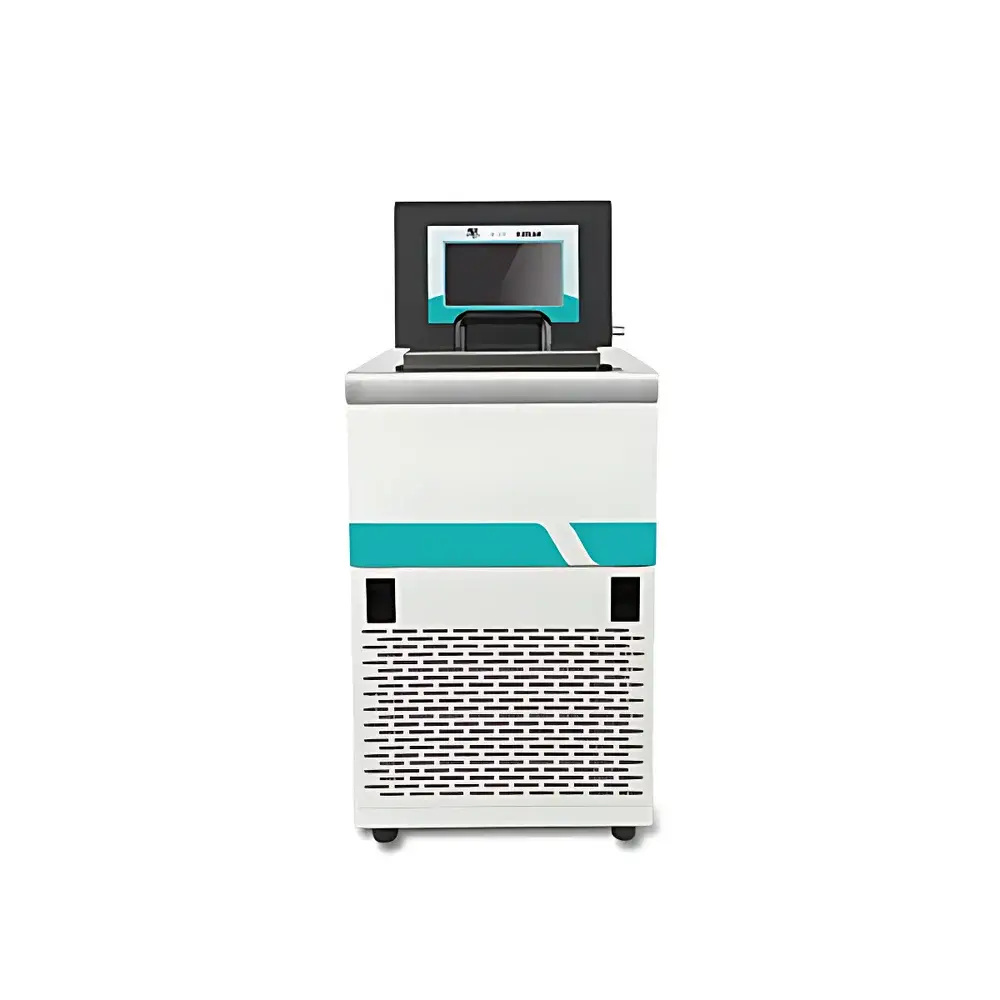
Ningbo Scientz DC-0530 Low-Temperature Circulating Bath (Heating & Cooling)
| Brand | Ningbo Scientz |
|---|---|
| Origin | Zhejiang, China |
| Manufacturer Type | Direct Manufacturer |
| Product Category | Domestic |
| Model | DC-0530 |
| Instrument Type | Water/Oil Bath Thermostatic Circulator |
| Circulation Mode | Internal & External Dual Circulation |
| Temperature Control | Dual-mode (Heating & Refrigeration) |
| Bath Dimensions (L×W×H) | 440 × 325 × 200 mm |
| Temperature Range | −5 °C to +100 °C |
| Temperature Stability | ±0.05 °C |
| Display | 7-inch Tilted Touchscreen |
| Compressor | Secop (Germany) Hermetic Scroll Compressor |
| Refrigerant | R-134a (ODP = 0, GWP = 1430) |
| Pump Flow Rate | Adjustable up to 20 L/min (external loop), max pressure 0.4 bar |
| Safety Features | Compressor overheat & overload protection, dry-run prevention, over-temperature alarm, auto-restart with memory retention |
Overview
The Ningbo Scientz DC-0530 Low-Temperature Circulating Bath is an engineered precision thermal management system designed for laboratory-scale temperature control of external equipment and internal bath environments. It operates on the principle of forced convection using a closed-loop refrigeration cycle coupled with resistive heating elements, enabling stable bidirectional temperature regulation from −5 °C to +100 °C. The unit integrates a high-efficiency Secop (Germany) hermetic scroll compressor and environmentally compliant R-134a refrigerant (zero ozone depletion potential), ensuring low acoustic emission (<52 dB(A) at 1 m) and long-term operational reliability. Its stainless-steel inner tank (440 × 325 × 200 mm, ~28.6 L usable volume) supports both immersion-based experiments and external circulation via a dual-mode pump—configurable for internal recirculation or closed-loop external load conditioning. This architecture meets the thermal stability requirements of ISO/IEC 17025-accredited calibration labs and GLP-compliant analytical workflows where temperature uniformity and repeatability are critical.
Key Features
- High-stability temperature control with ±0.05 °C stability (measured at sensor location, 1-hour dwell at setpoint) and ±0.1 °C uniformity across bath volume per ASTM E1137/E1137M
- 7-inch tilted capacitive touchscreen interface with intuitive PID parameter tuning, real-time graphing of temperature vs. time, and event logging (start/stop, alarms, setpoint changes)
- Dual-circulation capability: switchable between internal bath homogenization and external load cooling/heating; adjustable flow rate (0–20 L/min) and pressure output (up to 0.4 bar)
- Intelligent power recovery: retains all user-defined parameters—including setpoint, timer, circulation mode, and PID coefficients—after power interruption; configurable auto-restart or standby mode on power-up
- Comprehensive safety suite: compressor thermal cutout, current overload protection, low-level fluid detection, over-temperature shutdown (adjustable threshold), and dry-run prevention circuitry
- Low-noise operation enabled by vibration-damped mounting, optimized refrigerant flow path, and brushless DC circulation pump
Sample Compatibility & Compliance
The DC-0530 accommodates aqueous solutions, silicone oils (up to 100 cSt), and low-volatility heat transfer fluids compatible with stainless-steel wetted parts (AISI 304). It is routinely deployed in applications requiring adherence to USP (Temperature Calibration of Laboratory Equipment), ASTM D1557 (Soil Compaction), ASTM D2857 (FTIR Sample Temperature Control), and ISO 17025 Clause 6.4.2 (Environmental Monitoring). While not certified to UL/CSA or CE for medical device use, its design conforms to IEC 61010-1:2010 safety requirements for laboratory electrical equipment. The unit supports audit-ready documentation when integrated into FDA 21 CFR Part 11–compliant data systems via optional RS485/Modbus RTU or USB-to-serial interfaces.
Software & Data Management
Local operation requires no PC software—the touchscreen provides full configuration, real-time monitoring, and programmable ramp-soak profiles (up to 10 segments). For centralized lab integration, optional Scientz LabLink™ firmware enables remote control and data export via Modbus RTU protocol (addressable as slave ID 1–247). Logged data (timestamped temperature, setpoint, pump status, alarms) exports in CSV format via USB flash drive. All parameter changes and alarm events are timestamped and stored in non-volatile memory for ≥30 days, supporting traceability under GLP and internal quality audits. No cloud connectivity or proprietary drivers are required.
Applications
- Condenser cooling for rotary evaporators (e.g., maintaining 5–15 °C coolant supply to prevent solvent loss during low-boiling-point distillations)
- Temperature stabilization of non-contact ultrasonic disruptors during cell lysis or nanoparticle dispersion protocols
- Exothermic/endothermic reaction control in jacketed glass reactors (−5 to 40 °C range typical for Grignard or enzymatic syntheses)
- Thermal conditioning of semiconductor test fixtures and optical alignment platforms requiring sub-0.1 °C drift over 8+ hour cycles
- Biochemical assay incubation support—e.g., enzyme kinetics studies requiring precise thermal gradients across multi-well plates via external manifold coupling
- Calibration of thermistors, RTDs, and infrared pyrometers against NIST-traceable references in metrology labs
FAQ
What is the maximum external loop length supported for stable temperature delivery?
For optimal thermal response and stability, we recommend ≤5 m total tubing length (ID ≥8 mm) with minimal bends. Longer loops require flow rate optimization and may reduce effective stability to ±0.15 °C.
Can the DC-0530 maintain −5 °C ambient in a 30 °C laboratory environment?
Yes—its cooling capacity is rated at 1.2 kW @ 25 °C ambient, sufficient to sustain −5 °C setpoint with full bath volume and no external load.
Is the bath fluid level sensor compatible with oil-based heat transfer media?
Yes—the capacitive level detection system functions reliably with dielectric fluids including silicone oil (0.5–50 cSt) and polyalphaolefins (PAOs), provided conductivity remains below 1 µS/cm.
Does the unit support external temperature feedback control (e.g., from a probe in the sample vessel)?
No—the DC-0530 uses only its built-in Pt100 sensor for control; it does not accept external PID input signals. For sample-vessel feedback, a secondary controller or PLC integration is required.
What maintenance intervals are recommended for long-term reliability?
Compressor oil inspection every 24 months; condenser coil cleaning every 6 months in dusty environments; annual verification of temperature sensor calibration using a NIST-traceable reference thermometer.



