
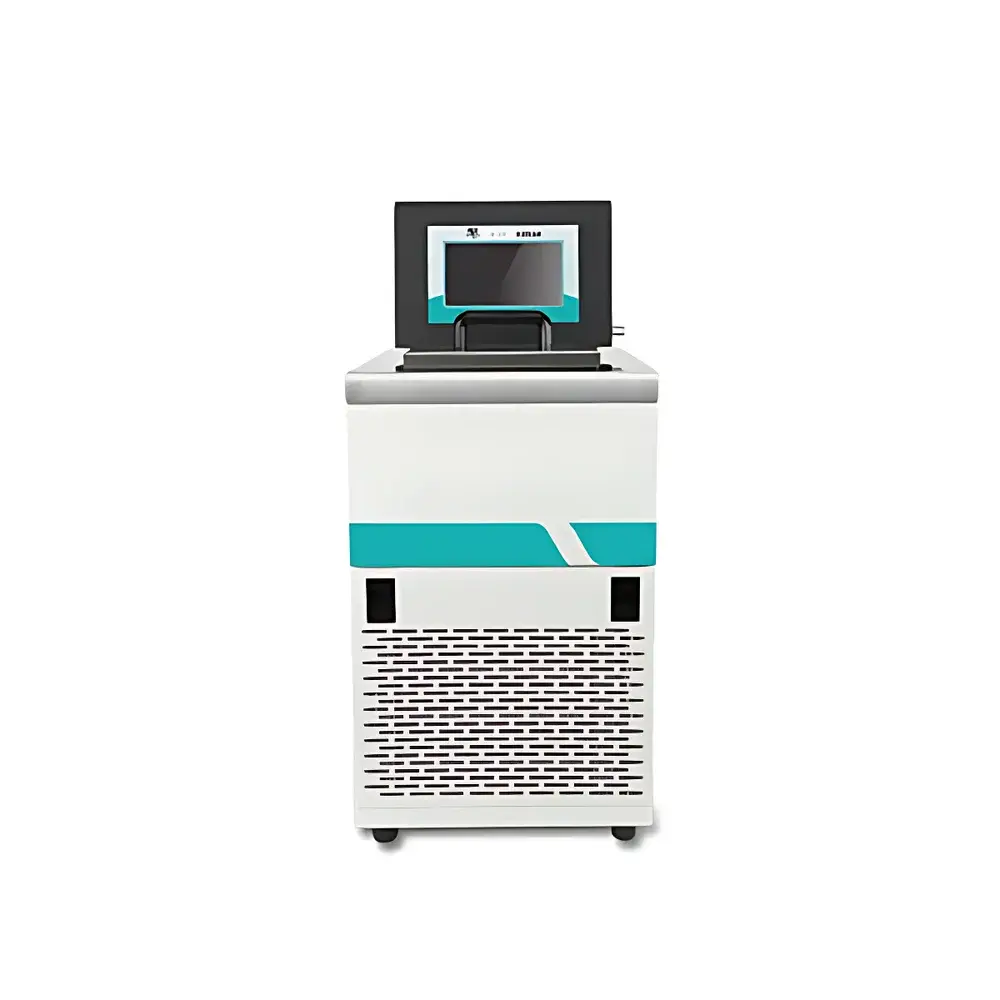
Ningbo Scientz DC-1010 Low-Temperature Constant-Temperature Circulating Bath (Heating & Cooling)
| Brand | Ningbo Scientz |
|---|---|
| Origin | Zhejiang, China |
| Manufacturer Type | Direct Manufacturer |
| Product Category | Domestic |
| Model | DC-1010 |
| Instrument Type | Constant-Temperature Bath |
| Circulation Mode | Internal & External Circulation |
| Temperature Control | Dual-mode (Heating & Refrigeration) |
| Bath Chamber Dimensions | 260 × 200 × 200 mm (L×W×H) |
| Temperature Range | −10 °C to +100 °C |
| Temperature Stability | ±0.05 °C |
Overview
The Ningbo Scientz DC-1010 Low-Temperature Constant-Temperature Circulating Bath is a precision-engineered thermal management system designed for laboratory environments requiring stable, programmable temperature control across a broad operational range (−10 °C to +100 °C). It operates on the principle of forced liquid circulation—utilizing a closed-loop refrigeration cycle combined with resistive heating—to maintain uniform thermal conditions within its stainless-steel bath chamber or external process loads. The unit employs an environmentally compliant refrigerant (R134a or equivalent low-GWP alternative), consistent with modern regulatory expectations for laboratory equipment in North America and the EU. Its core architecture integrates a high-efficiency hermetic compressor (Secop, Germany), PID-based digital temperature regulation, and dual-mode thermal actuation—enabling seamless transitions between cooling and heating without manual intervention. As a primary or auxiliary thermal source, the DC-1010 supports both internal bath stabilization and external temperature control via its dual-circulation capability, making it suitable for integration into complex experimental setups such as rotary evaporator condenser jackets, ultrasonic probe systems, and jacketed reactor vessels.
Key Features
- High-stability temperature control with ±0.05 °C stability over time and spatial uniformity ≤±0.1 °C across the bath volume
- 7-inch angled capacitive touchscreen interface supporting intuitive parameter input, real-time trend visualization, and multi-step program storage
- Configurable auto-shutdown timer and power-loss recovery mode—retains user-defined settings and optionally resumes operation upon re-powering
- Adjustable circulation pump flow rate (0–20 L/min typical range) with selectable internal-only, external-only, or combined circulation paths
- Integrated safety protections: compressor overheat cutoff, current overload detection, dry-run prevention, and high/low temperature alarms
- Low-noise operation (<55 dB(A) at 1 m) achieved via vibration-damped mounting and Secop’s ultra-quiet scroll compressor technology
Sample Compatibility & Compliance
The DC-1010 accommodates aqueous, ethylene glycol–water mixtures, silicone oils, and other non-corrosive heat-transfer fluids compatible with 304 stainless steel wetted parts. Its sealed bath design prevents evaporation loss and minimizes contamination risk during extended operation. While not certified to ISO/IEC 17025 or ASTM E2877 for metrological traceability, the system meets general-purpose laboratory performance requirements outlined in ASTM D1500 (petroleum product testing), USP (thermal validation for pharmaceutical applications), and ISO 17025 Annex A.2 (equipment suitability assessment). All electrical components comply with IEC 61010-1:2010 for laboratory equipment safety; refrigerant handling adheres to EPA SNAP and EU F-Gas Regulation (EU) No 517/2014.
Software & Data Management
The DC-1010 operates autonomously via its embedded microcontroller and does not require external PC software for basic function execution. However, optional RS485/Modbus RTU or USB-to-serial interfaces enable integration into centralized lab automation platforms (e.g., LabVIEW, DeltaV, or custom SCADA). Logged data—including setpoint, actual bath temperature, compressor status, and runtime hours—can be exported in CSV format via USB flash drive. Audit trail functionality supports GLP-compliant workflows when paired with validated third-party data acquisition systems; full 21 CFR Part 11 compliance requires supplemental electronic signature and access control layers implemented at the host system level.
Applications
- Condenser cooling for rotary evaporators in organic synthesis and natural product isolation
- Temperature stabilization of non-contact ultrasonic homogenizers and sonoreactors in cell lysis and nanoparticle dispersion
- Thermal control of chemical reaction blocks, calorimetry cells, and viscometer jackets
- Calibration of thermocouples, RTDs, and infrared sensors against NIST-traceable references
- Stabilization of optical benches, interferometers, and semiconductor wafer probing stations requiring sub-0.1 °C thermal drift suppression
- Biological sample incubation support in enzymatic assays, protein crystallization trials, and microbial growth studies
FAQ
What is the maximum external load capacity supported by the DC-1010’s external circulation mode?
The unit delivers up to 20 L/min at 0.3 MPa pressure head under optimal fluid viscosity conditions (e.g., 30% glycol/water at 25 °C); actual performance depends on tubing length, diameter, and system backpressure.
Can the DC-1010 operate continuously at −10 °C ambient temperature?
Yes—the refrigeration system is rated for continuous operation down to −10 °C ambient, provided adequate ventilation (≥15 cm clearance on all sides) and absence of condensation-prone environments.
Is the bath chamber drain port compatible with standard laboratory tubing?
Yes—it features a 1/2″ BSP threaded outlet, adaptable to common 8 mm or 10 mm ID silicone or fluoropolymer tubing using standard compression fittings.
Does the DC-1010 support ramp-and-soak temperature profiling?
Yes—up to 10 segmented programs, each with independent ramp rate (0.1–10.0 °C/min), soak duration (0–99 h 59 min), and target temperature can be stored and recalled.
Are calibration certificates available for purchase?
Factory calibration reports (temperature accuracy verification at three points: 0 °C, 25 °C, and 70 °C) are included; UKAS-accredited calibration must be arranged separately through authorized third-party labs.



