
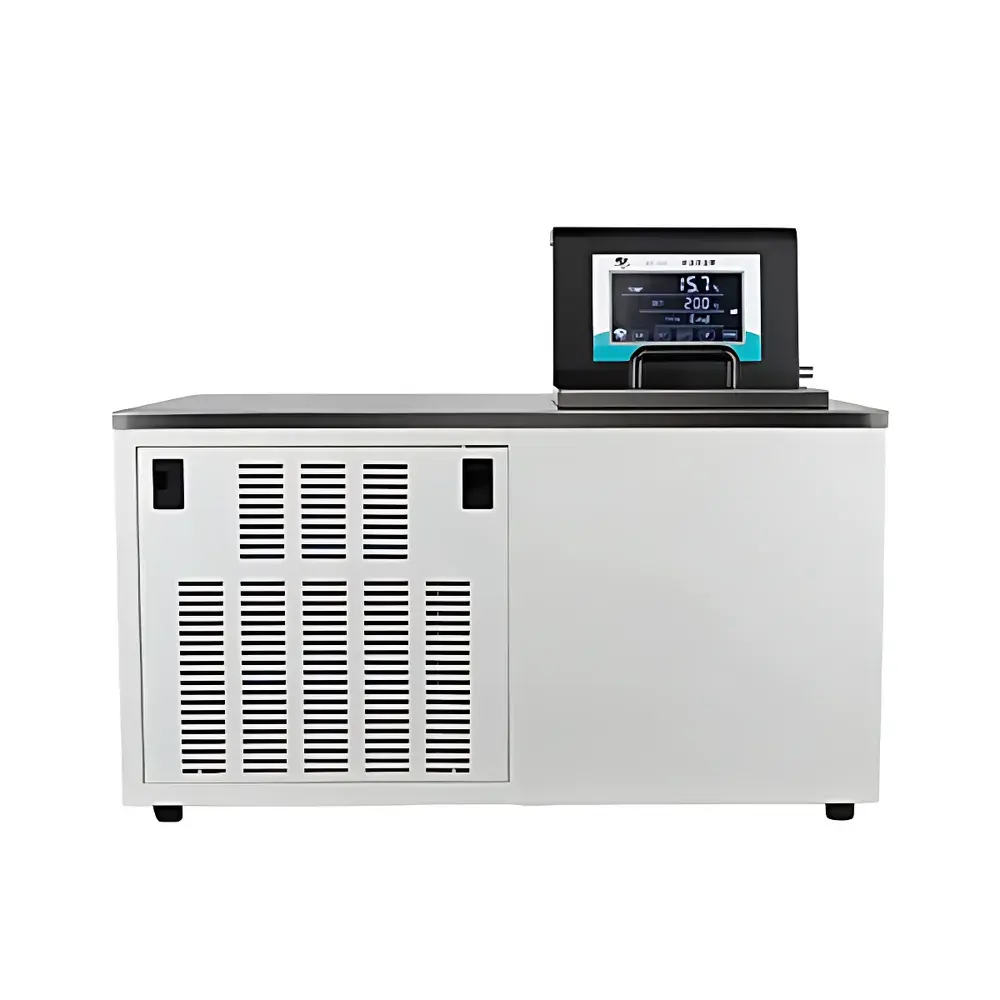
Ningbo Scientz DCW-0506 Low-Temperature Constant-Temperature Circulating Bath (Heating & Cooling)
| Brand | Ningbo Scientz |
|---|---|
| Origin | Zhejiang, China |
| Manufacturer Type | OEM Manufacturer |
| Product Category | Domestic |
| Model | DCW-0506 |
| Instrument Type | Water/Oil Bath Circulator |
| Circulation Mode | Internal & External |
| Temperature Control | Dual-mode (Heating & Refrigeration) |
| Bath Chamber Dimensions (L×W×H) | 260 × 200 × 140 mm |
| Temperature Range | −6 °C to +100 °C |
| Temperature Stability | ±0.05 °C |
| Display | 7-inch Tilted Touchscreen |
| Compressor | Secop (formerly Danfoss) Hermetic Scroll Compressor |
| Refrigerant | R134a (ODP = 0, GWP = 1430) |
| Pump Flow Rate | Adjustable up to 15 L/min (external loop) |
| Safety Protections | Compressor overheat & overload cutoff, dry-run protection, overtemperature alarm |
Overview
The Ningbo Scientz DCW-0506 is a high-precision, dual-function circulating bath engineered for laboratory environments requiring stable, programmable thermal control across a wide operational range (−6 °C to +100 °C). It operates on the principle of closed-loop liquid circulation—using a thermally conductive medium (water or silicone oil) to absorb, transfer, and dissipate heat via an integrated refrigeration system and electric heating elements. The unit employs a Secop hermetic scroll compressor with R134a refrigerant—a zero-ozone-depletion potential (ODP = 0) hydrofluorocarbon compliant with international environmental regulations including EU F-Gas Regulation (EU No 517/2014). Its PID-controlled microprocessor ensures dynamic thermal regulation with ±0.05 °C stability under steady-state conditions, making it suitable not only as a standalone temperature bath but also as an external thermal source for peripheral equipment such as rotary evaporator condensers, ultrasonic probe systems, jacketed reactors, and semiconductor test fixtures.
Key Features
- High-stability thermal control: Achieves ±0.05 °C temperature uniformity in internal bath mode and ±0.1 °C in external circulation applications.
- Dual-mode operation: Seamless switching between heating-only, cooling-only, and simultaneous heating/cooling modes for precise ramp-and-soak protocols.
- Intelligent 7-inch tilted touchscreen interface: Supports real-time display of setpoint, actual temperature, elapsed time, pump speed, and system status; includes multi-language UI support (English, Chinese, Spanish).
- Programmable timer function: Automatically terminates operation upon reaching user-defined duration, enhancing experimental repeatability and unattended safety.
- Configurable power recovery behavior: Retains all parameter settings after power interruption; optional auto-restart or standby mode on power-up per user preference.
- Adjustable external circulation pump: Flow rate continuously adjustable from 0–15 L/min with pressure compensation, enabling compatibility with diverse load impedances (e.g., long tubing runs, high-backpressure reactors).
- Comprehensive safety architecture: Integrated safeguards include compressor overheat protection, motor overload cutoff, low-level fluid alarm, dry-run detection, and independent overtemperature limit controller meeting IEC 61010-1 Class II requirements.
Sample Compatibility & Compliance
The DCW-0506 accommodates aqueous solutions, glycol-water mixtures, and silicone oils (viscosity ≤ 50 cSt) within its stainless-steel bath chamber (260 × 200 × 140 mm internal dimensions). Its external circulation port supports standard 1/4″–3/8″ compression fittings and is compatible with ASTM D1500, ISO 3104, and USP thermal validation protocols when used in viscosity, refractive index, or conductivity calibration workflows. The unit conforms to CE marking requirements (2014/30/EU EMC Directive, 2014/35/EU LVD Directive), RoHS 2011/65/EU, and meets essential performance criteria outlined in GLP-compliant thermal management systems per OECD Series on Principles of Good Laboratory Practice.
Software & Data Management
While the DCW-0506 operates autonomously via its embedded controller, optional RS485 (Modbus RTU) or USB-to-serial interface enables integration into centralized lab automation platforms. Logged data—including timestamped temperature readings, pump status, compressor duty cycle, and alarm events—can be exported in CSV format for traceability. When deployed in regulated environments (e.g., pharmaceutical QC labs), the device supports audit-trail-ready configurations when paired with validated third-party SCADA software compliant with FDA 21 CFR Part 11 requirements for electronic records and signatures.
Applications
- Condenser cooling for rotary evaporation systems requiring sub-ambient temperatures during solvent recovery.
- Temperature stabilization of non-contact ultrasonic homogenizers and sonicators used in cell lysis or nanoparticle dispersion.
- Thermal conditioning of reaction vessels in synthetic organic chemistry and catalytic studies.
- Controlled incubation of biological samples (e.g., enzyme kinetics, protein folding assays) where thermal drift must remain below ±0.1 °C over extended durations.
- Calibration of temperature-sensitive sensors (RTDs, thermistors, IR pyrometers) against NIST-traceable references.
- Thermal testing of electronic components and semiconductor packages under controlled thermal cycling profiles.
FAQ
What is the maximum allowable working temperature for silicone oil in the DCW-0506?
The bath chamber is rated for continuous operation up to +100 °C with water and up to +80 °C with standard methylphenyl silicone oils (e.g., Dow Corning 200 Fluid, viscosity 50 cSt). For higher-temperature oils, consult the manufacturer’s chemical compatibility chart prior to use.
Can the DCW-0506 maintain sub-zero temperatures while circulating externally?
Yes—the unit achieves −6 °C at the bath sensor with full external circulation enabled, provided ambient temperature remains ≤ +25 °C and heat load on the external loop does not exceed 800 W.
Is the refrigerant R134a compliant with current environmental regulations?
R134a has zero ozone depletion potential (ODP = 0) and is permitted under current EU F-Gas and U.S. EPA SNAP regulations, though laboratories planning long-term deployment should evaluate future transition pathways toward lower-GWP alternatives (e.g., R1234ze(E)) as regional phase-down schedules evolve.
Does the device support remote monitoring via Ethernet or Wi-Fi?
No native Ethernet or Wi-Fi module is included; however, third-party industrial gateways with Modbus TCP translation can be deployed to enable networked supervision in converged lab infrastructure environments.



