
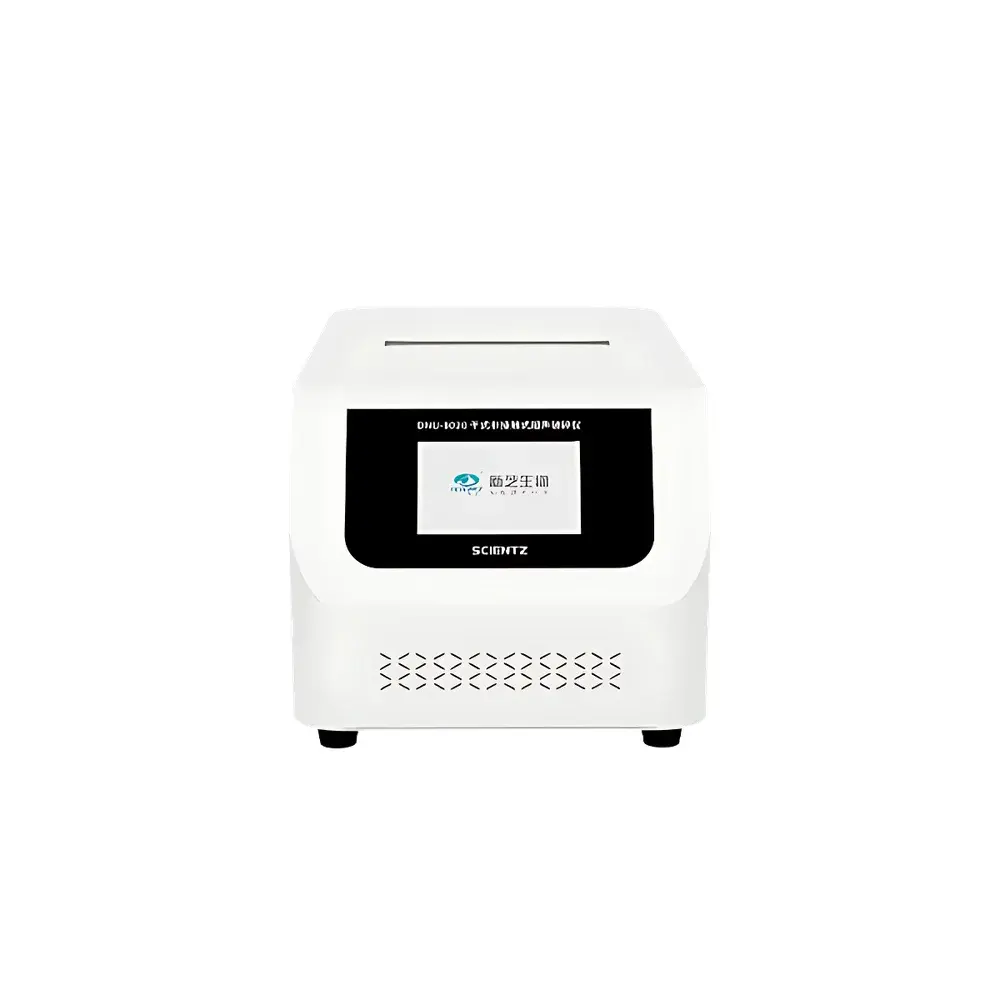
Ningbo Scientz DNU-8020 Dry, Non-Contact Ultrasonic Disruptor
| Brand | Scientz |
|---|---|
| Origin | Zhejiang, China |
| Manufacturer Type | Original Equipment Manufacturer (OEM) |
| Product Category | Domestic |
| Model | DNU-8020 |
| Instrument Type | Non-Contact Ultrasonic Cell Disruptor |
| Operating Frequency | 35–40 kHz |
| Ultrasonic Power Output | 50 W |
| Sample Volume per Tube | 2 mL |
| Maximum Simultaneous Samples | 8 |
Overview
The Ningbo Scientz DNU-8020 is a dry, non-contact ultrasonic disruptor engineered for precise, reproducible lysis of biological samples without physical probe contact or liquid coupling media. Unlike conventional bath or probe-based sonicators—whose energy transmission depends on water immersion and suffers from inconsistent attenuation, thermal drift, and probe erosion—the DNU-8020 employs a focused transducer array mounted beneath a thermally stabilized aluminum sample plate. This architecture delivers broadband ultrasonic energy (35–40 kHz) directly through the tube wall into the sample, enabling efficient cavitation in microliter-to-milliliter volumes. The system operates on the principle of acoustic cavitation: rapid pressure fluctuations induce microbubble formation, growth, and implosive collapse within the liquid phase, generating localized shear forces sufficient to disrupt cell membranes, solubilize inclusion bodies, and fragment chromatin—while preserving labile biomolecules such as RNA, native proteins, and extracellular vesicles. Designed for integration into high-throughput nucleic acid workflows and biosafety-sensitive applications, the DNU-8020 meets the operational requirements of GLP-compliant laboratories handling BSL-2 and BSL-3 agents.
Key Features
- Dry operation mode eliminates reliance on water baths, removing variability from temperature gradients, evaporation losses, and cross-contamination via shared coupling medium.
- Non-contact architecture ensures zero sample contact with transducers or moving parts—eliminating both mechanical carryover and particulate contamination from probe wear (e.g., titanium debris), critical for proteomics and NGS library prep.
- Simultaneous processing of up to eight 2 mL microcentrifuge tubes (e.g., PCR-grade polypropylene) without custom consumables—reducing cost-per-sample and simplifying workflow scalability.
- Digitally adjustable amplitude and time parameters enable method standardization across operators and instruments; built-in thermal monitoring prevents overheating during extended cycles.
- Enclosed chamber design complies with ISO 13849-1 safety requirements for laboratory equipment, providing containment for aerosol-generating procedures involving mycobacteria, lentiviral vectors, or pathogenic bacterial cultures.
Sample Compatibility & Compliance
The DNU-8020 accommodates standard 2 mL conical-bottom microcentrifuge tubes (diameter ≤11 mm, height ≤45 mm), including low-binding, RNase-free, and sterile-certified variants. It supports aqueous suspensions of Gram-negative and Gram-positive bacteria (e.g., E. coli, B. subtilis), mammalian cell lines (HEK293, CHO), yeast (S. cerevisiae), and tissue homogenates. Validation studies conducted by third-party CROs confirm compatibility with downstream qPCR, Western blotting, and mass spectrometry workflows. The instrument conforms to IEC 61010-1:2010 for electrical safety and EMC compliance per EN 61326-1:2013. While not certified under FDA 21 CFR Part 11, its parameter logging capability supports audit-ready documentation for ISO/IEC 17025-accredited testing laboratories.
Software & Data Management
The DNU-8020 operates via an embedded touchscreen interface with firmware supporting protocol storage (up to 20 user-defined methods), real-time power feedback, and cycle completion timestamps. All settings—including duration, amplitude (% of max 50 W), and pause intervals—are recorded locally with ISO 8601-formatted timestamps. Optional RS-232 or USB-C connectivity enables export of session logs (CSV format) for integration into LIMS or ELN systems. No cloud dependency or proprietary software installation is required; data integrity is maintained through write-once EEPROM storage resistant to power interruption.
Applications
- Pre-analytical preparation for quantitative real-time PCR (qRT-PCR): consistent lysis of low-input clinical isolates (e.g., sputum-derived M. tuberculosis) without RNA degradation.
- Membrane protein extraction: gentle yet effective disruption of E. coli inclusion bodies while retaining tertiary structure for functional reconstitution.
- Nanoparticle formulation: uniform emulsification of lipid nanoparticles (LNPs) for mRNA delivery, validated via dynamic light scattering (DLS) size distribution analysis.
- Chromatin shearing for ChIP-seq: reproducible DNA fragmentation (200–500 bp range) across replicate samples, minimizing bias introduced by enzymatic digestion.
- High-value reagent activation: controlled sonication of antibody-conjugated beads or CRISPR ribonucleoprotein complexes without aggregation or denaturation.
FAQ
Does the DNU-8020 require water cooling or external chillers?
No. The system uses passive thermal management via an aluminum heat-sink baseplate and duty-cycle optimization to maintain sample temperatures below 25 °C during standard 30-second cycles.
Can it process viscous or high-density samples such as whole blood or tissue lysates?
Yes—provided viscosity remains below 10 mPa·s and particulate load does not exceed 15% w/v; pre-filtration through 40-µm mesh is recommended for heterogeneous suspensions.
Is validation documentation available for GMP environments?
Scientz provides IQ/OQ templates and a factory calibration certificate traceable to NIM (China National Institute of Metrology); full PQ support requires site-specific protocol development per USP & ISO 13485 guidelines.
What tube types are verified for optimal energy transfer?
Polypropylene tubes meeting ASTM D4101 specifications demonstrate >92% acoustic coupling efficiency; polycarbonate and glass tubes are not recommended due to impedance mismatch and fracture risk.
How is maintenance performed?
Zero scheduled maintenance is required; periodic inspection of the sample plate surface for micro-scratches and cleaning with isopropanol wipes suffices for long-term performance stability.




