
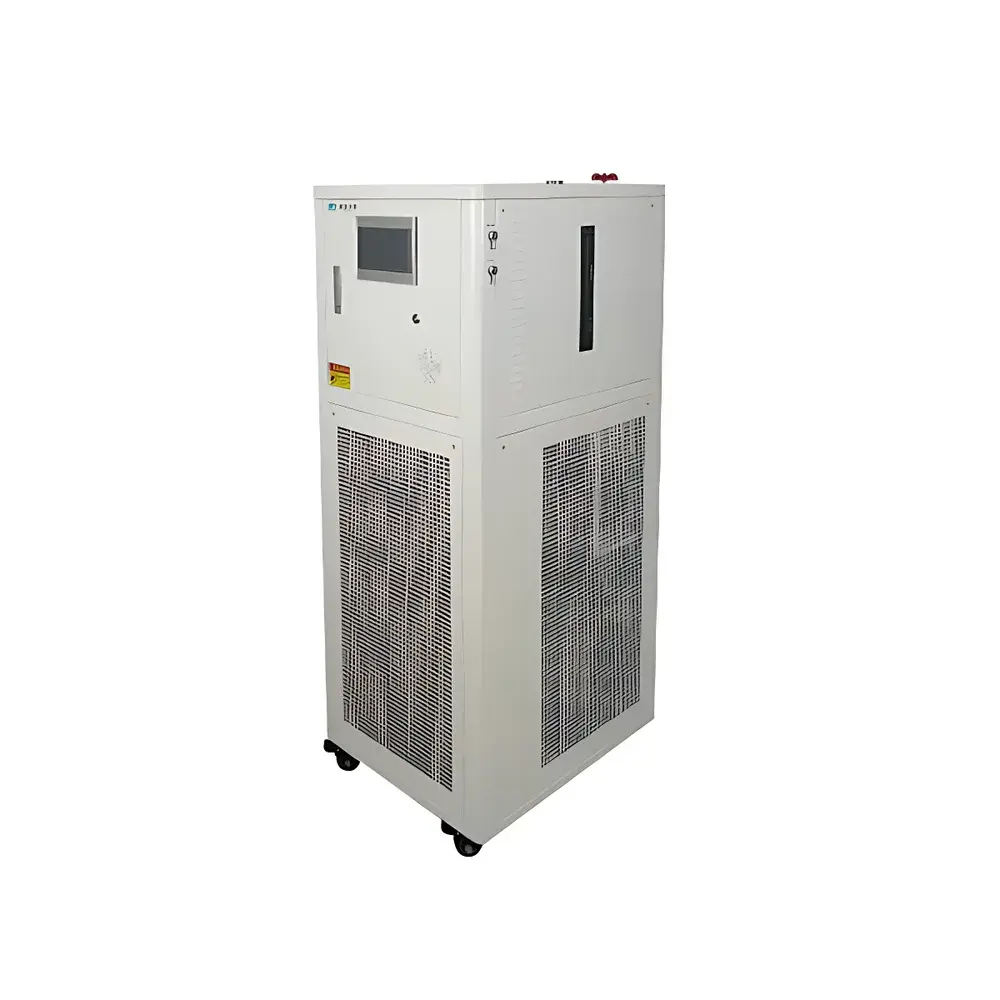
Ningbo Scientz L1.5-8 Series Cryogenic & Ambient Temperature Control System (–80 °C to 20 °C)
| Brand | Scientz |
|---|---|
| Origin | Zhejiang, China |
| Manufacturer Type | Direct Manufacturer |
| Country of Origin | China |
| Model | L1.5-8 Series |
| Temperature Range | –80 °C to 20 °C |
| Temperature Accuracy | ±0.5 °C |
| Control Algorithm | PID Fuzzy Logic |
| Communication Interface | RS-485 with MODBUS RTU Protocol |
| Display | 7-inch color touchscreen with real-time temperature curve visualization and logging |
| Programmability | Up to 5 multi-step programs (30 segments per program) |
| Temperature Feedback Points | Three independent PT100 inputs (unit internal temp, outlet fluid temp, external process material temp) |
| Safety Protections | Compressor overload protection, high-pressure switch, thermal relay, overheat sensor, low-fluid-level detection, sensor fault monitoring, self-diagnostic system |
| Circulation System | Fully sealed closed-loop design |
| Fluid Operating Range | –25 °C to 200 °C |
| Temperature Differential Control | Adjustable setpoint offset between jacket and process material temperature |
Overview
The Ningbo Scientz L1.5-8 Series Cryogenic & Ambient Temperature Control System is an engineered thermal management platform designed for precise, stable, and reproducible temperature regulation across demanding laboratory and pilot-scale applications. Operating within a broad working range of –80 °C to 20 °C, the system leverages a closed-loop refrigeration architecture combined with high-efficiency heat exchange to deliver consistent thermal performance under dynamic load conditions. Its core function is to regulate the temperature of external process equipment—such as glass or stainless-steel jacketed reactors, microchannel reactors, and environmental test chambers—by circulating thermally stable heat transfer fluid through an insulated, hermetic loop. Unlike open-bath systems, this fully sealed design prevents moisture ingress at low temperatures and eliminates volatile oil mist generation at elevated setpoints, ensuring long-term fluid integrity and operator safety. The system implements adaptive PID fuzzy logic control, enabling rapid response to thermal disturbances while maintaining tight stability—critical for exothermic reaction control, crystallization kinetics studies, and accelerated aging tests.
Key Features
- Precision temperature control with ±0.5 °C accuracy at the fluid outlet and ±1 °C at the process material interface, verified under steady-state load conditions
- Triple-point PT100 temperature monitoring: simultaneous acquisition of internal unit temperature, circulation loop outlet temperature, and externally mounted process temperature (via user-supplied sensor)
- Differential temperature control mode: programmable offset between jacket fluid and reaction mass enables active suppression of thermal lag during rapid heating/cooling transitions
- Intuitive 7-inch color touchscreen HMI with embedded data logging; supports real-time temperature curve overlay, historical trend review, and CSV export via USB
- MODBUS RTU over RS-485 interface for seamless integration into centralized SCADA or LIMS environments—compatible with standard industrial automation protocols
- Comprehensive hardware safety layer including compressor overload protection, high-pressure cut-off switches, thermal relays, low-fluid-level sensors, and redundant overtemperature detection
- Five independent multi-segment programs (up to 30 steps each), supporting ramp-hold-soak profiles required for ICH Q5C stability testing, polymerization initiation, and catalyst activation protocols
Sample Compatibility & Compliance
The L1.5-8 Series interfaces with a wide variety of external equipment, including single- and double-jacketed glass reactors (0.5–50 L), stainless-steel pilot reactors, microstructured flow reactors (e.g., Corning AFR, Vapourtec R-Series), and automotive component environmental test fixtures. Its sealed circulation design meets ISO 14644-1 Class 8 cleanroom compatibility requirements when paired with appropriate heat transfer fluids (e.g., silicone oils, ethylene glycol/water mixtures). While not certified to UL/CSA standards out-of-the-box, the unit complies with EN 61000-6-2 (immunity) and EN 61000-6-4 (emissions) for laboratory electromagnetic environments. Its programmable logging functionality supports GLP-compliant audit trails when used in conjunction with validated third-party data acquisition software meeting FDA 21 CFR Part 11 requirements.
Software & Data Management
No proprietary PC software is bundled; all configuration, operation, and data retrieval occur locally via the onboard touchscreen interface. Temperature curves are stored internally with timestamped metadata (date, time, program ID, segment number) and exportable to USB storage in comma-separated values (CSV) format. The MODBUS RTU register map includes read-only access to all three PT100 channels, current setpoint, active program status, alarm history codes, and cumulative compressor runtime—enabling integration with LabVIEW, MATLAB, or custom Python-based monitoring dashboards. Audit-ready data exports include raw sensor readings sampled at 1 Hz, with no interpolation or filtering applied.
Applications
- Chemical synthesis: Precise control of exothermic nitration, sulfonation, and hydrogenation reactions in jacketed reactors; enables adherence to ASTM E2554 kinetic modeling guidelines
- Pharmaceutical development: Temperature profiling for polymorph screening, amorphous solid dispersion stability assessment, and lyophilization cycle development
- Microreactor process intensification: Rapid thermal cycling for residence-time distribution studies and kinetic parameter estimation in continuous-flow systems
- Automotive component validation: Simultaneous thermal conditioning of battery modules, power electronics, and HVAC actuators across –40 °C to +85 °C equivalent ranges using cascaded or auxiliary chiller support
- Materials science: Controlled cooling rates for metal alloy annealing simulations and polymer crystallinity analysis per ISO 11357-3
FAQ
What heat transfer fluids are compatible with the L1.5-8 system?
The system supports silicone oils (e.g., DC200 series), polyalphaolefins (PAOs), and aqueous glycol solutions. Fluid selection must align with the target operating range and chemical compatibility with reactor seals.
Can the unit operate continuously at –80 °C?
Yes—designed for unattended 24/7 operation at rated extremes, provided ambient room temperature remains ≤25 °C and ventilation clearance meets specifications.
Is external temperature feedback mandatory for material temperature control?
Yes. Accurate process temperature regulation requires connection of an external PT100 sensor to the designated input terminal; the system defaults to outlet fluid control if no external probe is detected.
Does the system support remote start/stop via digital I/O?
No discrete I/O terminals are provided; remote command execution is exclusively supported via MODBUS RTU register writes.
How is calibration traceability maintained?
The unit ships with factory calibration certificates for all three PT100 inputs. End users may perform field verification using NIST-traceable reference probes; no internal recalibration routine is user-accessible.





