
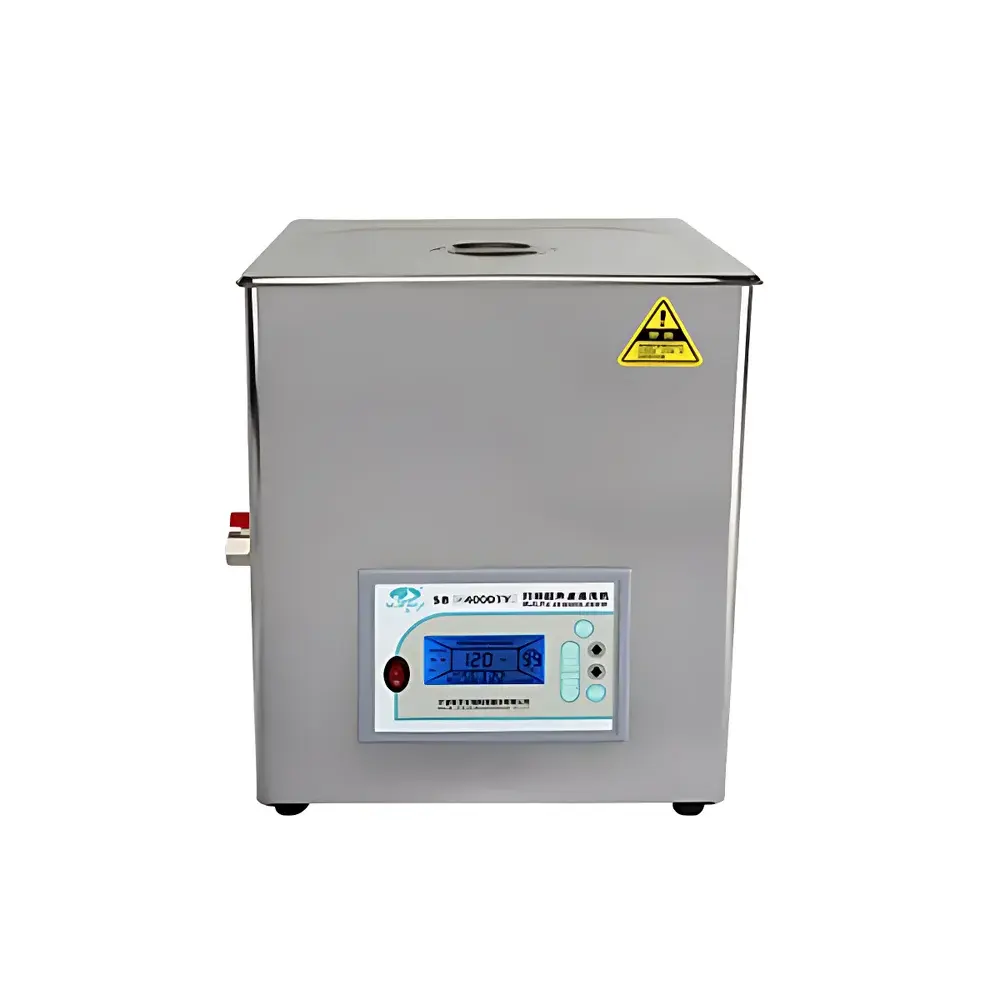
Ningbo Scientz SB-400DTY Sweep-Frequency Ultrasonic Cleaner
| Brand | Ningbo Scientz |
|---|---|
| Origin | Zhejiang, China |
| Manufacturer Type | Direct Manufacturer |
| Instrument Type | General-Purpose Ultrasonic Cleaner |
| Tank Capacity | 15 L |
| Ultrasonic Frequency | 48 kHz (Sweep Mode) |
| Ultrasonic Power Output | 800 W |
| Power Adjustment | Not Available |
| Temperature Control | Not Available |
| Timer Adjustment | Yes (1–999 min) |
| Sound-Dampening Lid | Included |
| Fill/Drain Fitting | Equipped |
Overview
The Ningbo Scientz SB-400DTY Sweep-Frequency Ultrasonic Cleaner is an industrial-grade laboratory cleaning system engineered for high-reproducibility removal of particulate, organic, and oily contaminants from complex geometries—including blind holes, narrow lumens, microfluidic channels, and delicate optical surfaces. It operates on the principle of acoustic cavitation: high-frequency mechanical vibrations (48 kHz, sweep-modulated) are transmitted into aqueous or mild solvent-based cleaning media via piezoelectric transducers bonded to the stainless-steel tank base. The resulting transient cavitation bubbles collapse asymmetrically near solid surfaces, generating localized micro-jets (>100 m/s) and shockwaves that dislodge adherent residues without mechanical abrasion or surface etching. Unlike fixed-frequency units, the SB-400DTY employs frequency sweeping across a narrow band centered at 48 kHz to suppress standing-wave formation, minimize node/antinode hotspots, and ensure uniform energy distribution throughout the 15-L tank volume—critical for consistent cleaning performance across heterogeneous sample loads.
Key Features
- Robust 15-liter stainless-steel tank (304 grade) with integrated transducer array for stable long-term operation under continuous duty cycles.
- Sweep-frequency drive architecture eliminates acoustic shadowing and improves cleaning uniformity—particularly beneficial for irregularly shaped or stacked labware (e.g., multi-well plates, capillary arrays, and microcentrifuge tube racks).
- Digital timer with 1–999 minute programmable range and automatic shutdown; real-time countdown display enhances protocol repeatability in GLP-compliant environments.
- Integrated sound-dampening lid reduces ambient noise to ≤65 dB(A) at 1 m distance—meeting ISO 14040 occupational exposure guidelines for routine lab use.
- Standard fill-and-drain ports support semi-automated fluid exchange, minimizing manual handling and enabling integration into multi-step cleaning workflows (e.g., rinse–clean–rinse sequences).
- Non-volatile parameter memory retains last-used settings after power interruption—supporting uninterrupted batch processing during scheduled maintenance or grid fluctuations.
Sample Compatibility & Compliance
The SB-400DTY is validated for cleaning a broad spectrum of laboratory and industrial substrates: borosilicate glassware (vials, pipettes, cuvettes), polymer-based consumables (PCR tubes, filter housings), metal components (stainless steel surgical instruments, precision bearings), and optically sensitive items (quartz cuvettes, microscope slides, lens elements). Its cavitation intensity profile complies with ASTM D2603-20 (Standard Test Method for Sonic Shear Stability of Lubricants) for non-destructive cleaning validation. While not certified for sterile reprocessing per ISO 17664 or AAMI ST98, it serves as a critical pre-sterilization step in ISO 13485-aligned medical device manufacturing facilities when paired with validated cleaning chemistries and post-rinse protocols.
Software & Data Management
The SB-400DTY operates via embedded firmware with no external software dependency. All operational parameters—including elapsed time, remaining cycle duration, and transducer activation status—are displayed on a high-contrast LED interface. Though it lacks USB/Ethernet connectivity or electronic audit trail functionality, its deterministic timer logic and non-volatile memory meet baseline data integrity requirements for non-GxP applications. For laboratories operating under FDA 21 CFR Part 11 or EU Annex 11, the unit may be incorporated into validated cleaning SOPs using complementary documentation tools (e.g., paper-based logbooks or LIMS-integrated work instructions).
Applications
- Pre-analytical preparation: Degassing solvents prior to HPLC mobile phase preparation; removing residual proteins and nucleic acids from reusable electrophoresis combs and gel trays.
- Materials science: Cleaning sintered metal filters, MEMS devices, and ceramic substrates prior to coating or metrology.
- Quality control labs: Decontaminating sampling probes, titration burettes, and volumetric flasks between batches per USP Analytical Instrument Qualification guidelines.
- Maintenance engineering: Restoring hydraulic component fidelity by eliminating carbon deposits from fuel injectors and valve bodies.
- Cultural heritage conservation: Gentle particulate removal from archival documents, coinage, and archaeological fragments without solvent immersion.
FAQ
Does the SB-400DTY support heating or temperature regulation?
No. This model is configured for ambient-temperature ultrasonic cleaning only. For thermally assisted cleaning (e.g., lipid dissolution), users must employ externally pre-heated solutions within safe thermal limits for the tank material.
Is the 48 kHz output truly sweep-mode, and how does it differ from fixed-frequency operation?
Yes. The unit modulates ±1.5 kHz around 48 kHz at 5 Hz repetition rate, disrupting resonant standing waves and preventing uneven cleaning zones—a documented limitation of single-frequency systems per ISO 13076 Annex B.
Can the SB-400DTY be used with flammable solvents?
Not recommended. The transducer design and lack of explosion-proof certification restrict operation to aqueous or water-miscible, non-volatile cleaning agents (e.g., diluted alkaline detergents, citric acid solutions).
What maintenance is required for sustained performance?
Quarterly inspection of transducer bond integrity and tank weld seams; annual replacement of the drain valve O-ring; avoidance of abrasive cleaners on the tank interior to preserve passive oxide layer.
Related Products



