
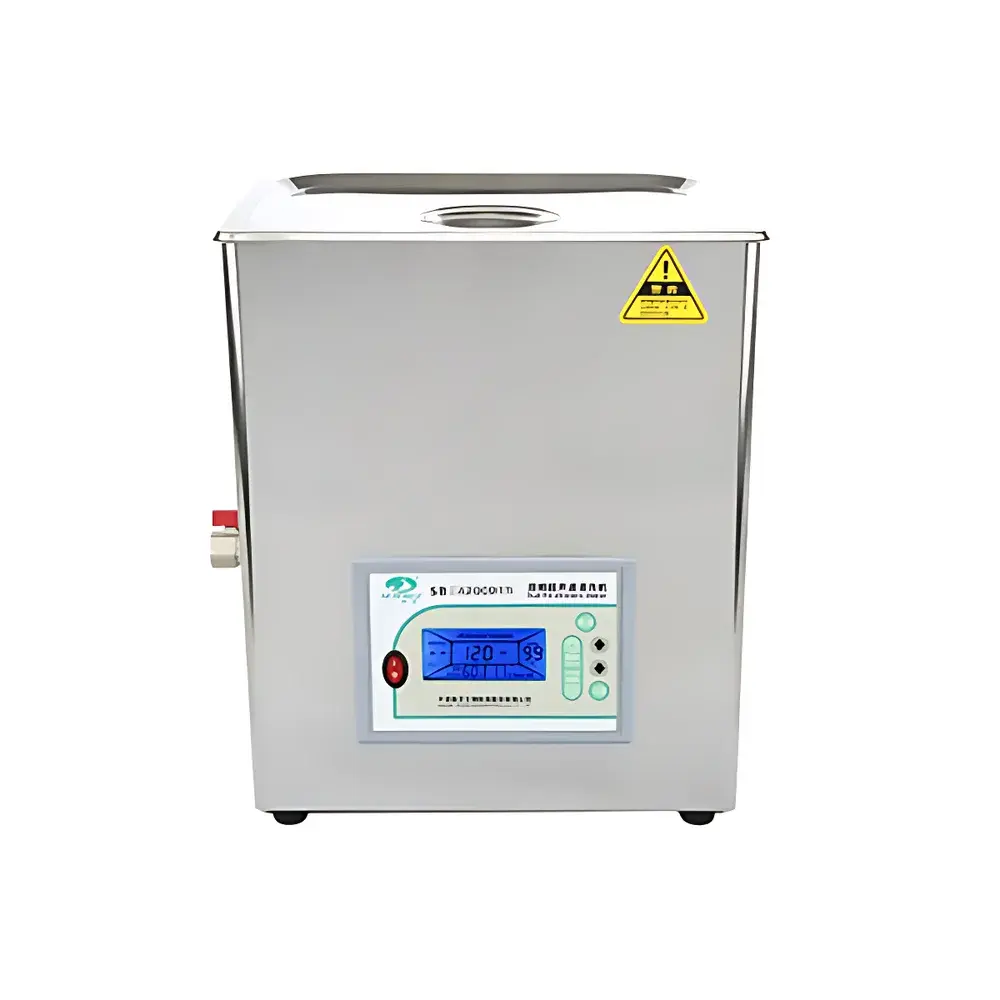
Ningbo Scientz SB-4200DTS Dual-Frequency Ultrasonic Cleaner
| Brand | Ningbo Scientz |
|---|---|
| Origin | Zhejiang, China |
| Manufacturer Type | Direct Manufacturer |
| Instrument Type | General-Purpose Ultrasonic Cleaner |
| Tank Capacity | 14.4 L |
| Ultrasonic Frequencies | 25 kHz / 40 kHz |
| Total Ultrasonic Power Output | 400 W |
| Power Adjustment Range | 40–100% |
| Heating Temperature Range | Ambient to 80 °C |
| Timer Functionality | Adjustable (1–999 min) |
| Sound-Dampening Lid | Included |
| Drain & Fill Ports | Equipped |
Overview
The Ningbo Scientz SB-4200DTS Dual-Frequency Ultrasonic Cleaner is an engineered solution for precision cleaning in academic, pharmaceutical, clinical, and industrial laboratories. It operates on the physical principle of acoustic cavitation—where high-frequency sound waves (25 kHz and 40 kHz) propagate through a liquid medium, inducing rapid formation and violent collapse of microscopic vapor bubbles. This transient cavitation generates localized shockwaves and microstreaming effects that mechanically dislodge particulate contaminants, organic residues, biofilms, and adsorbed oils from complex geometries—including blind holes, narrow lumens, porous surfaces, and microstructured substrates—without mechanical abrasion or chemical aggression. Unlike single-frequency systems, dual-frequency operation enables synergistic cleaning: lower frequencies (25 kHz) deliver higher energy per cavitation event for robust removal of tenacious particulates, while higher frequencies (40 kHz) produce denser bubble populations ideal for delicate substrates and fine-detail cleaning. The unit’s stainless-steel tank (304 grade), integrated heating system, and programmable digital interface support reproducible, protocol-driven cleaning validated under GLP-compliant workflows.
Key Features
- Dual-frequency transduction: Simultaneous or selectable 25 kHz and 40 kHz ultrasonic output for application-optimized cleaning performance
- Adjustable power delivery: Continuous 40–100% ultrasonic power control (total 400 W nominal) to match sample sensitivity and soil load
- Precise thermostatic regulation: Digital PID-controlled heating from ambient temperature up to 80 °C, with ±1 °C stability across the 14.4 L tank volume
- Intuitive digital interface: LED display showing real-time bath temperature and remaining cycle time; memory retention for all settings after power interruption
- Acoustically optimized enclosure: Integrated sound-dampening lid reduces airborne noise to ≤65 dB(A) at 1 m distance, meeting ISO 7779 requirements for laboratory environments
- Functional utility ports: Front-mounted fill/drain valves and overflow outlet enable closed-loop solvent recovery or automated fill-and-drain sequences
Sample Compatibility & Compliance
The SB-4200DTS accommodates a broad spectrum of laboratory and industrial samples, including borosilicate glassware (vials, cuvettes, pipette tips), polymer-based consumables (centrifuge tubes, microplates), metallic components (surgical instruments, watch mechanisms, fuel injectors), optical elements (lens assemblies, quartz cuvettes), and jewelry-grade substrates (gold alloys, gemstones). Its non-corrosive 304 stainless-steel tank complies with ASTM A240 and meets FDA-recommended material standards for indirect food- and medical-device contact. While not certified as a sterilizer, the device supports disinfection protocols when used with EPA-registered aqueous disinfectants (e.g., peracetic acid blends) under validated time/temperature/cavitation intensity parameters. The instrument architecture adheres to IEC 61010-1 safety standards for laboratory electrical equipment and incorporates overtemperature and dry-run protection circuits compliant with EN 60335-1.
Software & Data Management
The SB-4200DTS operates via embedded firmware without external PC dependency. All operational parameters—including frequency selection, power level (%), set temperature (°C), and timer duration (1–999 min)—are stored in non-volatile memory and retained following power loss, satisfying basic ALCOA+ data integrity principles for routine lab use. Though it lacks Ethernet or USB connectivity, its deterministic behavior, calibrated thermal response, and repeatable cavitation output enable full traceability within paper-based or LIMS-integrated SOP documentation. For regulated environments (e.g., USP , ISO 13485), users may log cycle parameters manually or integrate the unit into broader process validation frameworks using external data loggers connected to the analog temperature output (0–5 VDC signal available upon request).
Applications
- Critical pre-analytical preparation: Degassing HPLC mobile phases, cleaning LC-MS sample vials, and decontaminating electrophoresis tanks
- Medical device reprocessing: Pre-sterilization cleaning of endoscopes, dental handpieces, and orthopedic implants per AAMI ST91 guidelines
- Materials science: Removing sintering aids from ceramic green bodies, deburring micro-machined metal parts, and preparing SEM/TEM substrates
- Life sciences: Disaggregating tissue homogenates, lysing bacterial cells for plasmid extraction, and dispersing nanoparticle suspensions
- Quality control labs: Validated cleaning of reference standards, calibration weights, and volumetric glassware per ISO/IEC 17025 clause 6.4.10
FAQ
Is the SB-4200DTS suitable for cleaning delicate optics such as microscope objectives?
Yes—when operated at 40 kHz with reduced power (40–60%) and aqueous, low-surfactant solutions, it effectively removes fingerprint oils and dust without damaging anti-reflective coatings.
Can this unit be used with flammable solvents like acetone or ethanol?
No. The SB-4200DTS is designed exclusively for aqueous or water-miscible solutions. Use only in well-ventilated fume hoods if volatile solvents are required—and only with explosion-proof ultrasonic systems certified to UL 61010-1 Annex BB.
Does the timer support automatic restart after power failure?
No—but all user-defined parameters (frequency, power, temperature, time) are preserved in memory; manual restart resumes from original settings.
What maintenance is required to ensure long-term cavitation efficiency?
Monthly descaling with 5% citric acid solution, biannual inspection of transducer adhesion integrity, and annual verification of temperature sensor calibration against NIST-traceable references.
Is the unit compatible with GMP documentation requirements?
It supports GMP-aligned practices through deterministic operation, parameter memory, and thermal stability—but formal 21 CFR Part 11 compliance requires external audit-trail logging hardware or software integration.



