
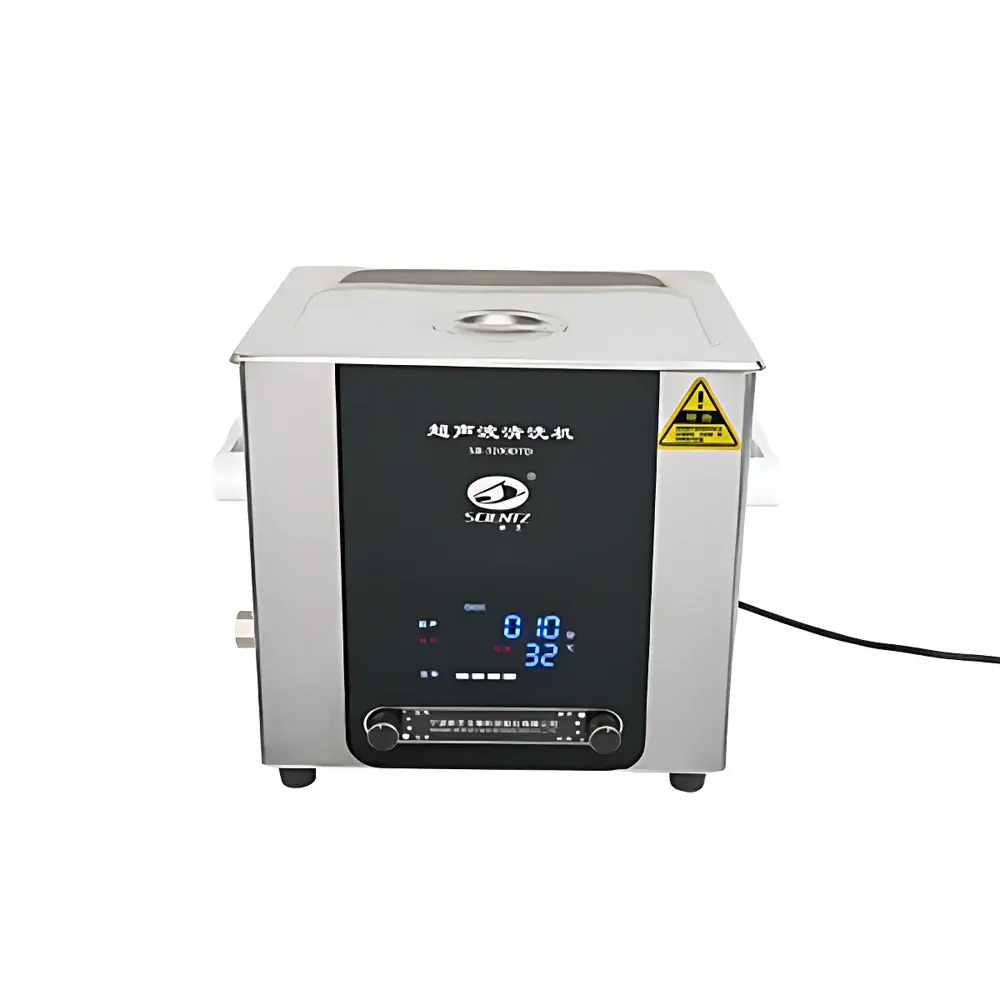
Ningbo Scientz SB-5200DTD Digital Ultrasonic Cleaner
| Brand | Ningbo Scientz |
|---|---|
| Origin | Zhejiang, China |
| Manufacturer Type | Direct Manufacturer |
| Instrument Type | General-Purpose Ultrasonic Cleaner |
| Capacity | 10 L |
| Ultrasonic Frequency | 40 kHz |
| Ultrasonic Power Output | 240 W |
| Power Adjustment | Yes (40–100% stepless) |
| Heating Range | Ambient to 80 °C |
| Timer Range | 1–999 min |
| Acoustic Lid | Included |
| Drain & Fill Ports | Equipped |
Overview
The Ningbo Scientz SB-5200DTD is a digitally controlled, general-purpose ultrasonic cleaner engineered for precision cleaning in research laboratories, quality control environments, and small-scale production settings. It operates on the principle of acoustic cavitation: high-frequency mechanical vibrations (40 kHz) generated by piezoelectric transducers are transmitted through the cleaning medium—typically aqueous or mild solvent-based solutions—inducing transient microbubble formation and collapse. This implosive cavitation generates localized shear forces exceeding 10,000 psi and temperatures up to 5,000 K at microscopic sites, enabling effective removal of particulate contaminants, organic residues, oils, and biofilms from complex geometries—including blind holes, narrow lumens, and textured surfaces—without mechanical abrasion or surface damage. Designed for reproducible, non-destructive cleaning, the SB-5200DTD complies with core laboratory operational expectations for consistency, traceability, and safety under routine use conditions.
Key Features
- Digital microprocessor control with real-time display of elapsed/remaining time and actual bath temperature
- Adjustable ultrasonic power output (40–100% in continuous mode), allowing optimization for delicate vs. robust substrates
- Programmable heating system (ambient to 80 °C ± 1 °C accuracy), enhancing solubilization kinetics for waxy or viscous residues
- Integrated acoustic lid with safety interlock to suppress airborne noise (≤ 65 dB(A) at 1 m) and minimize solvent evaporation
- Stainless steel tank (304 grade) with integrated drain valve and fill port for rapid solution exchange and maintenance
- Automatic shutdown with power interruption memory: retains last-set parameters (time, temperature, power) upon re-energization
- Overheat protection and dry-run safeguard to prevent transducer damage during low-fluid operation
Sample Compatibility & Compliance
The SB-5200DTD accommodates a broad range of sample types and materials, including borosilicate glassware (vials, cuvettes, pipette tips), stainless steel surgical instruments, aluminum and titanium components, polymer-based microfluidic chips, quartz optics, and precious metal jewelry. Its 10 L tank volume supports batch processing of standard labware without overcrowding—critical for uniform energy distribution. While not certified for sterile reprocessing per ISO 17664 or EN 285, the unit meets general-purpose cleaning requirements aligned with ASTM D2603 (standard test method for ultrasonic cleaning performance) and supports GLP-compliant documentation when paired with external logging tools. For regulated environments, users may implement procedural controls (e.g., validated cleaning cycles, temperature/time logs, solution change protocols) to satisfy internal SOPs or FDA-aligned quality systems.
Software & Data Management
The SB-5200DTD operates via embedded firmware with no external PC dependency. All operational parameters are stored in non-volatile memory and recalled after power loss. While it lacks USB/Ethernet connectivity or cloud integration, its digital interface supports audit-ready manual recording: users can log cycle start/end times, set temperature, applied power level, and solution composition in lab notebooks or LIMS-compatible spreadsheets. The timer resolution (1-minute increments) and temperature feedback loop (PT100 sensor) provide sufficient granularity for method transfer and inter-laboratory reproducibility. For facilities requiring electronic records compliant with 21 CFR Part 11, external data acquisition modules or time-stamped video monitoring may be deployed alongside the unit.
Applications
- Cleaning of analytical glassware prior to HPLC, ICP-MS, or titration to eliminate carryover and blank interference
- Preparation of cell culture vessels and centrifuge tubes to reduce endotoxin and protein residue levels
- De-gassing of mobile phases and calibration standards to prevent bubble formation in flow-based instrumentation
- Surface preparation of SEM/TEM samples and electrochemical electrodes to ensure contaminant-free interfaces
- Maintenance of optical components (lenses, prisms, fiber optic connectors) where solvent wiping risks micro-scratching
- Supporting sample homogenization in extraction workflows (e.g., plant tissue lysis, nanoparticle dispersion) when used with appropriate vessels and cooling
FAQ
What cleaning solutions are compatible with the SB-5200DTD?
Aqueous alkaline, neutral, or mildly acidic detergents; ethanol/water mixtures; and low-surface-tension solvents (e.g., isopropanol) are commonly used. Avoid halogenated hydrocarbons and strong oxidizers unless explicitly validated for compatibility with 304 stainless steel and transducer encapsulation materials.
Can this unit be used for sterilization?
No. Ultrasonic cleaning removes bioburden but does not achieve sterility. It is a pre-sterilization step only. Autoclaving, ethylene oxide, or hydrogen peroxide plasma remain required for terminal sterilization.
Is degassing functionality built-in?
Yes—the 40 kHz frequency and adjustable power enable efficient degassing of solvents and buffers. For optimal results, operate at 60–80% power for 5–10 minutes before analytical use.
How often should the cleaning solution be replaced?
Solution replacement frequency depends on soil load and application. In QC labs, daily replacement is typical; in low-throughput research, change every 8–12 hours of cumulative operation or when visible turbidity or foam stability declines.
Does the unit support continuous operation?
Yes, with active cooling and periodic solution refreshment. Continuous runs exceeding 60 minutes at full power require monitoring of bath temperature drift and transducer thermal load to maintain long-term reliability.



