
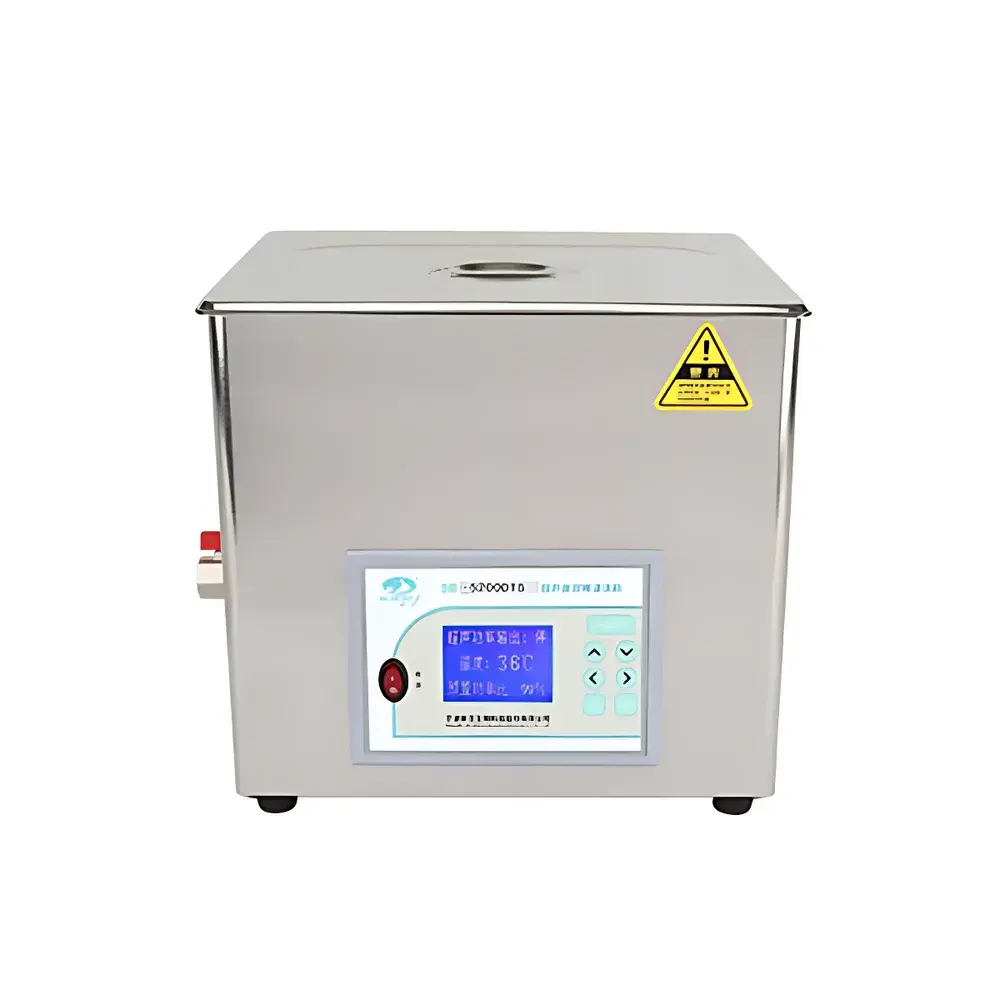
Ningbo Scientz SB-5200DTS Dual-Frequency Ultrasonic Cleaner
| Brand | Scientz |
|---|---|
| Origin | Zhejiang, China |
| Manufacturer Type | Direct Manufacturer |
| Instrument Type | General-Purpose Ultrasonic Cleaner |
| Tank Capacity | 10 L |
| Ultrasonic Frequencies | 25 kHz / 40 kHz |
| Ultrasonic Power Output | 240 W / 360 W |
| Power Adjustment Range | 40–100% |
| Temperature Control Range | Ambient to 80 °C |
| Timer Function | Fixed (non-adjustable) |
| Sound-Dampening Lid | Included |
| Drain & Fill Ports | Equipped |
Overview
The Ningbo Scientz SB-5200DTS Dual-Frequency Ultrasonic Cleaner is an engineered laboratory-grade cleaning system designed for high-reproducibility removal of particulate contaminants, organic residues, and adsorbed films from complex-surface substrates. It operates on the principle of acoustic cavitation—where high-frequency mechanical vibrations (25 kHz and 40 kHz) are transmitted into a liquid medium via piezoelectric transducers bonded to the stainless-steel tank base. These vibrations generate transient microbubbles that grow and collapse violently under alternating pressure cycles, producing localized shockwaves (~1000 atm) and microjet streams (>400 m/s) capable of penetrating blind holes, capillary channels, and micro-textured surfaces. Unlike single-frequency systems, dual-frequency operation mitigates standing-wave node formation and enables broader spectral energy distribution—enhancing cleaning uniformity across heterogeneous sample geometries and improving particle detachment efficiency in both low-viscosity solvents (e.g., water, ethanol) and moderately viscous aqueous detergents.
Key Features
- Dual-frequency capability (25 kHz and 40 kHz) supports application-specific optimization: lower frequency for aggressive macro-contaminant removal (e.g., machining oils, carbon deposits), higher frequency for gentle yet effective cleaning of delicate optics and microfluidic components.
- Adjustable ultrasonic power output (40–100% of rated capacity) allows precise energy modulation to prevent erosion of soft substrates (e.g., polymer microplates, anodized aluminum) while maintaining cleaning efficacy.
- Integrated heating system with digital PID temperature control (ambient to 80 °C) accelerates dissolution kinetics of waxy or hydrophobic residues and improves surfactant performance in aqueous cleaning formulations.
- Stainless-steel tank (304 grade) with sound-dampening lid reduces ambient noise emission to ≤65 dB(A) at 1 m distance—meeting ISO 7779-compliant acoustic requirements for shared laboratory environments.
- Front-panel digital display shows real-time bath temperature and remaining cycle duration; automatic shutdown upon completion ensures compliance with unattended operation protocols under GLP guidelines.
- Standard drain and fill ports enable rapid solution exchange and integration with recirculating filtration units for extended batch processing or solvent recovery workflows.
Sample Compatibility & Compliance
The SB-5200DTS accommodates a wide range of laboratory and industrial substrates—including borosilicate glassware (vials, cuvettes, pipette tips), stainless-steel surgical instruments, silicon wafers, quartz optical components, and precision-machined metal parts. Its non-contact cleaning mechanism preserves dimensional integrity and surface finish without abrasive media or mechanical scrubbing. The unit complies with IEC 61000-6-3 (EMC emissions) and IEC 61010-1 (safety requirements for electrical equipment). When operated with validated cleaning agents and documented parameters, it supports adherence to ASTM D2603 (ultrasonic cleaning verification), ISO 15883-1 (washer-disinfectors), and USP (cleaning validation for pharmaceutical equipment).
Software & Data Management
While the SB-5200DTS operates via embedded firmware without external PC connectivity, its digital interface logs critical operational parameters—including actual temperature, nominal power setting, and elapsed time—for manual entry into electronic lab notebooks (ELNs). The device supports audit-trail-ready documentation when paired with standardized SOPs covering calibration (temperature sensor verification per ISO/IEC 17025), preventive maintenance (transducer impedance checks every 6 months), and cleaning validation (residue testing per USP ). Optional RS-232 or USB-to-serial adapters may be integrated for third-party data acquisition systems requiring timestamped parameter logging.
Applications
- Routine decontamination of volumetric glassware, centrifuge tubes, and HPLC sample vials prior to trace-level analysis.
- Pre-analytical preparation of tissue homogenates and cell lysates where mechanical shear must be minimized.
- Cleaning of MEMS devices, semiconductor masks, and photomask blanks prior to lithography steps.
- Removal of biofilm and proteinaceous residue from reusable endoscopic components in clinical research settings.
- Surface activation of polymeric substrates before plasma treatment or coating deposition.
- Ultrasonic-assisted degassing of mobile phases and calibration standards in analytical chemistry workflows.
FAQ
Is the timer programmable?
No—the SB-5200DTS features a fixed-duration operation mode; users must manually initiate and terminate cycles.
Can the unit operate continuously for extended periods?
Yes, continuous operation up to 8 hours is supported under ambient conditions ≤30 °C and relative humidity <70%, provided cooling airflow around the transducer housing remains unobstructed.
What cleaning solutions are compatible?
Aqueous alkaline, neutral, or mild acidic detergents are recommended; avoid halogenated solvents, strong oxidizers (e.g., concentrated HNO₃), and undiluted ethanol above 70% v/v to prevent transducer delamination.
Does the unit include temperature calibration certification?
Factory calibration is performed using NIST-traceable RTD probes; users should verify accuracy annually with a secondary calibrated thermometer per ISO/IEC 17025 internal quality procedures.
How often should the tank be descaled?
In hard-water regions, descaling with 5% citric acid solution is advised every 200 operating hours or monthly—whichever occurs first—to maintain cavitation efficiency and prevent transducer thermal impedance drift.



