
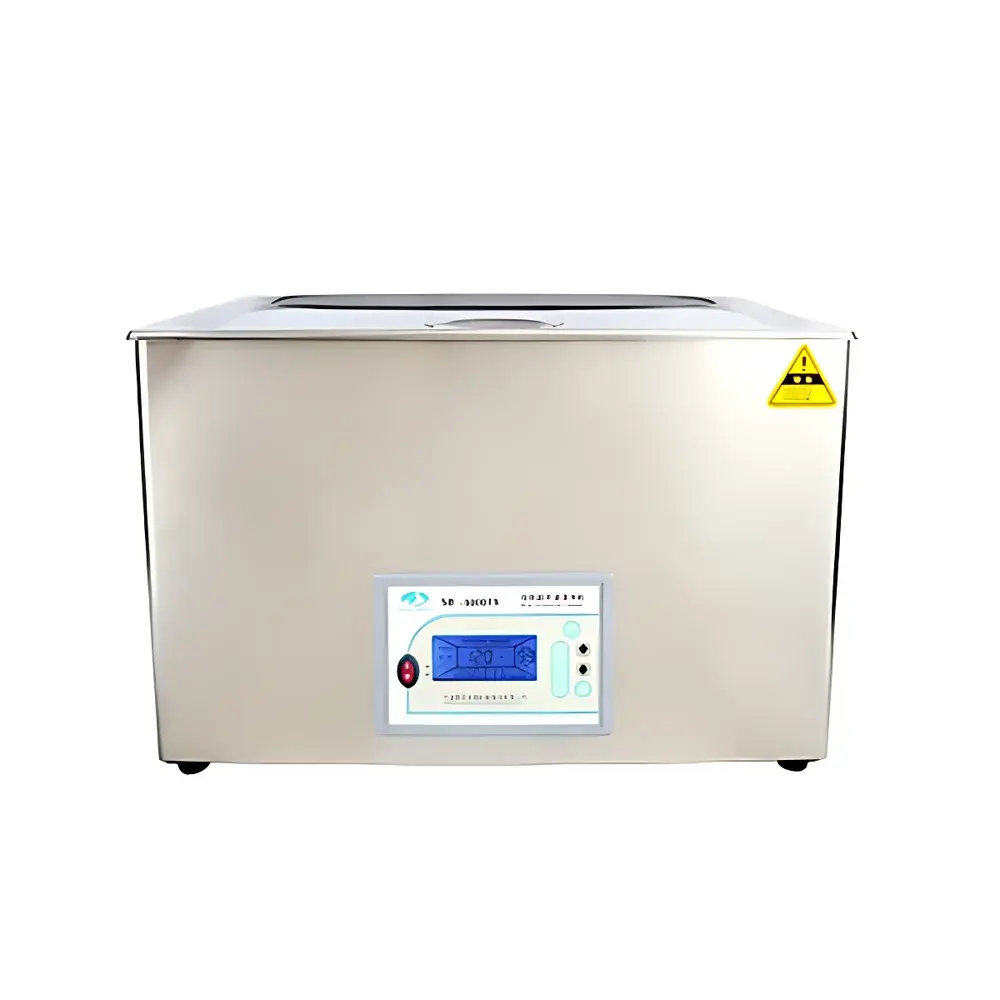
Ningbo Scientz SB-800DTS Dual-Frequency Ultrasonic Cleaner
| Brand | Scientz |
|---|---|
| Origin | Zhejiang, China |
| Manufacturer Type | Direct Manufacturer |
| Instrument Type | General-Purpose Ultrasonic Cleaner |
| Tank Capacity | 6 L |
| Ultrasonic Frequencies | 25 kHz / 40 kHz |
| Ultrasonic Power Output | 180 W |
| Power Adjustment | Not Adjustable |
| Temperature Range | Ambient to 80 °C |
| Timer Function | Not Adjustable |
| Sound-Dampening Lid | Included |
| Drain & Fill Fitting | Equipped |
Overview
The Ningbo Scientz SB-800DTS Dual-Frequency Ultrasonic Cleaner is an engineered laboratory-grade cleaning system designed for reproducible, non-contact removal of particulate, organic, and oily contaminants from complex-surface substrates. It operates on the principle of acoustic cavitation—where high-frequency sound waves (25 kHz and 40 kHz) propagate through a liquid medium, generating transient microbubbles that collapse violently near solid surfaces. This implosive collapse produces localized shockwaves and microstreaming forces capable of dislodging sub-micron residues from blind holes, capillary channels, threaded interfaces, and porous matrices without mechanical abrasion or surface erosion. Unlike single-frequency systems, the dual-frequency capability enables broad-spectrum cleaning efficacy: lower frequency (25 kHz) delivers higher energy per cavitation event—ideal for robust removal of heavy particulates and greases—while the higher frequency (40 kHz) offers finer spatial resolution and reduced surface stress, making it suitable for delicate optics, microfluidic devices, and precision instrumentation components.
Key Features
- Dual-frequency transducer array (25 kHz and 40 kHz) optimized for simultaneous or selectable operation, enabling process flexibility across diverse sample classes
- Stainless steel tank (6 L capacity) with reinforced corners and seamless welds for long-term chemical resistance and structural integrity
- Integrated heating system with PID-controlled temperature regulation (ambient to 80 °C), supporting thermally enhanced cleaning protocols for waxy or polymerized residues
- Acoustically damped hinged lid with gasketed seal to reduce ambient noise emission and prevent solvent evaporation during extended cycles
- Front-panel digital display showing real-time bath temperature and remaining cycle time; supports manual start/stop and visual status feedback
- Standard drain valve and fill port for rapid solution exchange—compatible with deionized water, aqueous detergents, and low-volatility solvents
- Over-temperature and dry-run protection circuits to safeguard transducers and user safety in unattended operation
Sample Compatibility & Compliance
The SB-800DTS accommodates a wide range of laboratory and industrial substrates including borosilicate glassware (vials, cuvettes, pipette tips), stainless steel surgical instruments, titanium dental tools, quartz optical components, MEMS devices, printed circuit boards (PCBs), and polymer-based microplates. Its cleaning performance aligns with common laboratory quality requirements for residue-free preparation prior to analytical workflows (e.g., HPLC vial conditioning, SEM sample mounting, or ICP-MS digestion vessel cleaning). While not certified to ISO 13485 or FDA 21 CFR Part 11 out-of-the-box, the instrument’s stable thermal control, repeatable timing (via external timer integration), and documented operational parameters support GLP-compliant documentation when used within validated SOPs. Users performing medical device reprocessing should verify compatibility with local regulatory guidance (e.g., AAMI ST79, EN ISO 15883).
Software & Data Management
The SB-800DTS is a standalone analog-digital hybrid unit with no embedded firmware or network connectivity. All operational parameters—including temperature setpoint and elapsed time—are monitored via a dedicated LED display; no data logging, remote control, or audit trail functionality is included. For laboratories requiring traceability, integration with external environmental monitoring systems (e.g., Vaisala viewLinc or DeltaTrak) is feasible using optional PT100 probe inputs (not supplied). The absence of software does not preclude compliance: many QC/QA labs successfully deploy this model under paper-based or Excel-tracked validation protocols, particularly where cleaning validation focuses on physical endpoint verification (e.g., water-break test, UV fluorescence inspection, or gravimetric residue analysis).
Applications
- Routine decontamination of volumetric glassware, centrifuge tubes, and filtration housings prior to sterilization or reuse
- Pre-analytical sample preparation: degassing mobile phases, dispersing nanomaterials, homogenizing tissue lysates, and extracting analytes from solid matrices
- Maintenance of high-precision metrology equipment—cleaning interferometer mirrors, laser cavity optics, and calibration standards
- Reprocessing of reusable medical instruments in low-to-medium risk categories (e.g., dental handpieces, orthodontic pliers) following AAMI-recommended detergent and exposure guidelines
- Restoration of antique or high-value items—including watch movements, gemstone settings, and museum-grade metal artifacts—without compromising patina or dimensional fidelity
FAQ
Is the ultrasonic power output adjustable on the SB-800DTS?
No. The unit delivers a fixed 180 W nominal acoustic power output at either selected frequency. Power modulation is not supported.
Can the SB-800DTS be used with flammable solvents?
Not recommended. The heater and transducer design are intended for aqueous or high-flashpoint solutions only. Use in explosive atmospheres requires explosion-proof certification not provided with this model.
What is the expected service life of the transducers under continuous use?
When operated within specified temperature and duty-cycle limits (≤ 8 hours/day, ≤ 80 °C), transducers typically maintain >90% nominal efficiency for 5+ years based on field data from comparable Scientz models.
Does the unit include a degassing mode?
No dedicated degassing cycle is implemented. However, initiating ultrasonication at room temperature for 2–5 minutes before heating effectively removes dissolved gases from aqueous baths.
Is third-party calibration or verification available?
Yes. Independent metrology labs can perform acoustic output mapping (per ASTM E1000) and temperature uniformity profiling (per ISO/IEC 17025) using calibrated hydrophones and PT100 arrays—though such services are not offered by Scientz directly.



