
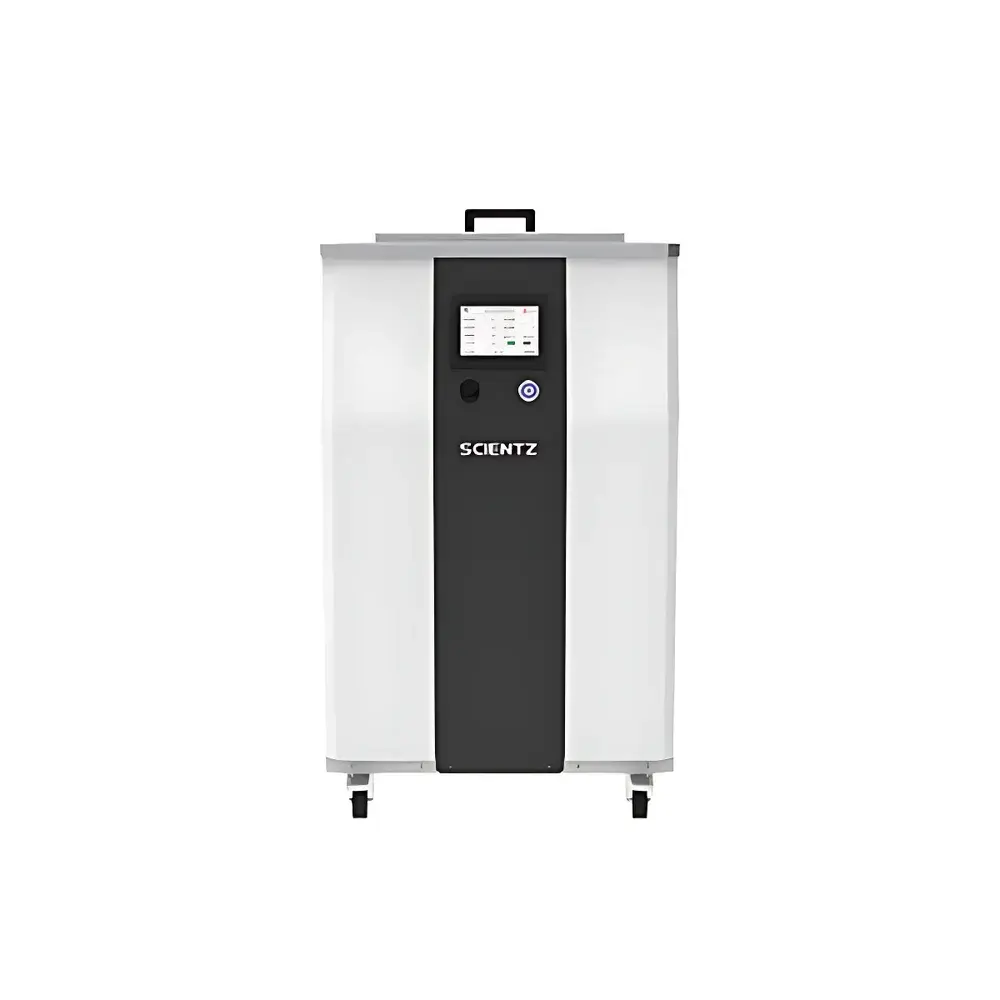
Ningbo Scientz SBL-90DT Benchtop Ultrasonic Cleaner with Heated & Cooled Temperature Control
| Brand | Ningbo Scientz |
|---|---|
| Origin | Zhejiang, China |
| Manufacturer Type | OEM/ODM Manufacturer |
| Instrument Type | General-Purpose Ultrasonic Cleaner |
| Tank Capacity | 90 L |
| Ultrasonic Frequency | 40 kHz |
| Ultrasonic Power Output | 1500 W |
| Power Adjustment | Yes (1–99% continuous) |
| Temperature Control Range | 5–80 °C (Heating & Active Cooling) |
| Timer Range | 1–9999 min |
| Lid with Sound-Dampening Design | Yes |
| Drain Option | Manual and Optional Automatic Drain Kit |
| Compliance | CE-marked |
Overview
The Ningbo Scientz SBL-90DT is a high-capacity benchtop ultrasonic cleaner engineered for reproducible, non-destructive cleaning of delicate and complex laboratory, industrial, and medical components. It operates on the principle of acoustic cavitation: high-frequency mechanical vibrations (40 kHz) generated by piezoelectric transducers are transmitted through an aqueous or solvent-based cleaning medium, inducing rapid formation and implosive collapse of microscopic vapor cavities. This transient collapse releases localized energy in the form of micro-jets and shockwaves—mechanically dislodging particulate contaminants, organic residues, biofilms, and adsorbed oils from surfaces, crevices, blind holes, and microstructures without abrasive contact. Unlike passive soaking or manual scrubbing, this process achieves uniform cleaning efficacy across geometrically challenging substrates—including glassware interiors, microfluidic channels, optical lenses, and surgical instruments—while preserving surface integrity and dimensional accuracy.
Key Features
- 90-liter stainless steel tank (304 grade) with reinforced corner welds and integrated transducer mounting for long-term structural stability and acoustic coupling efficiency.
- Digitally controlled temperature management system featuring both resistive heating (up to 80 °C) and thermoelectric cooling (down to 5 °C), enabling precise thermal conditioning of cleaning baths for optimized solubility, enzymatic activity, or cold-sensitive sample handling.
- Full-touch HMI interface with real-time display of elapsed time, set time, actual bath temperature, and active ultrasonic power level (1–99% adjustable in 1% increments).
- Intelligent power memory function: automatically recalls last-used settings—including time, temperature, and power—after power interruption, supporting GLP-compliant workflow continuity.
- Acoustically insulated lid with ergonomic latch mechanism reduces ambient noise to ≤55 dB(A) at 1 m distance and prevents solvent evaporation during extended cycles.
- Configurable drain options: standard manual valve plus optional motorized auto-drain kit for unattended batch processing and integration into multi-step cleaning protocols.
Sample Compatibility & Compliance
The SBL-90DT accommodates a broad range of materials including borosilicate glass, fused quartz, stainless steel (304/316), titanium alloys, anodized aluminum, silicone elastomers, and most common polymers (e.g., PTFE, PP, PC). It is routinely deployed in ISO 13485-certified medical device reprocessing workflows and meets key safety and electromagnetic compatibility requirements per IEC 61010-1 (Electrical Safety for Laboratory Equipment) and IEC 61000-6-3 (EMI Emission Limits). While not certified as a Class II medical device under FDA 21 CFR Part 820, its design supports validation documentation required for GMP-compliant cleaning processes—including temperature mapping, ultrasonic intensity profiling (per ASTM E1733-95), and cycle traceability when paired with external data loggers.
Software & Data Management
The SBL-90DT operates via embedded firmware with no proprietary PC software dependency. All operational parameters are stored in non-volatile memory and accessible via front-panel interface. For audit-ready environments, optional RS-232 or USB-to-serial interfaces enable connection to third-party SCADA or LIMS systems for timestamped event logging (start/stop, temperature deviation >±2 °C, timeout alerts). Firmware supports user-defined protocol presets (up to 10), each storing independent combinations of time, temperature, and power—facilitating repeatable execution of SOP-defined cleaning sequences compliant with USP and ISO 15883-1 guidelines.
Applications
- Pre-analytical preparation: degassing mobile phases, cleaning HPLC vials, sonication-assisted dissolution of standards, and removal of residual solvents from GC autosampler vials.
- Biotechnology: cell lysis optimization (with controlled amplitude and pulse mode), DNA shearing for NGS library prep, and homogenization of tissue suspensions prior to centrifugation.
- Quality control labs: cleaning of calibration standards, reference material containers, and volumetric glassware to eliminate carryover artifacts in trace elemental analysis (ICP-MS, AAS).
- Medical device manufacturing: post-machining deburring of orthopedic implants, cleaning of endoscopic channels, and removal of lubricants from precision dental handpieces.
- Optics and microelectronics: residue-free cleaning of photomasks, MEMS wafers, and fiber optic connectors prior to coating or bonding steps.
FAQ
What is the recommended cleaning solution for general labware?
Aqueous alkaline detergent solutions (pH 9–11) are optimal for organic soils; deionized water suffices for particulate removal. Avoid chlorinated or highly acidic solvents unless verified compatible with 304 stainless steel and transducer encapsulation.
Can the SBL-90DT be used for sterilization?
No—it performs cleaning and disinfection-level bioburden reduction but does not achieve sterility assurance (SAL ≤10⁻⁶). Autoclaving or ethylene oxide treatment remains required for terminal sterilization.
Is calibration support available?
Scientz provides transducer output verification reports (cavitation intensity mapping per ASTM E1733) and temperature sensor calibration certificates (traceable to NIST standards) upon request.
How often should the tank solution be changed?
Change frequency depends on soil load and bath temperature; typical practice is daily replacement for high-throughput labs or after 8–10 cycles in low-contamination settings. Conductivity monitoring is advised to detect dissolved solids accumulation.
Does the unit support external timer integration?
Yes—via dry-contact relay output (NO/NC), enabling synchronization with robotic arms, fill stations, or PLC-controlled wash-rinse-dry sequences.



