
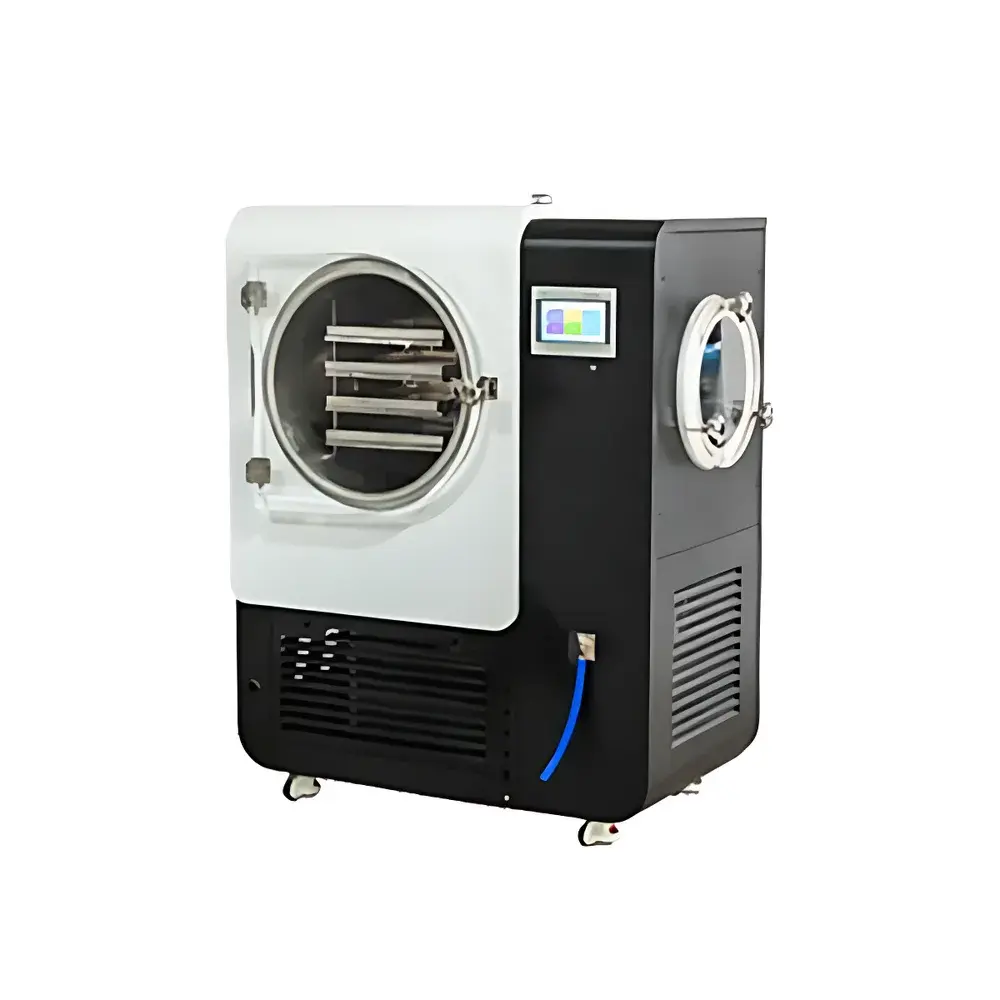
Ningbo Scientz SCIENTZ-100YG/A Benchtop Silicon-Oil Heated Pilot-Scale Freeze Dryer
| Brand | Ningbo Scientz |
|---|---|
| Origin | Zhejiang, China |
| Manufacturer Type | OEM Manufacturer |
| Instrument Type | Shelf-Type (Non-Contact Heating) |
| Application Scope | Pilot-Scale Processing |
| Lyophilization Area | 0.21 m² |
| Ultimate Vacuum (No Load) | ≤5 Pa |
| Condensate Capacity (24 h) | 4 kg/24 h |
| Cold Trap Temperature (No Load) | ≤−70 °C |
| Dimensions (L×W×H) | 750 × 640 × 1200 mm |
Overview
The Ningbo Scientz SCIENTZ-100YG/A is a pilot-scale, silicon-oil heated, in-situ freeze dryer engineered for reproducible lyophilization of thermally sensitive biological, pharmaceutical, and environmental samples under controlled vacuum and thermal conditions. It operates on the fundamental principle of sublimation—removing water from frozen samples via phase transition directly from solid to vapor under low-pressure conditions—while maintaining structural integrity and bioactivity. Unlike resistive-heated systems, this model employs a closed-loop silicon-oil circulation system to deliver precise, uniform heat transfer across stainless-steel shelves, enabling accurate control over primary drying (sublimation) and secondary drying (desorption) phases. Its integrated cold trap and drying chamber design minimizes footprint while preserving mechanical rigidity and thermal isolation—critical for process development, method validation, and small-batch production in regulated environments.
Key Features
- Stainless-steel (SUS304) structural frame with welded square tubing for long-term corrosion resistance and mechanical stability
- Silicon-oil heating system with PID temperature algorithm, achieving ±3 °C shelf temperature uniformity during both heating and cooling cycles
- Programmable freeze-drying protocol support: up to 40 temperature segments per cycle, with configurable ramp rates, hold times, and pressure setpoints
- PLC-based control architecture with color touchscreen interface, real-time parameter visualization (shelf temperature, cold trap temperature, chamber pressure, oil temperature), and event-driven alarm logging
- Three-tier user permission management (Operator / Technician / Administrator) compliant with GLP documentation requirements
- Automated vacuum sequencing logic: vacuum pump activation delayed until cold trap reaches preset temperature, extending pump service life and reducing oil contamination risk
- Transparent polycarbonate drying chamber—single-piece molded, non-adhesive, high-clarity, chemically resistant—enabling full visual monitoring without compromising vacuum integrity
- Integrated inert gas purging port (optional N₂ or Ar connection) for oxygen-sensitive sample handling and residual moisture control
Sample Compatibility & Compliance
The SCIENTZ-100YG/A accommodates diverse sample formats including vials (2–20 mL), Petri dishes, flasks, and custom trays—suitable for lyophilizing microbial cultures, plant extracts, serum proteins, nucleic acids, soil matrices, food homogenates, and pharmaceutical intermediates. Its design supports compliance with key international standards for analytical sample preparation: ASTM D4294 (soil moisture analysis), ISO 11348 (toxicity testing with freeze-dried bioreporters), USP (sterile product lyophilization), and FDA 21 CFR Part 11 when paired with audit-trail-enabled software. All critical parameters—including vacuum level, shelf temperature, and condenser performance—are digitally recorded with timestamped metadata, facilitating traceability and regulatory review.
Software & Data Management
Freeze-drying protocols and real-time sensor data are automatically logged to internal storage and exportable via USB drive in CSV format. Optional PC-based upper-computer software enables remote monitoring, historical curve overlay comparison, batch report generation (PDF/Excel), and electronic signature integration. Data retention includes full cycle logs, alarm history (with cause codes), pump runtime counters, and calibration verification timestamps. Optional UPS backup ensures uninterrupted operation during brief power interruptions—preserving sample integrity and process continuity.
Applications
- Academic & research institutions: lyophilization of bacterial/fungal cultures, plant tissue sections, RNA/DNA libraries, and protein standards for structural biology
- Food science labs: dehydration of functional ingredients (probiotics, enzymes, antioxidants), shelf-life stability studies, and texture preservation analysis
- Environmental testing: soil/sediment sample stabilization prior to heavy metal speciation or organic contaminant extraction
- Pharmaceutical R&D: formulation screening of injectables, excipient compatibility testing, and lyo-cycle optimization for monoclonal antibodies
- Cultural heritage conservation: controlled dehydration of water-damaged archival documents and parchment without dimensional distortion
- Government laboratories: residue analysis (e.g., pesticide metabolites in produce), forensic evidence preservation, and reference material preparation
FAQ
What is the maximum batch capacity for vial-based processing?
The 0.21 m² shelf area supports approximately 1,200 standard 10-mL vials (arranged in 3×4 arrays per tray), depending on vial height and spacing requirements.
Is the system compatible with GMP documentation workflows?
Yes—when configured with optional audit-trail software and electronic signature modules, it meets ALCOA+ data integrity principles and supports 21 CFR Part 11 compliance for regulated environments.
Can the cold trap temperature be lowered beyond −70 °C?
An optional cascade refrigeration unit is available to achieve ≤−80 °C cold trap performance, enhancing condensation efficiency for solvents with higher vapor pressure (e.g., ethanol, acetone).
Does the system support automated pressure rise test (PRT) functionality?
While not built-in, PRT can be implemented manually via timed vacuum hold-and-monitor sequences; third-party software add-ons provide automated PRT scripting and pass/fail evaluation.
What maintenance intervals are recommended for the vacuum pump?
Vacuum pump oil replacement is advised every 500 operational hours or semiannually—whichever occurs first—with runtime tracking embedded in the control system.



