
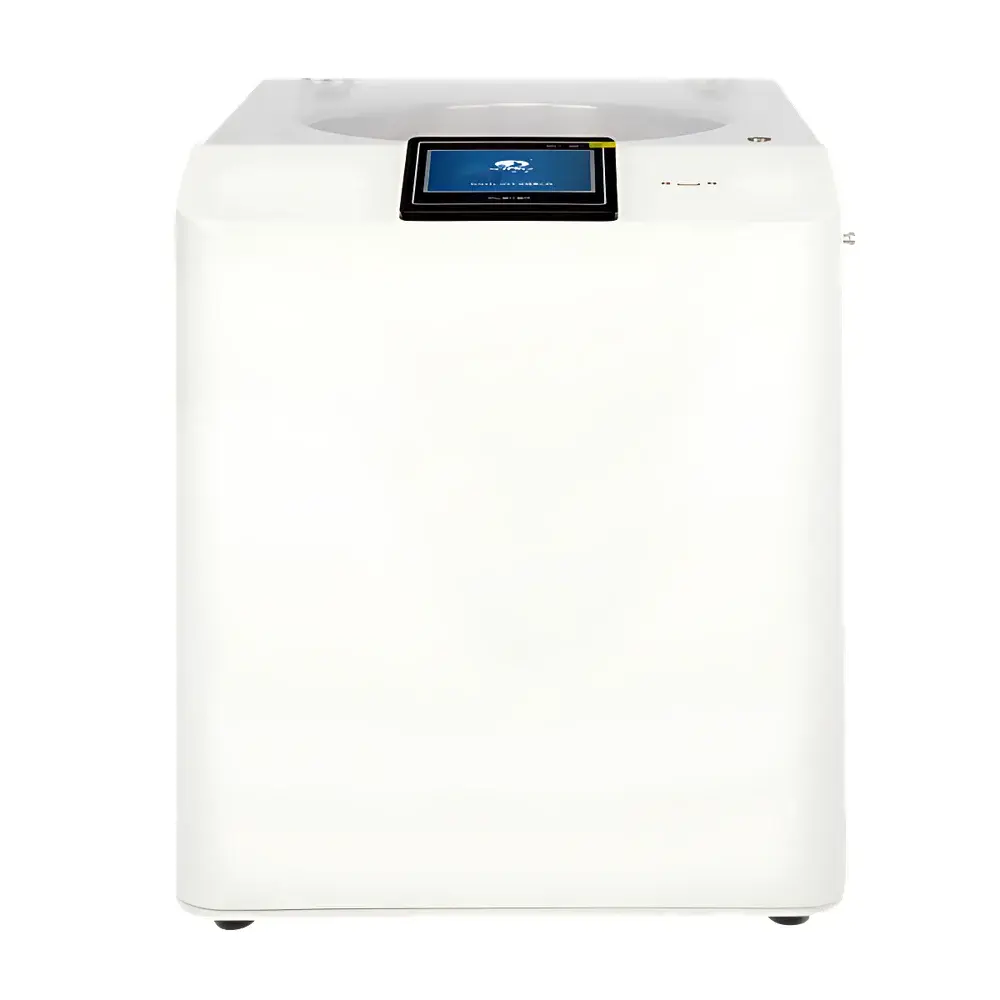
Ningbo Scientz SCIENTZ-10LS Split-type Vacuum Centrifugal Concentrator
| Brand | Ningbo Scientz |
|---|---|
| Origin | Zhejiang, China |
| Manufacturer Type | Direct Manufacturer |
| Product Category | Domestic |
| Model | SCIENTZ-10LS |
| Instrument Type | Standard Shelf-type Freeze Dryer |
| Scale | Pilot-scale |
| Lyophilization Area | 0.21 m² |
| Ultimate Vacuum (No-load) | ≤5 Pa |
| Condensate Capacity (24 h) | 4 kg/24 h |
| Cold Trap Temperature (No-load) | ≤−70 °C |
| Dimensions (L×W×H) | 750 × 640 × 1200 mm |
Overview
The Ningbo Scientz SCIENTZ-10LS Split-type Vacuum Centrifugal Concentrator is an engineered solution for solvent removal and sample concentration under controlled low-temperature vacuum conditions. Unlike conventional rotary evaporators or standalone freeze dryers, this system integrates centrifugal force with deep-vacuum and cryogenic condensation to prevent sample bumping, foaming, or cross-contamination during volatile solvent evaporation. Its operational principle relies on the physical relationship between vapor pressure and boiling point: as chamber pressure decreases below 5 Pa, solvents such as ethanol, acetone, ethyl acetate, and aqueous buffers undergo phase transition at sub-zero temperatures—typically −30 °C to −60 °C—while centrifugal acceleration (up to 2,500 × g, depending on rotor configuration) maintains sample integrity within tubes or microplates. Designed specifically for pilot-scale laboratory workflows, the SCIENTZ-10LS supports batch processing of up to 96 × 1.5 mL tubes or equivalent multi-well formats, making it suitable for translational research environments where reproducibility, scalability, and regulatory traceability are critical.
Key Features
- Split-system architecture: Separates the centrifugal concentrator unit from the ultra-low temperature cold trap (≤−70 °C), enabling modular installation, improved thermal isolation, and simplified maintenance.
- Vacuum-integrated centrifugation: Dual-axis motor control synchronizes rotor speed and vacuum ramping to minimize aerosol generation and ensure consistent pellet retention across heterogeneous sample types.
- Intelligent vacuum regulation: Digital pressure feedback loop dynamically adjusts vacuum pump output to maintain setpoint stability within ±0.3 Pa—critical for heat-labile biomolecules including nucleic acids and monoclonal antibodies.
- Programmable temperature management: Peltier-cooled rotor chamber and refrigerated condenser operate independently; users may define multi-step temperature profiles (e.g., −10 °C hold → −40 °C ramp) to optimize desolvation kinetics.
- Corrosion-resistant construction: 316L stainless steel centrifuge chamber, fluoropolymer-coated internal tubing, and chemically inert rotor materials (aluminum alloy with electropolished finish) ensure compatibility with organic solvents and acidic/basic buffers.
Sample Compatibility & Compliance
The SCIENTZ-10LS accommodates standard microcentrifuge tubes (0.2–50 mL), PCR strips, deep-well plates, and custom adapters for lyophilization vials. It is routinely deployed in GLP-compliant laboratories for pre-analytical sample preparation prior to LC-MS, NMR, or enzymatic activity assays. While not certified as a medical device, its vacuum and temperature performance aligns with key parameters referenced in ASTM F2457 (Standard Practice for Determining Residual Moisture in Lyophilized Biological Products) and ISO 22081 (Biotechnology — Freeze-drying process validation). When integrated with N/ND-series freeze dryers or external −80 °C cold traps, the system meets minimum requirements for USP sterile processing support and FDA 21 CFR Part 11 audit-trail readiness when paired with Scientz’s optional data logging software.
Software & Data Management
The instrument operates via an embedded 7-inch capacitive touchscreen interface with real-time graphing of vacuum pressure, chamber temperature, rotor speed, and elapsed time. All parameter sets—including up to 20 user-defined methods—are stored with timestamped metadata (operator ID, date/time, firmware version). Optional Ethernet or RS-485 connectivity enables remote monitoring and integration into LIMS or ELN platforms. Raw sensor logs export in CSV format; event-triggered alarms (e.g., vacuum breach >10 Pa, condenser overload) generate automatic email notifications when configured with SMTP server credentials. Audit trail functionality complies with ALCOA+ principles for data integrity in regulated environments.
Applications
- Concentration and desalting of DNA/RNA extracts prior to sequencing library preparation or qPCR.
- Removal of acetonitrile or methanol from HPLC fractions without thermal degradation of metabolites.
- Stabilization of labile enzyme inhibitors or peptide conjugates through gentle solvent exchange.
- Preparative-scale purification of monoclonal antibodies and immunoglobulin G (IgG) fractions from cell culture supernatants.
- High-throughput sample conditioning for clinical biomarker discovery workflows requiring strict batch consistency.
FAQ
Can the SCIENTZ-10LS perform full lyophilization cycles without external equipment?
No. As a vacuum centrifugal concentrator, it requires coupling with a compatible cold trap (e.g., Scientz CT-40 or CT-60 series) or integration with N/ND-series freeze dryers to achieve primary drying and secondary drying phases required for true lyophilization.
What rotor configurations are supported out-of-the-box?
Standard delivery includes a 24-position aluminum rotor for 1.5–2.0 mL tubes. Optional accessories include 48-position microplate rotors, 12-position 15-mL conical tube carriers, and custom-fit adapters for 96-well PCR plates.
Is the system compliant with 21 CFR Part 11 for electronic records?
The base unit provides electronic signatures, audit trails, and secure user authentication only when equipped with Scientz’s validated DataMaster Pro software package and configured with role-based access controls and encrypted database storage.
How is calibration verified for vacuum and temperature sensors?
Vacuum transducers are factory-calibrated against NIST-traceable barometric standards; temperature probes are certified per ISO/IEC 17025 by third-party metrology labs. Annual recalibration services are available through authorized Scientz service centers.



