
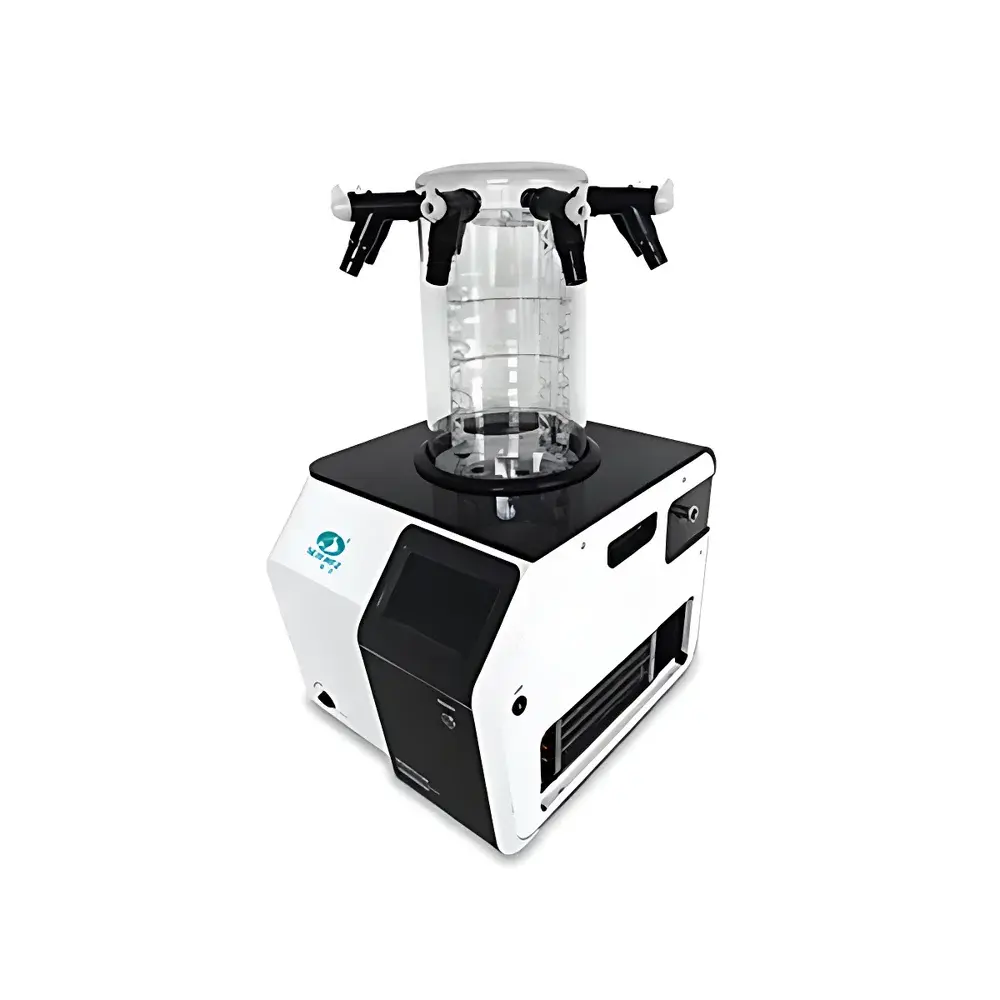
Ningbo Scientz SCIENTZ-10ND/C Benchtop Manifold Freeze Dryer with Heated Shelf and -56°C Cold Trap
| Brand | Scientz |
|---|---|
| Origin | Zhejiang, China |
| Manufacturer Type | Direct Manufacturer |
| Instrument Type | Manifold Freeze Dryer with Hydraulic Press Cap (Optional) |
| Application | Laboratory-Scale Lyophilization |
| Freeze-Drying Area | 0.12 m² |
| Ultimate Vacuum (Empty Chamber) | ≤5 Pa |
| Condenser Capacity | 3 kg/24 h |
| Cold Trap Temperature (Empty) | ≤−56°C |
| Dimensions (L×W×H) | 590 × 460 × 400 mm + 440 mm (Chamber Height) |
| Compressor | Imported High-Efficiency Refrigeration Compressor |
| Control Interface | 7-inch Full-Color TFT Touchscreen |
| Heating System | 36 V Silicone Rubber Heated Shelf with PID Temperature Control |
| Chamber Material | One-Piece Molded Polycarbonate (Optically Transparent, Corrosion-Resistant, Hermetic Seal) |
| Manifold Ports | 8 Standard Ø24 mm Neck Ports (Compatible with ASTM D3222 / ISO 8536-4 Vials) |
Overview
The Scientz SCIENTZ-10ND/C is a compact, benchtop manifold freeze dryer engineered for precision lyophilization in academic, governmental, and early-stage biopharmaceutical laboratories. It operates on the fundamental principle of sublimation under controlled vacuum and low-temperature conditions: frozen aqueous samples are dried without passing through the liquid phase, preserving structural integrity, biological activity, and chemical stability of thermolabile compounds such as proteins, nucleic acids, vaccines, enzymes, and live microorganisms. The system integrates a high-efficiency imported refrigeration compressor, a heated shelf with programmable PID control, and an optically transparent polycarbonate drying chamber—enabling real-time visual monitoring of ice sublimation and cake formation. Designed for reproducibility and operational safety, it meets core functional requirements for method development, small-batch process optimization, and sample preparation prior to analytical testing (e.g., HPLC, GC-MS, SEM, or PCR). Its modular architecture supports seamless integration into GLP-compliant workflows when paired with validated data logging and audit-trail-enabled software.
Key Features
- Heated shelf with precise 36 V low-voltage silicone rubber heating elements and adaptive PID temperature regulation—eliminates thermal overshoot and ensures uniform heat transfer across the 0.12 m² drying surface.
- High-performance cold trap operating at ≤−56°C (empty), capable of condensing up to 3 kg of water vapor per 24-hour cycle; optional −80°C dual-stage cascade refrigeration system available for low-eutectic-point formulations.
- 7-inch full-color TFT touchscreen interface with industrial-grade embedded OS—displays real-time cold trap temperature, shelf temperature, chamber pressure, and elapsed time; supports multi-step program storage (up to 32 profiles).
- One-piece molded optical-grade polycarbonate drying chamber—chemically inert, impact-resistant, fully transparent, and hermetically sealed; allows unobstructed observation of sublimation front progression and cake morphology.
- Eight standardized Ø24 mm manifold ports compliant with ISO 8536-4 and ASTM D3222 vial dimensions; accommodates both stoppered and valve-sealed glass vials; includes quick-release clamps and inert gas purge valve (N₂ or Ar compatible).
- Intelligent vacuum management: automatic pump start delay until cold trap reaches setpoint (prevents oil backstreaming); optional oil mist filter and auto differential-pressure valve for extended pump service life.
Sample Compatibility & Compliance
The SCIENTZ-10ND/C accommodates diverse sample formats—including serum vials (2–20 mL), microbiological culture tubes, tissue specimens in cryovials, botanical extracts, nanoparticle suspensions, and environmental matrices (soil slurries, wastewater solids). Its design adheres to foundational principles outlined in USP , ISO 22055, and ICH Q5C for lyophilized product stability assessment. While not certified for GMP manufacturing, its repeatable thermal and vacuum performance supports method qualification per FDA 21 CFR Part 11–enabled data acquisition systems (when used with optional Scientz DataLink software). The system is routinely deployed in ISO/IEC 17025-accredited labs for sample prep in food safety (AOAC 2012.01), clinical diagnostics (CLSI EP17-A2), and environmental analysis (EPA Method 531.1).
Software & Data Management
Data logging is performed automatically at user-defined intervals (1–60 s resolution) and stored onboard with ≥10,000-cycle history retention. All critical parameters—including shelf temperature, condenser temperature, chamber pressure, and elapsed time—are timestamped and exportable via USB flash drive in CSV format. Optional Scientz DataLink PC software enables graphical overlay of multiple lyophilization cycles, deviation alerts, and compliance-ready PDF report generation with digital signature fields. When configured with audit-trail mode, the system records operator ID, parameter changes, and event timestamps—aligning with ALCOA+ data integrity principles required under FDA 21 CFR Part 11 and EU Annex 11 for regulated research environments.
Applications
This freeze dryer serves as a primary tool in preclinical and analytical laboratories across disciplines: microbial strain preservation (ATCC protocols), viral vector stabilization (AAV, lentivirus), monoclonal antibody formulation screening, botanical extract concentration, nanomaterial dispersion preservation (preventing agglomeration), forensic tissue archiving, soil nutrient profiling (EPA SW-846 3540C), pesticide residue matrix preparation (EN 15662), and vaccine candidate lyophilization (WHO TRS 961 Annex 2). Its heated shelf capability facilitates controlled primary drying studies essential for establishing shelf-life models and optimizing secondary drying endpoints.
FAQ
What is the maximum sample volume per batch?
Based on the 0.12 m² shelf area and typical loading density (≤10 mm depth), the system supports up to 1.5 L of aqueous solution per cycle—subject to eutectic temperature and collapse temperature constraints.
Can the SCIENTZ-10ND/C be used for sterile processing?
No—it lacks ISO Class 5 cleanroom certification, integrated HEPA filtration, or SIP capability; it is intended for non-aseptic sample preparation only.
Is the polycarbonate chamber autoclavable?
No—polycarbonate degrades above 121°C; cleaning is performed with 70% ethanol or isopropanol followed by nitrogen purge.
Does the system support remote monitoring?
Yes—via optional Ethernet module and Scientz CloudLink API (RESTful interface), enabling integration with lab information management systems (LIMS) and centralized equipment dashboards.
What vacuum pump is recommended for optimal performance?
A two-stage rotary vane pump with ≤1×10⁻³ mbar ultimate vacuum and ≥12 m³/h pumping speed (e.g., Edwards RV8, Agilent TWISTRA 10) is advised; oil mist filtration strongly recommended for long-term reliability.



