
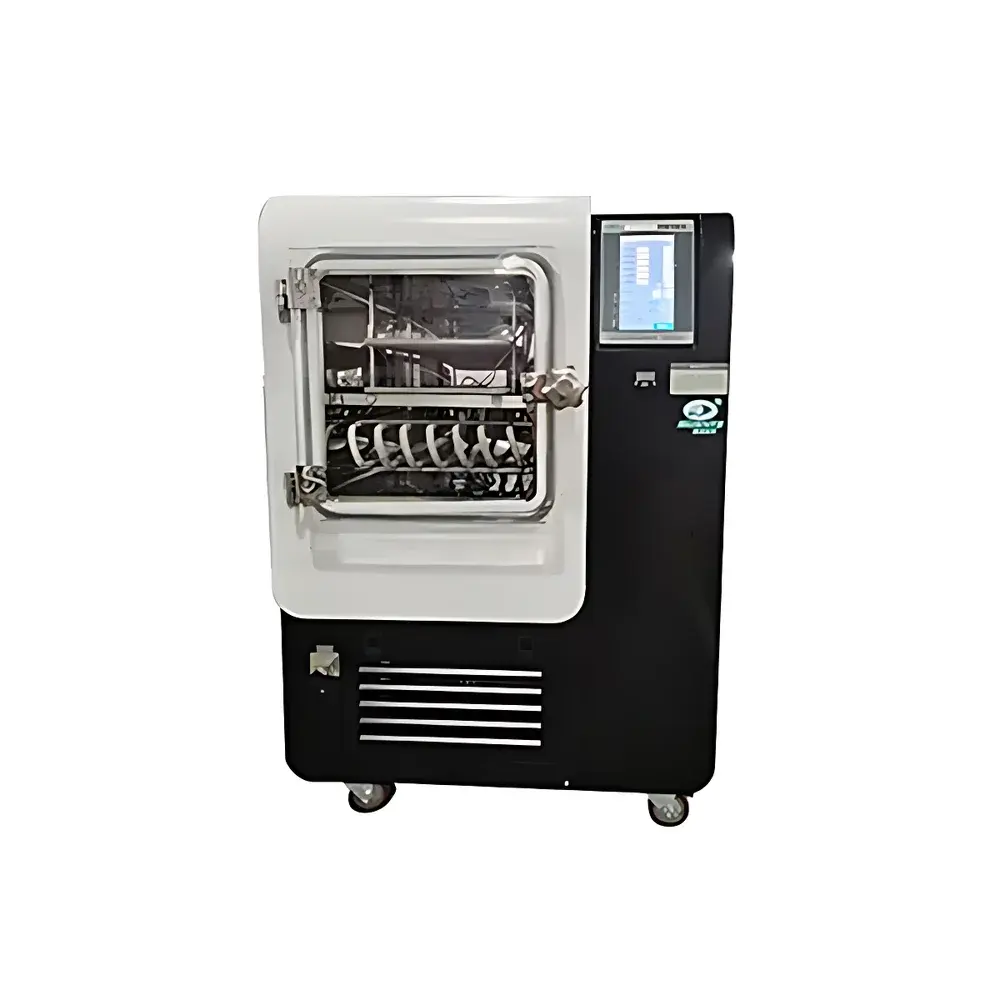
Ningbo Scientz SCIENTZ-10YG/A Pilot-Scale In-Situ Silicon Oil Heated Freeze Dryer
| Brand | Ningbo Scientz |
|---|---|
| Origin | Zhejiang, China |
| Manufacturer Type | OEM Manufacturer |
| Instrument Type | Shelf-Type Freeze Dryer |
| Application Scale | Pilot-Scale |
| Lyophilization Area | 0.21 m² |
| Ultimate Vacuum (No Load) | ≤5 Pa |
| Condensate Capacity (24 h) | 4 kg/24 h |
| Cold Trap Temperature (No Load) | ≤−70 °C |
| Dimensions (L×W×H) | 750 × 640 × 1200 mm |
Overview
The Ningbo Scientz SCIENTZ-10YG/A is a pilot-scale, in-situ freeze dryer engineered for reproducible lyophilization process development and small-batch production under controlled thermal and vacuum conditions. It operates on the fundamental principle of sublimation—removing water from frozen samples under deep vacuum while maintaining product integrity through precise thermal management. Unlike conventional electric-heated models, the SCIENTZ-10YG/A employs a closed-loop silicon oil circulation system to heat and cool shelves uniformly, enabling accurate simulation of industrial-scale freeze drying cycles. Its integrated cold trap and drying chamber architecture minimizes footprint without compromising condensation efficiency or vacuum stability—making it especially suitable for method optimization in food science, biopharmaceutical sample preparation, environmental specimen stabilization (e.g., soil, sludge), cultural heritage conservation (e.g., parchment and manuscript dehydration), and academic research requiring batch-to-batch consistency.
Key Features
- Shelf temperature control via silicon oil medium ensures uniform heat transfer across all trays; temperature deviation remains within ±3 °C after equilibrium.
- Programmable PLC-based controller with full-color touchscreen interface supports up to 40-segment lyophilization profiles per recipe, including ramp, hold, and step modes.
- Three-tier user permission system (Operator / Technician / Administrator) complies with GLP/GMP documentation requirements and audit-trail readiness.
- Real-time monitoring and automatic logging of critical parameters: shelf temperature, product temperature (via optional PT100 probe), cold trap temperature, chamber pressure, and silicon oil temperature.
- Transparent polycarbonate drying chamber—single-piece injection molded, corrosion-resistant, non-porous, and optically clear—for uninterrupted visual observation of ice sublimation and cake formation.
- Intelligent vacuum management: vacuum pump activation is gated by cold trap temperature setpoint to prevent oil backstreaming and extend pump service life.
- Integrated compressor protection logic—including high/low pressure cutoff, oil level monitoring, and overheat shutdown—enhances long-term operational reliability.
Sample Compatibility & Compliance
The SCIENTZ-10YG/A accommodates diverse sample formats including vials (10–50 mL), Petri dishes, custom trays, and T-shaped external racks (optional). Its 0.21 m² shelf area and 4 kg/24 h condensate capacity support typical pilot batches of biologicals (e.g., proteins, vaccines, serum), botanical extracts, microbial cultures, food matrices (fruits, meats, pet nutrition), and environmental solids (soil, sediment, biofilm). The system meets general laboratory safety standards per IEC 61010-1 and conforms to key regulatory expectations for data integrity: all process records are timestamped, non-erasable, and exportable via USB to external PCs for review or submission under FDA 21 CFR Part 11-compliant workflows (when paired with validated software). While not certified as Class A medical device equipment, its design aligns with ISO 22000 (food safety), ISO 13485 (medical device QMS), and USP lyophilization guidance for analytical reference material preparation.
Software & Data Management
Data acquisition and reporting are handled by Scientz’s proprietary LyoControl™ firmware, supporting local storage of ≥100 complete lyophilization cycles with full parameter traceability. Export formats include CSV and PDF reports compatible with LIMS integration. Optional PC-based upper-computer software enables remote monitoring, historical curve overlay comparison, and statistical analysis of drying rates and endpoint detection. U disk backup functionality allows secure off-device archiving. For continuity-critical applications, an optional UPS interface maintains controller operation during brief power interruptions, preserving active cycle state and preventing thermal shock to sensitive samples.
Applications
- Pharmaceutical R&D: formulation screening of lyophilized injectables, stability testing of monoclonal antibodies and nucleic acid therapeutics.
- Agricultural & Food Science: preservation of probiotics, enzyme powders, fruit purees, meat analogs, and pet food ingredients without Maillard degradation.
- Environmental Analysis: moisture removal from soil, sludge, and plant tissue prior to heavy metal or organic contaminant quantification (EPA Method 3540C, ISO 11464).
- Cultural Heritage Conservation: low-temperature dehydration of water-damaged manuscripts, archival photographs, and archaeological textiles.
- Academic Research: preparation of standards for FTIR, XRD, SEM, and BET surface area analysis; cryopreservation of nanomaterial dispersions and polymer scaffolds.
FAQ
What is the maximum allowable load volume per cycle?
The unit supports up to 4 kg of ice-equivalent water load per 24-hour condensation cycle. Actual throughput depends on sample composition, container geometry, and primary drying time.
Can shelf temperature be controlled independently during freezing and drying phases?
Yes—the silicon oil system permits fully independent ramping, holding, and cooling of shelves throughout all stages, including pre-freezing, annealing, primary drying, and secondary drying.
Is the system compatible with inert gas backfilling?
Yes—standard configuration includes a solenoid-controlled nitrogen inlet valve for post-drying inert gas purging to prevent oxidation of oxygen-sensitive compounds.
Does the controller support ASTM E2500 or ISO 13485 validation protocols?
While the base firmware does not ship with pre-validated IQ/OQ documents, the architecture supports third-party validation packages; Scientz provides DQ templates and electronic logs required for vendor-assisted qualification.
What refrigeration upgrade options are available?
An optional cascade refrigeration system achieves ≤−80 °C cold trap temperature, recommended for low-eutectic-point formulations such as high-concentration protein solutions or amorphous small molecules.
Related Products



