
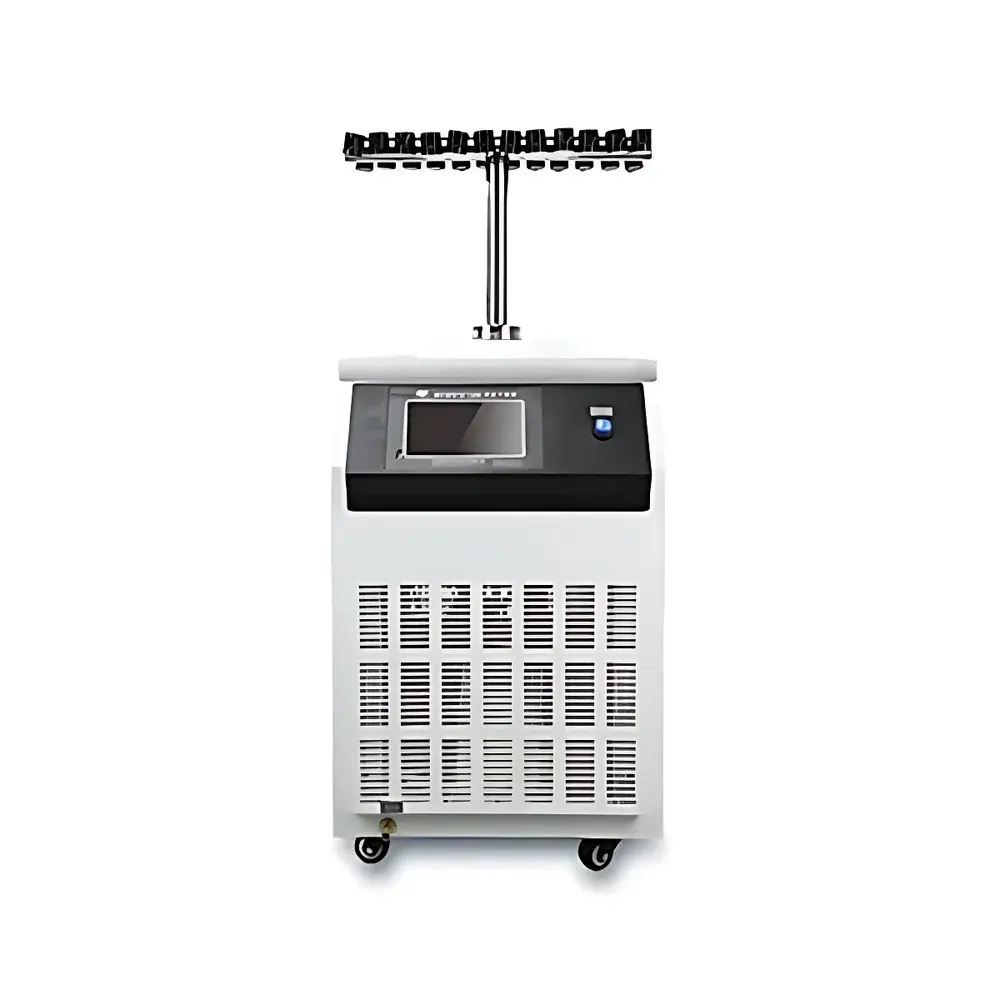
Ningbo Scientz SCIENTZ-12N/E T-Style Manifold Freeze Dryer
| Brand | Scientz |
|---|---|
| Origin | Zhejiang, China |
| Manufacturer Type | Direct Manufacturer |
| Instrument Type | Manifold Freeze Dryer |
| Application | Laboratory Use |
| Lyophilization Area | 0.12 m² |
| Ultimate Vacuum (Empty) | ≤5 Pa |
| Condensate Capacity (24 h) | 4 kg/24 h |
| Cold Trap Temperature (Empty) | ≤−56 °C |
| Dimensions (L×W×H) | 600 × 450 × 720 mm + 440 mm (Manifold Height) |
Overview
The Ningbo Scientz SCIENTZ-12N/E is a T-style manifold freeze dryer engineered for precision lyophilization of small-to-medium batch samples in academic, governmental, and industrial R&D laboratories. It operates on the fundamental principle of sublimation under deep vacuum—where frozen water transitions directly from solid to vapor without passing through the liquid phase—preserving structural integrity, biological activity, and chemical stability of thermolabile substances. This process minimizes denaturation, aggregation, and oxidation, making it indispensable for stabilizing proteins, enzymes, vaccines, nucleic acids, microbial cultures, plant tissues, and nanomaterials. Designed as an evolution of the SCIENTZ-10N platform, the SCIENTZ-12N/E delivers enhanced condensation capacity (4 kg/24 h) and improved thermal efficiency while maintaining a compact footprint—ideal for space-constrained lab environments where benchtop real estate is at a premium.
Key Features
- Compact, integrated design with total external dimensions of 600 × 450 × 720 mm (plus 440 mm manifold height), enabling flexible placement on standard laboratory benches.
- High-efficiency imported compressor refrigeration system achieving ≤−56 °C cold trap temperature under no-load conditions; optional −80 °C dual-stage cascade configuration available for low-eutectic-point materials.
- 7-inch true-color capacitive touchscreen interface with industrial-grade embedded OS, supporting responsive operation, multi-user access control, and real-time display of critical parameters: cold trap temperature, chamber pressure, shelf temperature (if equipped), and vacuum status.
- Transparent one-piece polycarbonate drying chamber—chemically resistant, impact-resistant, optically clear, and fully sealable—enabling uninterrupted visual monitoring of sublimation progress and ice formation dynamics.
- Intelligent vacuum management: programmable vacuum pump activation threshold (e.g., pump engages only after cold trap reaches preset temperature), extending pump service life and reducing oil backstreaming risk.
- Standard 8-port T-manifold with universal 24/29 mm O-ring interfaces compatible with globally standardized lyophilization flasks and stopper-sealed vials.
Sample Compatibility & Compliance
The SCIENTZ-12N/E accommodates diverse sample formats—including serum vials, glass ampoules, flat-bottomed flasks, and custom containers—across life science, pharmaceutical, food, environmental, and materials research domains. Its validated performance supports protocols aligned with ISO 22000 (food safety), ISO 13485 (medical device manufacturing), and GLP-compliant workflows. While not inherently 21 CFR Part 11–certified, its data logging architecture—featuring timestamped, non-erasable freeze-drying curve storage on internal flash memory and exportable .csv/.txt files via USB—facilitates audit-ready documentation when deployed within controlled quality systems. Optional eutectic point detection and vacuum-controlled primary drying modes further support method development per ICH Q5C and USP guidance for lyophilized biologics.
Software & Data Management
All operational data—including time-stamped temperature profiles, vacuum trends, and stage transitions—are automatically recorded and stored internally. Users may export complete lyophilization logs to USB drives for offline analysis or integration into LIMS environments. The system supports up to 100 user-defined freeze-drying programs, each with customizable ramp rates, hold durations, and pressure setpoints. Optional PC-based upper-computer software enables advanced visualization, comparative curve overlay, statistical deviation reporting, and PDF report generation with digital signature fields—suitable for regulatory submissions and internal SOP documentation.
Applications
- Biopharmaceutical R&D: Stabilization of monoclonal antibodies, recombinant enzymes, viral vectors, and mRNA-LNP formulations prior to analytical characterization or accelerated stability testing.
- Agricultural & Food Science: Preservation of heat-sensitive phytochemicals, probiotic strains, meat extracts, and vegetable powders for compositional analysis and shelf-life studies.
- Environmental Testing: Preparation of soil, sludge, and sediment samples for trace metal speciation, organic contaminant quantification, and microbial community profiling.
- Materials Engineering: Drying of hydrogels, MOFs, aerogels, and catalytic nanoparticles without pore collapse or agglomeration.
- Clinical & Diagnostic Labs: Long-term archiving of clinical isolates (bacteria, fungi, viruses), reference standards, and serum panels under inert gas backfill (via optional purge valve).
FAQ
What is the maximum batch volume supported by the SCIENTZ-12N/E?
The unit supports up to 4 kg of ice condensation per 24-hour cycle, corresponding to approximately 4–5 L of aqueous sample volume depending on solute concentration and freezing behavior.
Can the system be used for sterile processing?
The SCIENTZ-12N/E is designed for research-grade lyophilization—not aseptic manufacturing. Sterility must be ensured upstream via filtration or autoclaving; the chamber itself is cleanable but not ISO Class 5 certified.
Is remote monitoring or network connectivity supported?
No built-in Ethernet or Wi-Fi module is included; however, exported data files are compatible with third-party SCADA and lab automation platforms via manual import.
What maintenance intervals are recommended for the compressor and vacuum pump?
Compressor oil inspection every 12 months; vacuum pump oil replacement every 500 operating hours or quarterly—whichever occurs first—using ISO VG 100 synthetic oil.
Does the system comply with CE or UL safety standards?
Yes—the instrument meets EN 61010-1:2019 (IEC 61010-1) for electrical safety in laboratory equipment and carries CE marking for the European Economic Area.



