
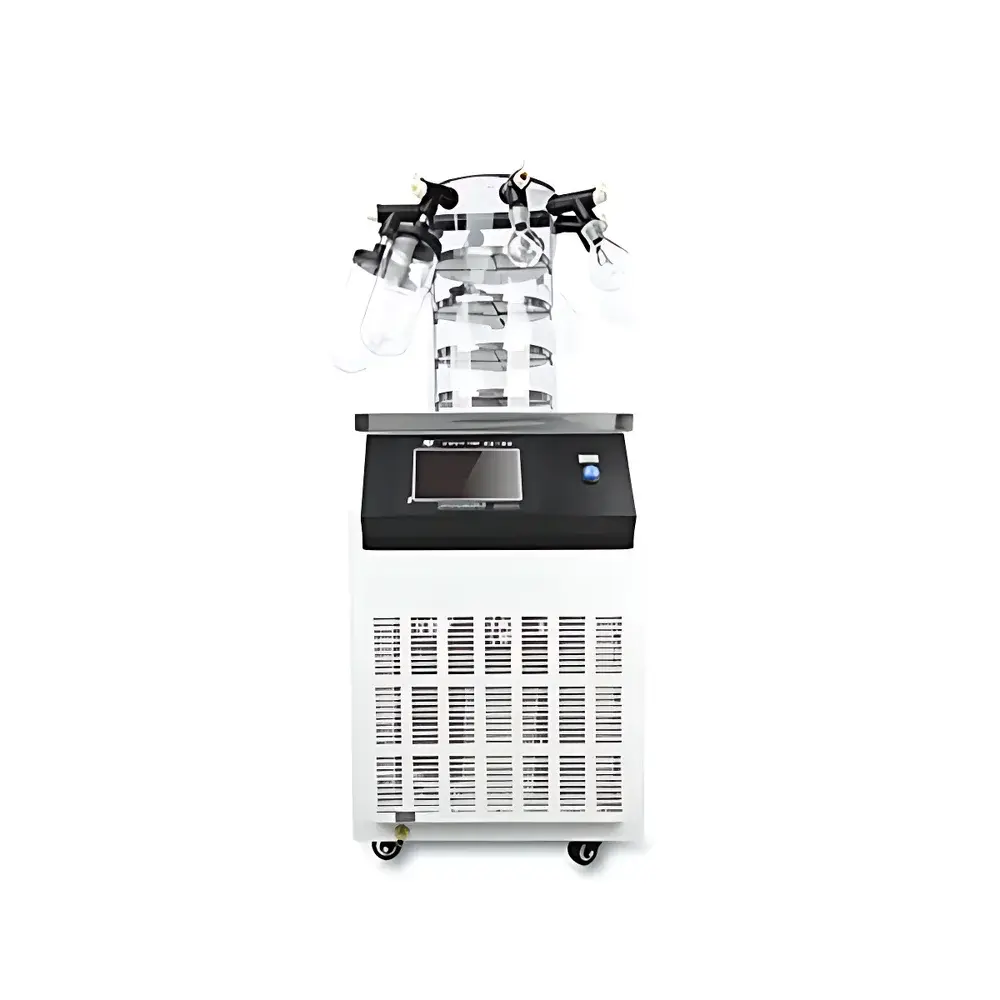
Ningbo Scientz SCIENTZ-12ND/C Benchtop Manifold Freeze Dryer with Heated Shelf and -56°C Cold Trap
| Brand | Scientz |
|---|---|
| Origin | Zhejiang, China |
| Manufacturer Type | OEM Manufacturer |
| Instrument Type | Manifold Freeze Dryer with Heated Shelf |
| Freeze-Drying Area | 0.12 m² |
| Ultimate Vacuum (Empty) | ≤5 Pa |
| Condensate Capacity | 3 kg/24 h |
| Cold Trap Temperature (Empty) | ≤-56°C |
| Dimensions (L×W×H) | 590 × 460 × 400 mm + 440 mm (height with chamber) |
| Power Supply | 220 V / 50 Hz |
Overview
The Scientz SCIENTZ-12ND/C is a compact, benchtop manifold freeze dryer engineered for precision lyophilization in academic, governmental, and early-stage biopharmaceutical laboratories. It operates on the principle of sublimation under deep vacuum—where ice transitions directly from solid to vapor without passing through the liquid phase—preserving structural integrity, biological activity, and chemical conformation of thermolabile samples. Designed for batch processing of vials, ampoules, or flasks mounted on a multi-port manifold, the system integrates a heated shelf (36 V silicone rubber heating plates), PID-controlled temperature regulation, and a high-efficiency single-stage or optional dual-stage cascade refrigeration system. Its standard cold trap achieves ≤-56°C (empty), with an optional -80°C compressor upgrade available for low-eutectic-point formulations. The unit complies with fundamental design principles aligned with ISO 22042 (freeze-drying equipment) and supports GLP-compliant documentation workflows when paired with validated data management protocols.
Key Features
- Heated shelf with precise PID temperature control (range: ambient to +60°C), enabling controlled primary and secondary drying phases without thermal overshoot
- 7-inch full-color industrial touchscreen interface with embedded real-time OS; displays cold trap temperature, chamber pressure, shelf temperature, and vacuum status simultaneously
- Transparent polycarbonate drying chamber—single-piece injection-molded, corrosion-resistant, optically clear—for full visual monitoring of sublimation progression and cake morphology
- Imported high-reliability scroll or piston compressor (e.g., Danfoss, Secop, or Embraco), ensuring rapid cooldown and stable low-temperature operation
- Intelligent vacuum management: pump activation delayed until cold trap reaches setpoint, extending pump service life and minimizing oil backstreaming risk
- Manifold configuration with eight standard 24/29 mm O.D. ports; compatible with internationally standardized lyophilization vials and stopper-sealed flasks
- Optional features include automatic pressure control valve, oil mist filter, eutectic point detection module, and electric defrost function for accelerated cycle turnaround
Sample Compatibility & Compliance
The SCIENTZ-12ND/C accommodates diverse sample formats—including aqueous solutions, protein suspensions, microbial cultures, tissue homogenates, and nanoparticle dispersions—in vials (2–20 mL), serum bottles, or custom containers mounted on the manifold. Its vacuum stability (<5 Pa) and thermal uniformity support reproducible drying of sensitive biomolecules (e.g., monoclonal antibodies, enzymes, plasmid DNA) and pharmaceutical intermediates. While not pre-certified for GMP manufacturing, the system meets foundational requirements for method development and analytical sample preparation under USP , ICH Q5C, and FDA 21 CFR Part 11–compatible data handling when used with audit-trail-enabled software extensions. All wetted surfaces are inert (stainless steel 304 cold trap, polycarbonate chamber), minimizing leachables and facilitating cleaning validation.
Software & Data Management
Freeze-drying cycles are programmable via the onboard HMI with up to 32 customizable profiles stored internally. Real-time parameters—including shelf temperature, chamber pressure, and cold trap temperature—are logged at user-defined intervals (1–60 s) and saved automatically to internal flash memory. Historical runs can be exported via USB to CSV format for offline analysis in Excel or MATLAB. Optional PC-based software provides trend visualization, deviation alerts, and electronic signature support for regulated environments. Data integrity safeguards include time-stamped records, immutable file naming conventions, and password-protected parameter modification—aligning with ALCOA+ principles for research-grade traceability.
Applications
This instrument serves as a core tool across multiple R&D domains: microbial strain preservation (bacteria, yeast, viruses); formulation development of biologics (vaccines, interferons, therapeutic proteins); preparation of reference standards for food safety testing (pesticide residue, mycotoxin analysis); stabilization of botanical extracts and traditional medicine compounds; lyophilization of nanomaterials to prevent agglomeration; and pretreatment of environmental matrices (soil, sludge, plant tissues) prior to elemental or organic contaminant analysis. Its heated shelf capability further enables optimization of drying kinetics for scale-up studies toward pilot-scale freeze dryers.
FAQ
What is the maximum batch capacity per cycle?
Up to 12 × 20 mL vials (or equivalent volume) can be processed simultaneously, limited by total condensable load (≤3 kg/24 h) and surface area (0.12 m²).
Can this system be used for sterile processing?
No—it lacks ISO Class 5 cleanroom integration, steam-in-place (SIP), or ethylene oxide (EO) compatibility; it is intended for non-sterile R&D use only.
Is the vacuum pump included?
No—the SCIENTZ-12ND/C requires a separate vacuum pump (e.g., two-stage oil rotary vane pump, ≥4 m³/h pumping speed); multiple international brands are compatible.
Does the system support automated cycle start/stop based on pressure or temperature thresholds?
Yes—programmable logic allows conditional stage transitions (e.g., initiate secondary drying when chamber pressure drops below 10 Pa for >30 min).
What maintenance is required for long-term reliability?
Recommended quarterly checks include vacuum pump oil replacement, cold trap cleaning, O-ring inspection, and calibration verification of temperature and pressure sensors using NIST-traceable references.



