
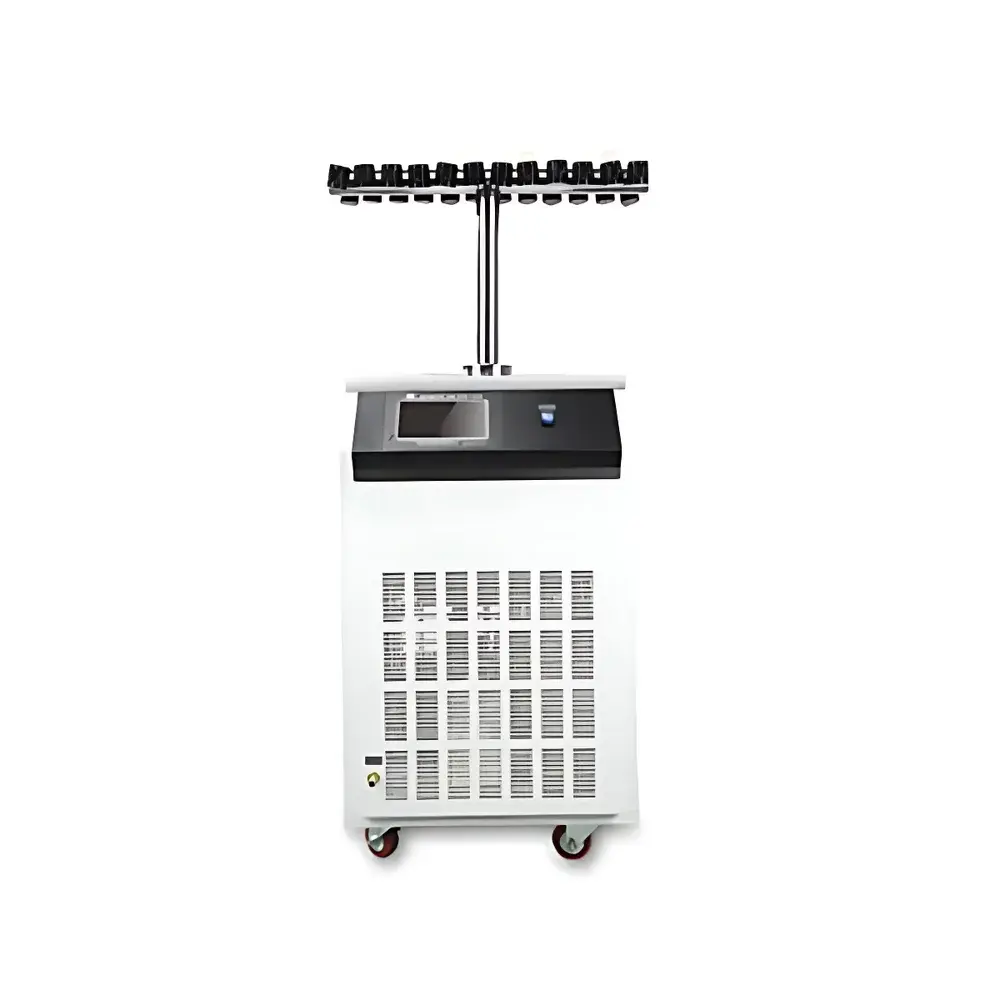
Ningbo Scientz SCIENTZ-18N/E Benchtop Pilot-Scale Freeze Dryer
| Brand | Ningbo Scientz |
|---|---|
| Origin | Zhejiang, China |
| Manufacturer Type | Direct Manufacturer |
| Region | Domestic (China) |
| Model | SCIENTZ-18N/E |
| Instrument Type | Standard Shelf-Type Freeze Dryer |
| Application Scale | Pilot-Scale |
| Lyophilization Area | 0.12 m² |
| Ultimate Vacuum | ≤5 Pa |
| Condensate Capacity (24 h) | 4 kg/batch |
| Cold Trap Temperature | ≤−56 °C |
| Dimensions (L×W×H) | 600 × 450 × 720 mm + 440 mm (cold trap height) |
Overview
The Ningbo Scientz SCIENTZ-18N/E is a pilot-scale, benchtop freeze dryer engineered for reproducible, high-fidelity lyophilization of thermolabile biological and pharmaceutical samples under controlled vacuum and sub-zero conditions. It operates on the principle of sublimation—removing water from frozen samples directly from solid to vapor phase without passing through liquid state—thereby preserving structural integrity, conformational stability, and bioactivity of sensitive compounds such as proteins, enzymes, vaccines, nucleic acids, microbial cultures, and plant tissues. Designed for laboratories requiring scalable processing beyond basic R&D but prior to full GMP manufacturing, the SCIENTZ-18N/E delivers 0.12 m² of shelf area and a condensate capacity of 4 kg per batch, supporting multi-vial, ampoule, or flask-based drying configurations. Its compact footprint (600 × 450 × 720 mm main unit + 440 mm cold trap extension) enables integration into standard lab environments while maintaining industrial-grade thermal and vacuum performance.
Key Features
- Imported high-efficiency refrigeration compressor delivering stable cold trap temperature ≤−56 °C (optional −80 °C dual-stage cascade system available for low-eutectic formulations)
- 7-inch true-color capacitive touchscreen interface with intuitive HMI navigation, real-time parameter visualization (cold trap temp, chamber pressure, shelf temp, elapsed time), and industrial-grade embedded OS for reliable operation
- Automated process logging: all critical parameters recorded at user-defined intervals; data stored internally and exportable via USB to PC for post-processing, audit trails, and compliance reporting
- Optically transparent, one-piece polycarbonate drying chamber—chemically resistant, impact-resistant, and fully sealed—enabling continuous visual monitoring of ice sublimation and cake formation
- Intelligent vacuum management: programmable vacuum pump start delay (activated only after cold trap reaches setpoint) to extend pump life and prevent oil backstreaming; optional vacuum oil mist filter and auto differential-pressure valve included
- Standard T-type manifold configuration with eight ports, compatible with internationally standardized lyophilization flasks (e.g., 100–500 mL) and stopper-sealed vials; optional wide-mouth歧管 for rapid loading/unloading
- Electric defrost function reducing regeneration cycle time by up to 40% compared to passive air-thaw methods
Sample Compatibility & Compliance
The SCIENTZ-18N/E accommodates diverse sample formats including serum vials, glass ampoules, culture tubes, petri dishes, and custom containers—ideal for lyophilizing aqueous solutions containing biologics (monoclonal antibodies, recombinant proteins), small-molecule APIs, botanical extracts, microbial suspensions, tissue homogenates, and environmental matrices (soil, sludge, wastewater solids). Its ≤5 Pa ultimate vacuum and precise temperature control meet baseline requirements for method development aligned with ICH Q5C, USP , and ISO 22033. While not certified for cGMP production, its data integrity features—including timestamped event logs, password-protected parameter editing, and USB-exportable raw datasets—support GLP-compliant documentation for preclinical research, QC testing, and regulatory submissions (e.g., FDA IND/CTA dossiers). The system complies with CE electromagnetic compatibility (EMC) and low-voltage directives, and conforms to GB/T 30429–2013 (Chinese national standard for freeze dryers).
Software & Data Management
The built-in operating system supports creation, storage, and recall of up to 100 customizable freeze-drying protocols. Each protocol defines ramp rates, hold durations, shelf temperature profiles, vacuum setpoints, and endpoint criteria (e.g., pressure rise test). All runs generate time-stamped CSV files containing second-by-second records of cold trap temperature, chamber pressure, shelf temperature, and system status flags. Data can be exported via USB 2.0 to Windows/Linux workstations for analysis in Excel, MATLAB, or specialized lyo-analytics platforms. Optional PC-based supervisory software provides remote monitoring, multi-unit fleet management, and automated report generation compliant with ALCOA+ principles (Attributable, Legible, Contemporaneous, Original, Accurate, Complete, Consistent, Enduring, Available). Audit trail functionality satisfies FDA 21 CFR Part 11 requirements when paired with institutional electronic signature infrastructure.
Applications
- Academic & Government Research: lyophilization of bacterial/viral stocks (ATCC/NCTC strains), plant tissue specimens, soil microbiome samples, pesticide residue standards, and forensic evidence
- Pharmaceutical Development: formulation screening of lyo-protectants, stability studies of protein therapeutics, preparation of reference standards for HPLC/GC-MS quantification, and pilot batches of sterile powders for Phase I trials
- Food & Agricultural Science: preservation of probiotics, enzymatic extracts, fruit/vegetable powders, meat analogs, and feed additives without Maillard degradation or lipid oxidation
- Materials Science: drying of nanosuspensions, MOFs, aerogels, and catalyst precursors where solvent removal must avoid particle aggregation or pore collapse
- Environmental Testing Labs: preparation of solid-phase extraction cartridges, sediment cores, and airborne particulate filters for elemental analysis (ICP-MS, XRF)
FAQ
What is the maximum batch capacity for this model?
The SCIENTZ-18N/E supports up to 4 kg of ice condensation per 24-hour cycle, with practical loading limited by surface area (0.12 m² shelf) and vial geometry—typically accommodating ~200 × 5 mL vials or ~80 × 20 mL vials per run.
Can it handle heat-sensitive biologics without activity loss?
Yes—the sublimation-based drying mechanism avoids liquid-phase exposure and thermal denaturation; combined with precise shelf temperature control (±0.5 °C) and low primary drying pressure, it preserves secondary/tertiary structure of monoclonal antibodies, enzymes, and live attenuated vaccines.
Is validation support available for IQ/OQ/PQ?
Scientz provides factory calibration certificates and operational qualification templates; users are responsible for site-specific installation qualification (IQ), operational qualification (OQ), and performance qualification (PQ) per internal SOPs and ISO/IEC 17025 guidelines.
Does it comply with FDA 21 CFR Part 11 for electronic records?
The system generates ALCOA+-compliant data files; full Part 11 compliance requires institutional implementation of access controls, electronic signatures, and audit trail review procedures—not inherent to the hardware alone.
What maintenance is required for long-term reliability?
Recommended quarterly inspection of vacuum seals, annual replacement of refrigeration oil and desiccant, biannual calibration verification of PT100 sensors, and routine cleaning of condenser coils and chamber interior using isopropanol-compatible wipes.



