
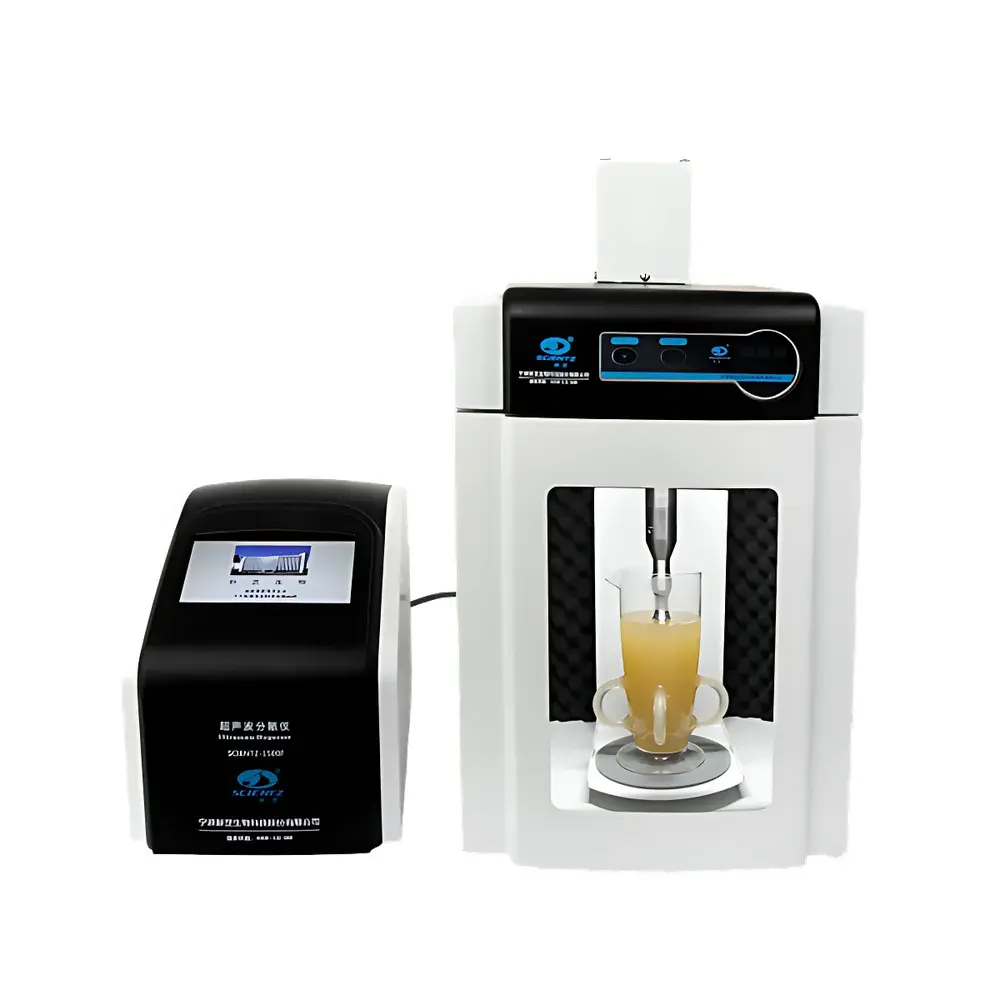
Ningbo Scientz SCIENTZ-2400F Ultrasonic Homogenizer
| Brand | Ningbo Scientz |
|---|---|
| Origin | Zhejiang, China |
| Manufacturer Type | Direct Manufacturer |
| Instrument Type | Ultrasonic Probe Homogenizer |
| Dimensions (W×D×H) | 416 × 244 × 300 mm |
| Sample Volume Range | 10–40,000 mL |
| Operating Frequency | 20–25 kHz |
| Power Output | Adjustable, Continuous & Pulsed Mode |
| Probe Material | Titanium Alloy (Grade 5) |
| Safety Features | Overtemperature Protection, Overload Detection, Timed Shutdown |
| Control Interface | Digital Panel with Real-Time Display |
| Cooling Method | Air-Cooled Generator |
| Compliance | CE-marked, ISO 9001 Certified Manufacturing Facility |
Overview
The Ningbo Scientz SCIENTZ-2400F Ultrasonic Homogenizer is an industrial-grade probe-type sonicator engineered for high-efficiency dispersion, emulsification, and cell disruption across research and production environments. It operates on the principle of acoustic cavitation—where high-intensity ultrasonic waves (20–25 kHz) propagate through a liquid medium via a titanium alloy probe, generating transient microbubbles that collapse violently near solid or immiscible phase interfaces. This localized energy release produces intense shear forces, microturbulence, and shockwaves sufficient to deagglomerate nanoparticles, exfoliate layered materials (e.g., graphene), stabilize oil-in-water emulsions, and lyse microbial or mammalian cells without thermal degradation. Unlike rotor-stator or bead-based homogenizers, the SCIENTZ-2400F delivers direct energy transfer into the sample volume, enabling scalable processing from microliter suspensions to 40 L batches—making it suitable for both benchtop R&D and pilot-scale formulation development.
Key Features
- Adjustable Power & Timing Control: Digital interface allows precise, stepless regulation of output power (0–100%) and treatment duration (1 s to 99 min 59 s), supporting reproducible protocol execution under GLP-compliant workflows.
- Pulsed & Continuous Operation Modes: Programmable pulse intervals (on/off ratio configurable from 0.1–9.9 s) minimize sample heating and prevent thermal denaturation—critical for heat-sensitive biomolecules and nanomaterials.
- Titanium Alloy Probe System: Standard probe (Φ6 mm, 125 mm length) constructed from ASTM Grade 5 Ti-6Al-4V ensures corrosion resistance, mechanical durability, and optimal acoustic impedance matching for efficient energy transmission.
- Thermal & Load Monitoring: Integrated temperature sensor in the generator housing triggers automatic shutdown if internal ambient exceeds safe operating limits; overload detection prevents transducer damage during viscous or particulate-laden processing.
- Horn Geometry Optimization: Proprietary “gourd-shaped” amplitude transformer enhances lateral and axial wave propagation, improving volumetric energy distribution and reducing dead zones in cylindrical vessels.
- Air-Cooled Architecture: Fan-assisted thermal management enables extended operation without external chiller dependency—reducing infrastructure requirements in shared laboratory spaces.
Sample Compatibility & Compliance
The SCIENTZ-2400F accommodates a broad spectrum of sample matrices: aqueous colloids (SiO₂, TiO₂, Fe₃O₄ nanoparticles), organic solvents (ethanol, chloroform, DMF), polymer melts (PEG, PLGA), biological suspensions (E. coli lysates, tissue homogenates), and food-grade emulsions (soy lecithin in sunflower oil). It supports compliance with method validation frameworks referenced in USP , ISO 13320 (laser diffraction particle sizing pre-treatment), and ASTM D7853 (nanomaterial dispersion stability testing). While not FDA 21 CFR Part 11–validated out-of-the-box, its digital logging capability (time-stamped power/duration records) forms a foundational audit trail for GMP-aligned documentation when integrated into validated SOPs.
Software & Data Management
The device features embedded firmware with non-volatile memory storing up to 10 user-defined protocols—including power setpoint, duration, pulsing sequence, and safety thresholds. All operational parameters are displayed in real time on the front-panel LCD, with no external software dependency. For traceability, manual logbooks or LIMS-integrated data capture can record batch-specific settings alongside post-processing analytical results (e.g., DLS size distribution, zeta potential, TEM morphology). No proprietary drivers or cloud connectivity are required—ensuring compatibility with air-gapped or IT-restricted laboratory networks.
Applications
- Nanomaterial dispersion: Deagglomeration of carbon nanotubes, graphene oxide, quantum dots, and metal oxide nanoparticles in aqueous or organic media.
- Vaccine adjuvant preparation: Uniform suspension of aluminum hydroxide gels and oil-in-water emulsions (e.g., MF59 analogues).
- Pharmaceutical formulation: Production of nanoemulsions for oral delivery, liposomal encapsulation, and amorphous solid dispersion stabilization.
- Food science: Homogenization of plant protein isolates, dairy-based functional ingredients, and flavor oil dispersions in beverages.
- Materials science: Exfoliation of 2D materials, dispersion of conductive fillers in polymer composites, and catalyst slurry preparation.
- Microbiology: Mechanical lysis of Gram-negative and Gram-positive bacteria, yeast, and spores for genomic DNA extraction and proteomic analysis.
FAQ
What is the maximum recommended viscosity for effective processing with the SCIENTZ-2400F?
For optimal cavitation efficiency, samples should not exceed 500 mPa·s at processing temperature. Higher viscosities require reduced probe immersion depth, lower amplitude settings, or pulsed-mode operation to maintain energy coupling.
Can the instrument be used with corrosive solvents such as concentrated acids or halogenated organics?
Titanium alloy probes resist most common solvents, but prolonged exposure to hydrofluoric acid, hot concentrated alkalis (>10% NaOH), or chlorine-containing compounds may cause surface etching. Use appropriate chemical compatibility charts and inspect probe integrity after each run.
Is calibration traceable to national standards available?
While the unit does not include built-in acoustic power calibration, Scientz provides optional NIST-traceable calorimetric validation reports upon request—performed using ASTM E2810 methodology with calibrated calorimeters.
How often should the ultrasonic probe be replaced?
Under typical usage (≤4 h/day, aqueous buffers), titanium probes retain structural integrity for 12–18 months. Visual inspection for pitting, erosion, or tip deformation is recommended before each use; replacement is advised when amplitude attenuation exceeds 15% relative to baseline.
Does the SCIENTZ-2400F meet electromagnetic compatibility (EMC) requirements for EU laboratories?
Yes—the generator complies with EN 61326-1:2013 (measurement/control lab equipment) and carries CE marking, confirming conformity with EU EMC Directive 2014/30/EU and Low Voltage Directive 2014/35/EU.



