
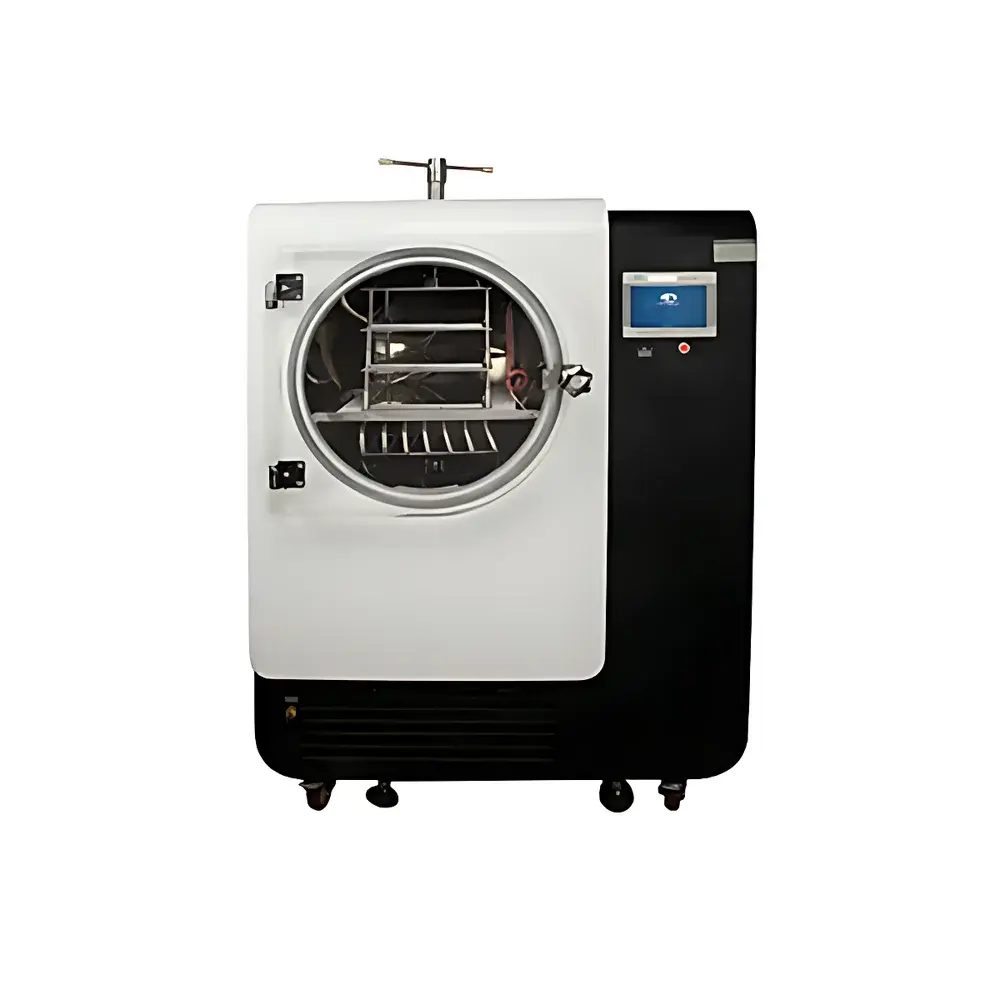
Ningbo Scientz SCIENTZ-30YG/B Benchtop Pilot-Scale Silicone-Oil Heated Freeze Dryer with In-Situ Shelf Heating
| Brand | Ningbo Scientz |
|---|---|
| Origin | Zhejiang, China |
| Manufacturer Type | Direct Manufacturer |
| Instrument Type | Standard Shelf-Type Freeze Dryer |
| Application Scope | Pilot-Scale Development & Process Optimization |
| Lyophilization Area | 0.21 m² |
| Ultimate Vacuum (No Load) | ≤5 Pa |
| Condensate Capacity (24 h) | 4 kg/24 h |
| Cold Trap Temperature (No Load) | ≤−70 °C |
| Dimensions (L×W×H) | 750 × 640 × 1200 mm |
Overview
The Ningbo Scientz SCIENTZ-30YG/B is a pilot-scale, in-situ shelf-heated freeze dryer engineered for reproducible lyophilization process development and small-batch production under controlled thermal and vacuum conditions. It operates on the fundamental principles of sublimation-based dehydration: frozen samples are subjected to low-pressure environments (<5 Pa) while heat is precisely delivered via silicone oil circulation to the stainless steel shelves (SUS304 construction), enabling controlled primary drying (ice sublimation) and secondary drying (bound water desorption). Unlike resistive or steam-heated systems, the silicone oil heating architecture ensures uniform shelf temperature distribution (±3 °C stability post-equilibration), critical for consistent cake structure, residual moisture control, and biomolecular integrity—particularly in sensitive applications such as protein formulations, nucleic acid preservation, and botanical extract stabilization. Its integrated cold trap and drying chamber design minimizes footprint without compromising condensation efficiency, making it suitable for space-constrained laboratories engaged in method development, regulatory-compliant sample preparation, and pre-GMP feasibility studies.
Key Features
- Shelf heating system driven by circulating silicone oil, delivering superior temperature uniformity and dynamic ramp/hold control across 40 programmable segments per cycle
- PLC-based control architecture with color touchscreen interface, supporting three-tier user permission management (operator, engineer, administrator) and audit-trail-capable parameter logging
- Real-time monitoring and archival of critical process variables: shelf temperature, product thermocouple temperature (optional), cold trap temperature, chamber pressure, and silicone oil inlet/outlet temperatures
- Intelligent vacuum management: vacuum pump activation delayed until cold trap reaches preset threshold (e.g., −60 °C), extending pump service life; total pump runtime logged for predictive maintenance
- Transparent polycarbonate drying chamber—single-piece molded, corrosion-resistant, gas-tight, and optically clear—for full visual observation of ice morphology, collapse onset, and drying front progression
- Configurable inert gas backfill (N₂ or Ar) via solenoid-controlled valve, supporting oxygen-sensitive materials and facilitating sterile transfer protocols
- Modular refrigeration system featuring imported compressors, brazed plate heat exchangers, and high-pressure safety cutouts; optional −80 °C cold trap upgrade available with cascade refrigeration
Sample Compatibility & Compliance
The SCIENTZ-30YG/B accommodates diverse sample formats including vials (2–20 mL), trays (up to 0.21 m²), and custom T-frame mounts. It supports lyophilization of aqueous solutions, suspensions, emulsions, and viscous gels—commonly used in pharmaceutical R&D (e.g., monoclonal antibodies, mRNA-LNPs), food science (freeze-dried probiotics, fruit powders), environmental analysis (soil extracts, sludge digests), and cultural heritage conservation (parchment, inked paper). The system’s data integrity framework aligns with GLP and GMP expectations: all process parameters are timestamped, non-erasable, and exportable via USB to CSV or proprietary .fdx format for offline review. Optional integration with 21 CFR Part 11-compliant software enables electronic signatures, user authentication, and change control logs—essential for FDA-regulated workflows.
Software & Data Management
The embedded control system records >10,000 data points per run at user-defined intervals (1–60 s). Freeze-drying curves—including shelf temperature ramps, vacuum profiles, and condenser load trends—are stored internally and exportable to USB drives. A dedicated PC-based viewer allows overlay comparison of multiple batches, deviation analysis against master curves, and annotated report generation (PDF/Excel). Remote supervision is supported via Ethernet or optional Wi-Fi module, enabling real-time status checks and alarm notifications through SNMP or email alerts. All data files include metadata (operator ID, batch ID, start/stop timestamps, hardware firmware version), ensuring traceability required under ISO 17025 and ASTM E2500-13 guidelines.
Applications
- Pharmaceutical development: formulation screening of lyoprotectants, cycle optimization for injectables, stability testing of biologics
- Food & agriculture research: dehydration of microbial cultures (lactic acid bacteria, yeasts), preservation of heat-labile nutrients (vitamin C, polyphenols), soil microbiome sample archiving
- Environmental testing: preparation of sediment, wastewater, and airborne particulate samples for ICP-MS, GC-MS, or NMR analysis
- Cultural heritage science: controlled dehydration of water-damaged manuscripts and archaeological textiles without structural distortion
- Academic training: hands-on instruction in mass transfer kinetics, phase diagrams, and freeze-drying thermodynamics
FAQ
What is the maximum batch capacity for vial-based lyophilization?
Standard configuration supports up to 1,200 × 2 mL vials or 400 × 10 mL vials on the 0.21 m² shelf area.
Can shelf temperature be controlled independently during primary and secondary drying phases?
Yes—each of the 40 programmable control segments allows independent setpoint, ramp rate, and dwell time for shelf temperature, vacuum level, and hold duration.
Is the system compatible with PAT (Process Analytical Technology) tools?
It provides analog 4–20 mA outputs and Modbus TCP interface for integration with external NIR probes, capacitance manometers, or tunable diode laser sensors.
What validation documentation is provided with the instrument?
Factory calibration certificates for temperature sensors (shelf and condenser), vacuum gauge, and pressure transducers are included; IQ/OQ templates compliant with ISO 9001 and EU Annex 15 are available upon request.
Does the system support automatic cycle interruption and resumption?
Yes—power failure recovery mode preserves current state and resumes from last valid segment upon restoration, provided UPS backup is installed.



