
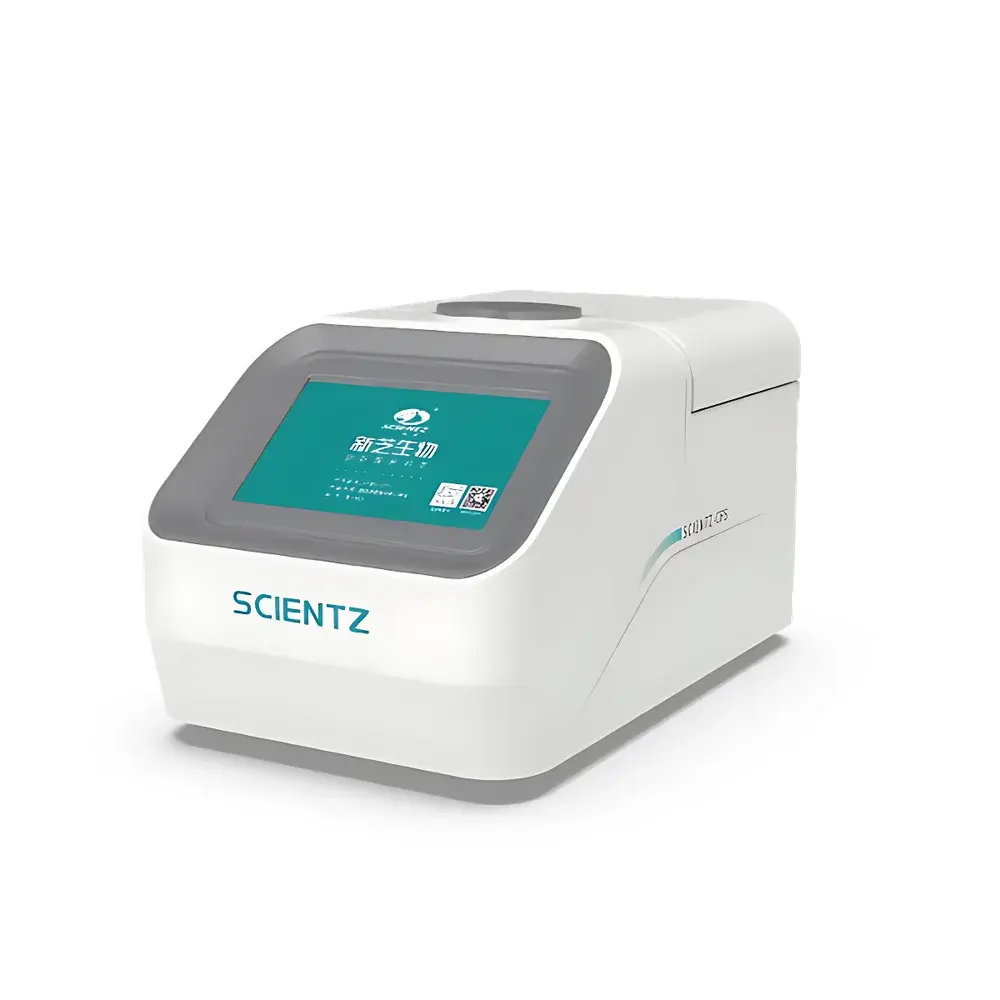
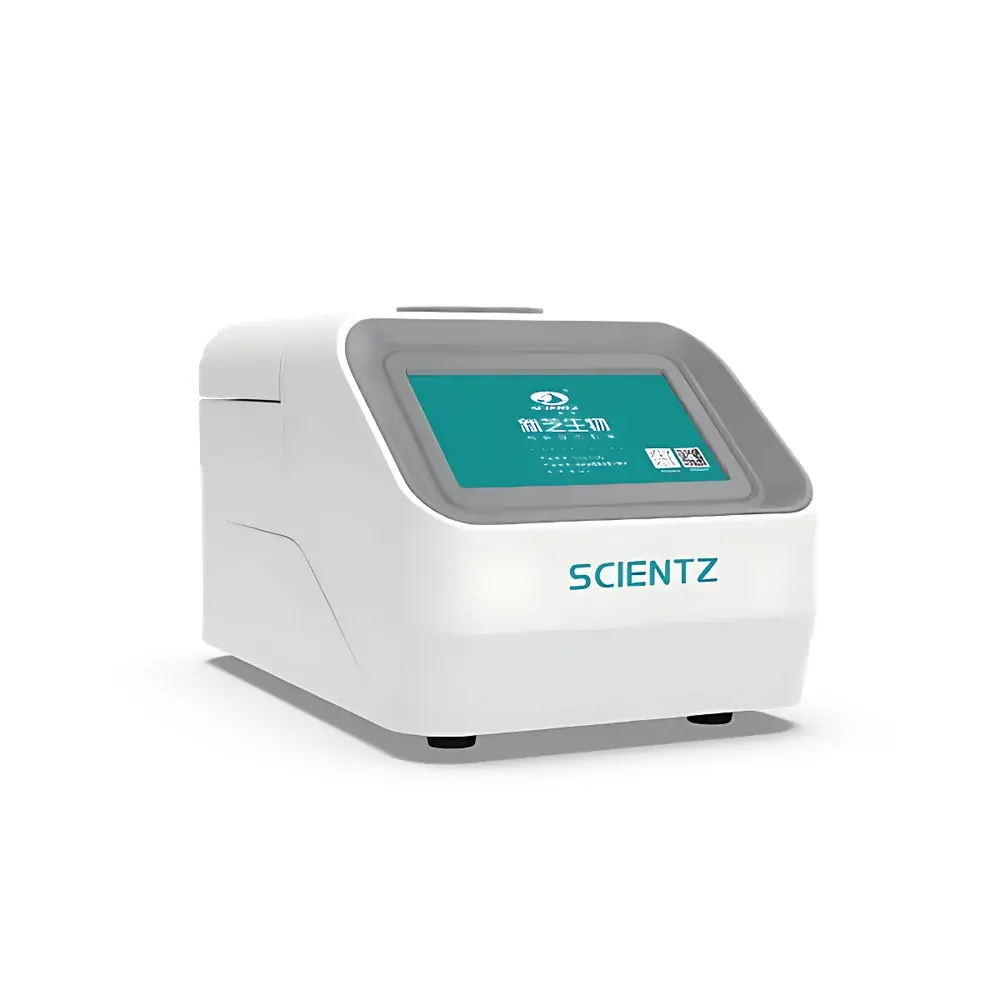
Ningbo Scientz SCIENTZ-CFS Ultrasonic Bacterial Turbidity Counter
| Brand | Ningbo Scientz |
|---|---|
| Origin | Zhejiang, China |
| Manufacturer Type | Direct Manufacturer |
| Regional Category | Domestic (China) |
| Model | SCIENTZ-CFS |
| Quotation | Upon Request |
| Measurement Time Range | 0–999 s (user-configurable) |
| Turbidity Detection Range | 0.00–6.00 McFarland (MCF) |
| Sample Volume | 1.5–4 mL |
| Throughput | 6 samples per run |
| Detectable Cell Size Range | 1.5–4 µm |
| Step Resolution | 0.01 MCF |
Overview
The Ningbo Scientz SCIENTZ-CFS Ultrasonic Bacterial Turbidity Counter is a dedicated benchtop instrument engineered for standardized microbial suspension preparation in regulated and research-intensive life science laboratories. It integrates three core functional modules—ultrasonic dispersion, optical turbidity measurement (based on McFarland standard calibration), and algorithm-driven dilution volume calculation—into a single automated workflow. Unlike conventional spectrophotometric or manual McFarland matching methods, the SCIENTZ-CFS applies controlled low-frequency ultrasonic energy (typically 40 kHz) to disrupt bacterial aggregates prior to optical density assessment, thereby minimizing measurement bias caused by clumping—a known source of variability in antimicrobial susceptibility testing (AST), vaccine titer standardization, and strain phenotyping workflows. Its optical detection system operates at 600 nm wavelength with temperature-compensated photodiode sensing, ensuring reproducible turbidity quantification across diverse Gram-positive and Gram-negative species.
Key Features
- Integrated ultrasonic dispersion module with adjustable power output (10–100% range) and time duration (0–999 s), enabling optimization for fragile or highly aggregating strains including Klebsiella pneumoniae mucoid variants and Staphylococcus epidermidis biofilm-forming isolates.
- High-precision turbidimetric measurement calibrated against NIST-traceable McFarland standards (0.5, 1.0, 2.0, 3.0, 4.0, 6.0 MCF), with linear response verified over the full 0.00–6.00 MCF operational range using certified polystyrene latex suspensions.
- Dedicated square-section quartz cuvettes (12.5 × 12.5 mm path length) with anti-reflective coating and silicone-sealed caps to prevent evaporation and cross-contamination during sequential processing of up to six samples per batch.
- 5-inch medical-grade capacitive touchscreen interface supporting real-time parameter adjustment, bilingual operation (English/Chinese), and audit-ready event logging—including timestamped user ID, measurement values, dispersion settings, and calculated diluent volumes.
- Embedded microprocessor performs real-time conversion from measured turbidity to target McFarland unit, then calculates precise diluent volume required to reach user-defined endpoint (e.g., 0.5 MCF for CLSI-compliant AST), outputting volumetric instructions in µL or mL with 0.01 MCF resolution.
Sample Compatibility & Compliance
The SCIENTZ-CFS accommodates standard 1.5–4 mL microbial suspensions in sterile, low-binding polypropylene tubes compatible with common laboratory centrifuges and biosafety cabinets. It has been validated for use with Escherichia coli ATCC 25922, Pseudomonas aeruginosa ATCC 27853, Staphylococcus aureus ATCC 29213, and clinical isolates exhibiting high auto-aggregation tendencies. The instrument’s firmware supports GLP-compliant data integrity requirements: all measurements are stored with immutable timestamps, operator credentials, and change history. While not FDA 510(k)-cleared, its operational logic aligns with CLSI M07-ED11 (Methods for Dilution Antimicrobial Susceptibility Tests for Bacteria That Grow Aerobically) and ISO 846:2019 (Plastics — Evaluation of the action of fungi and bacteria). Data export is available via USB 2.0 port in CSV format for integration into LIMS or ELN platforms.
Software & Data Management
The embedded operating system features role-based access control (administrator, technician, trainee) with password-protected configuration changes. All measurement sessions generate structured metadata logs containing sample ID, turbidity reading, dispersion parameters, target MCF, calculated diluent volume, and pass/fail status relative to ±0.05 MCF tolerance thresholds. Audit trails comply with ALCOA+ principles (Attributable, Legible, Contemporaneous, Original, Accurate, Complete, Consistent, Enduring, Available) and support retrospective review during internal quality audits or regulatory inspections. No cloud connectivity or remote telemetry is implemented—data remains fully under local user control.
Applications
- Standardization of inoculum density for Clinical and Laboratory Standards Institute (CLSI) and European Committee on Antimicrobial Susceptibility Testing (EUCAST) antimicrobial susceptibility assays.
- Routine preparation of consistent bacterial suspensions for vaccine potency testing, live biotherapeutic product (LBP) manufacturing, and challenge studies in preclinical models.
- High-throughput strain phenotyping workflows requiring reproducible cell density normalization prior to RNA extraction, metabolite profiling, or flow cytometry.
- Quality control of microbial culture collections, including verification of viability and suspension homogeneity prior to cryopreservation or lyophilization.
- Academic and industrial microbiology labs performing comparative growth kinetics, biofilm formation assays, or antibiotic synergy screening where inter-run turbidity variability must be minimized.
FAQ
Does the SCIENTZ-CFS require external calibration standards for daily use?
No. The instrument includes factory-installed McFarland reference standards and supports user-initiated multi-point recalibration using supplied calibration kits (Cat. No. SCIENTZ-CFS-CAL-KIT).
Can it process viscous or capsule-rich bacterial suspensions such as K. pneumoniae mucoid strains?
Yes. The ultrasonic dispersion module has been empirically optimized for mucoid and encapsulated isolates; recommended settings are 60% power for 45 s, validated via microscopic agglutination assessment.
Is the data export format compatible with common LIMS systems?
Yes. CSV exports include ISO 8601 timestamps, UTF-8 encoding, and header rows compliant with ASTM E1467-05 (Standard Practice for Laboratory Information Management Systems).
What safety certifications does the device hold?
It complies with IEC 61010-1:2010 for electrical safety and IEC 61326-1:2013 for electromagnetic compatibility (EMC); CE marking is affixed per EU Directive 2014/30/EU.
How is traceability maintained across multiple users in shared lab environments?
Each login session is tied to a unique alphanumeric user ID; all actions—including parameter modification, calibration, and result export—are appended to the audit log with cryptographic hash integrity verification.





