
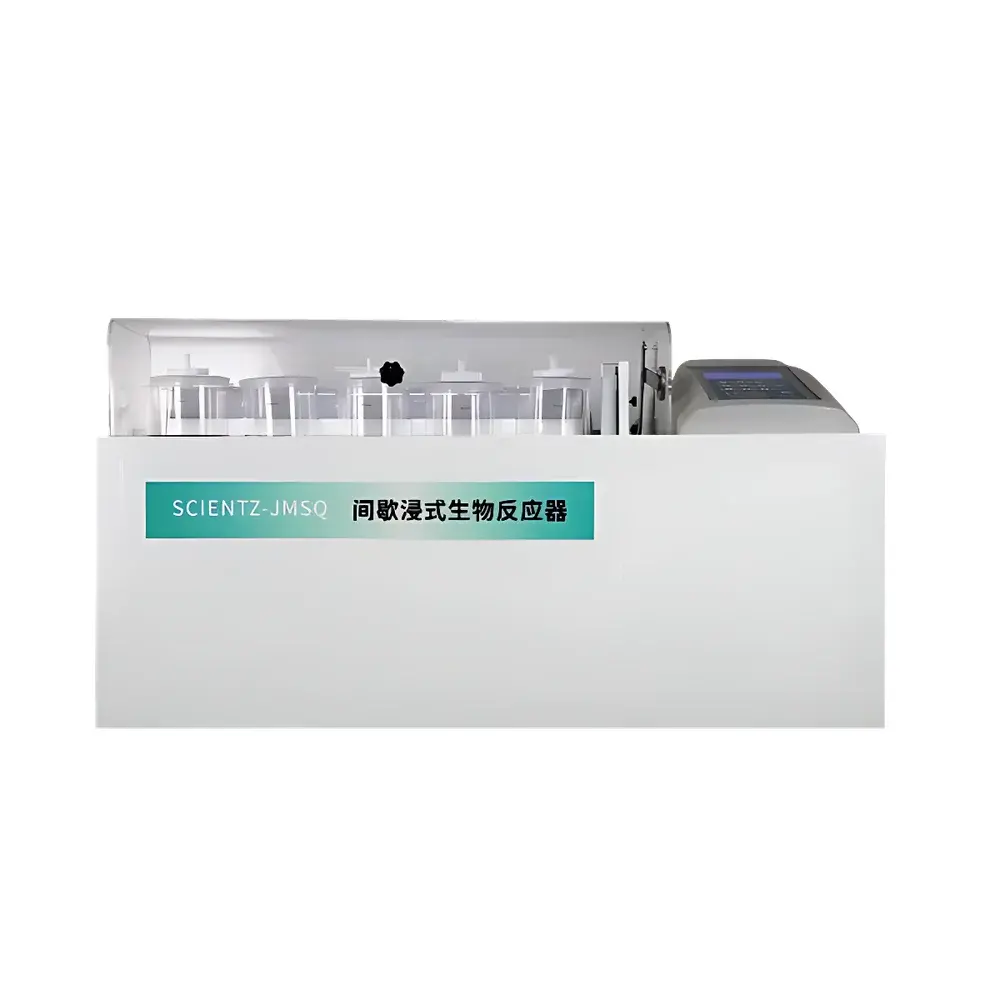
Ningbo Scientz SCIENTZ-JMSQ Intermittent Immersion Bioreactor
| Brand | Ningbo Scientz |
|---|---|
| Origin | Zhejiang, China |
| Manufacturer Type | Direct Manufacturer |
| Country of Origin | China |
| Model | SCIENTZ-JMSQ |
| Temperature Range | Ambient to 30 °C |
| Vessel Capacity | 5 × 500 mL |
| Number of Culture Vessels | 5 |
Overview
The Ningbo Scientz SCIENTZ-JMSQ Intermittent Immersion Bioreactor is a purpose-engineered platform for plant cell, tissue, and organ culture under controlled sterile conditions. It operates on the intermittent immersion principle—where explants are periodically submerged in liquid nutrient medium and then exposed to gas-phase oxygen during inter-immersion intervals—thereby optimizing mass transfer, reducing shear stress, and enhancing morphogenic development. This hydrodynamic regime supports high-density growth while minimizing hyperhydricity and phenolic exudation, making it particularly suitable for micropropagation of recalcitrant species, synthetic seed production, secondary metabolite biosynthesis, and pre-acclimatization studies. Designed for laboratory-scale R&D and pilot-scale production, the system integrates sterilizable culture vessels, programmable immersion cycles, temperature-regulated chamber housing, and uniform LED-based illumination—all within a compact, GMP-aligned architecture.
Key Features
- Intermittent Immersion Control: Precise microprocessor-driven timing of submersion duration (0–999 min) and inter-immersion interval (0–999 min), enabling empirical optimization of oxygen/nutrient exchange kinetics for diverse plant genotypes.
- Multi-Vessel Parallel Operation: Five independently sealable 500 mL borosilicate glass or autoclavable polycarbonate culture vessels allow comparative experiments or process replication under identical environmental parameters.
- Temperature Regulation: Peltier-based cooling module maintains chamber temperature from ambient up to 30 °C with ±0.5 °C stability, critical for thermosensitive embryogenic cultures and synchronized developmental transitions.
- Programmable Illumination: Full-spectrum white LEDs (400–700 nm PAR range) deliver adjustable intensity (0–200 µmol·m⁻²·s⁻¹) and photoperiod control (on/off cycling), supporting photomorphogenesis and photosynthetic competence in green tissues.
- Liquid-Level Sensing & Safety Logic: Capacitive level sensors monitor medium volume in real time; automatic suspension of immersion cycles occurs upon low-level detection or overflow condition, preventing vessel dry-out or overflow-induced contamination.
- Comprehensive Alarm System: Audible/visual alerts for temperature deviation, power interruption, sensor fault, door opening during operation, and abnormal pressure differentials—ensuring operational integrity and sample protection.
Sample Compatibility & Compliance
The SCIENTZ-JMSQ accommodates a broad spectrum of explant types—including shoot tips, nodal segments, somatic embryos, protocorm-like bodies (PLBs), and root primordia—from monocots (e.g., orchids, rice) and dicots (e.g., potato, strawberry, medicinal herbs). All wetted components comply with USP Class VI biocompatibility standards and are autoclavable at 121 °C for 20 min. The system meets ISO 13485 design controls for medical device-associated bioprocessing equipment and supports GLP-compliant documentation via optional audit trail logging (when paired with Scientz BioLog software). While not certified for clinical-grade manufacturing, its modular construction aligns with FDA Q5C and ICH S6(R1) guidance for plant-derived biologics process development.
Software & Data Management
The embedded controller features a 4.3-inch TFT touchscreen interface with intuitive icon-based navigation and password-protected parameter locking. All operational logs—including immersion timestamps, temperature setpoints, light duty cycles, and alarm events—are stored internally for ≥30 days and exportable via USB to CSV format. When connected to Scientz BioLog v3.2 (Windows-compatible), users gain access to remote monitoring, multi-parameter trend analysis, electronic batch record generation, and 21 CFR Part 11–compliant user authentication and signature workflows—facilitating regulatory submissions and internal quality audits.
Applications
- High-efficiency micropropagation of elite horticultural cultivars and forest tree species
- Somatic embryogenesis scaling for conifer and hardwood regeneration programs
- In vitro conservation of endangered or clonally propagated plant genetic resources
- Optimization of biotransformation pathways for alkaloid, flavonoid, or terpenoid production
- Root induction and ex vitro acclimatization trials prior to greenhouse transfer
- Teaching modules in plant biotechnology, tissue culture, and bioreactor engineering curricula
FAQ
What sterilization methods are compatible with the SCIENTZ-JMSQ culture vessels?
All vessels and tubing sets are autoclavable at 121 °C, 103 kPa for 20 minutes; ethylene oxide and gamma irradiation are not recommended due to material compatibility constraints.
Can the immersion frequency be adjusted per vessel independently?
No—the system executes synchronized immersion cycles across all five vessels to ensure experimental uniformity; independent control requires multiple units or custom integration with PLC-based automation.
Is CO₂ supplementation supported?
The standard configuration does not include gas blending or inline CO₂ monitoring; however, the chamber has a dedicated gas inlet/outlet port compatible with external humidified air or enriched gas supply systems.
What is the maximum allowable viscosity of culture medium?
For reliable pump-driven immersion, medium dynamic viscosity should remain below 10 mPa·s at 25 °C; higher viscosities may impair flow uniformity and require viscosity-adjusted cycle timing.
Does the system support long-term unattended operation?
Yes—continuous operation for up to 30 days is validated under stable power and ambient humidity <70% RH; periodic visual inspection of tubing integrity and medium evaporation is recommended every 72 hours.




