
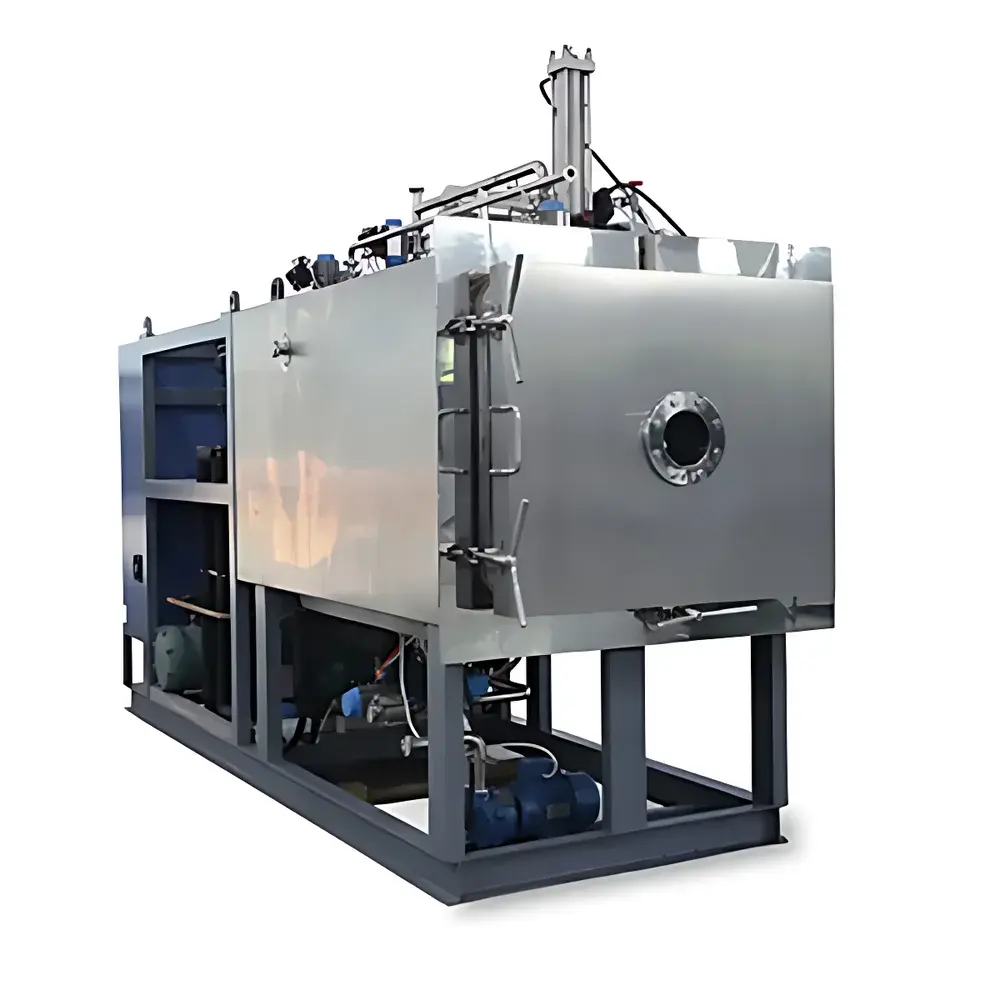
Ningbo Scientz SCIENTZ-S Pilot-Scale Freeze Dryer
| Brand | Ningbo Scientz |
|---|---|
| Origin | Zhejiang, China |
| Manufacturer Type | Direct Manufacturer |
| Equipment Type | Standard Shelf-Type Freeze Dryer |
| Application Scale | Pilot-Scale |
| Lyophilization Area | 0.21 m² |
| Ultimate Vacuum (Empty Chamber) | ≤5 Pa |
| Condensate Capacity (24 h) | 4 kg/24 h |
| Cold Trap Temperature (Empty) | ≤−70 °C |
| Dimensions (L×W×H) | 750 × 640 × 1200 mm |
Overview
The Ningbo Scientz SCIENTZ-S Pilot-Scale Freeze Dryer is an engineered solution for controlled, scalable lyophilization under strict thermal and vacuum conditions. Based on the fundamental principles of sublimation—where ice transitions directly from solid to vapor under low-pressure, low-temperature environments—the SCIENTZ-S enables reproducible primary and secondary drying cycles essential for preserving thermolabile biologicals, pharmaceuticals, and functional foods. Designed specifically for pilot-scale development and process transfer, it bridges the gap between laboratory feasibility studies and commercial manufacturing readiness. Its integrated shelf-cooling system uses silicone oil as a uniform heat-transfer medium, ensuring precise thermal management across the entire 0.21 m² drying surface. The unit operates with a high-efficiency dual-stage refrigeration system capable of maintaining cold trap temperatures at or below −70 °C (empty), supporting rapid water vapor capture and minimizing re-deposition risks during extended drying runs.
Key Features
- Integrated PLC-based control architecture with full-color touchscreen HMI for intuitive operation and real-time parameter monitoring.
- Pre-programmed freeze-drying protocols—over 30 validated curves, each configurable in up to 40 temperature/time segments—to support diverse sample matrices and regulatory documentation requirements.
- In-situ pre-freezing and drying eliminates manual handling, reducing contamination risk and improving batch consistency.
- Shelf temperature uniformity maintained within ±1 °C across all shelves, verified via calibrated PT100 sensors embedded in the silicone oil circuit.
- High-transparency acrylic chamber door enables continuous visual inspection of product morphology, cake formation, and sublimation front progression without compromising vacuum integrity.
- Dual-mode CIP (Clean-in-Place) functionality—manual and fully automated—with programmable wash cycles, rinse sequences, and drain timing for GMP-aligned facility integration.
- Comprehensive hardware protection logic including compressor delay start, vacuum pump overpressure interlock, and condenser overload monitoring to extend service life and ensure operational continuity.
Sample Compatibility & Compliance
The SCIENTZ-S accommodates heterogeneous sample forms—including liquids, pastes, suspensions, and solid fragments—without requiring specialized trays or containment vessels. Its modular chamber design supports standard 300 mm × 400 mm stainless steel trays, compatible with common vial racks and bulk pans used in pharmaceutical development. The system meets foundational mechanical and electrical safety standards per IEC 61010-1 and complies with CE marking requirements for laboratory equipment. While not certified as Class A or B cleanroom-compatible out-of-the-box, its sealed construction, smooth-welded internal surfaces, and optional inert gas purge valve (N₂ or argon) facilitate adaptation into ISO 14644-compliant environments. Data integrity features—including time-stamped event logging, user-access levels, and audit trail export via USB—align with ALCOA+ principles and support compliance with FDA 21 CFR Part 11 when paired with validated third-party software.
Software & Data Management
Control firmware supports USB-based data export of complete cycle logs—including shelf temperature, chamber pressure, condenser temperature, and elapsed time—in CSV format for offline analysis. Optional PC-based software provides graphical overlay of multiple batches, deviation alerts, and customizable report templates compliant with GLP documentation workflows. All freeze-drying curves are stored internally with timestamped version control; users may import/export protocols using encrypted USB drives to prevent unauthorized modification. Remote monitoring capability (via optional Ethernet/WiFi module) delivers live telemetry to enterprise LIMS or MES platforms, enabling centralized oversight across multi-unit installations.
Applications
- Pharmaceutical Development: Stabilization of monoclonal antibodies, viral vectors, peptide therapeutics, and sterile APIs where residual moisture content must remain below 1–2% w/w to ensure long-term stability and bioactivity retention.
- Biobanking & Regenerative Medicine: Preservation of primary cell cultures, stem cell monolayers, decellularized tissues, and extracellular matrix scaffolds while maintaining structural integrity and enzymatic function post-rehydration.
- Nutraceutical & Functional Food Processing: Dehydration of probiotic cultures, botanical extracts, and enzyme-rich concentrates without Maillard reaction or oxidation—critical for shelf-life extension and label claim substantiation.
- Academic & Industrial R&D: Process parameter optimization (e.g., shelf ramp rate, primary drying endpoint detection), formulation screening, and scale-up modeling using consistent thermal profiles across benchtop, pilot, and production systems.
- Museum Conservation & Archaeological Science: Stabilization of waterlogged organic artifacts—including wood, textiles, and parchment—prior to display or archival storage, minimizing dimensional distortion and hydrolytic degradation.
FAQ
What is the maximum allowable load volume per cycle?
The SCIENTZ-S is rated for up to 4 kg of frozen water-equivalent mass per 24-hour cycle, assuming optimal freezing depth and uniform loading distribution across the 0.21 m² shelf area.
Can the system be validated for GMP use?
Yes—while the base configuration requires user-performed IQ/OQ/PQ, the SCIENTZ-S includes all necessary instrumentation (RTDs, pressure transducers, data logging) and protocol flexibility to support formal validation against USP <1211>, ISO 20957, and EU Annex 15 requirements.
Is silicone oil leakage a concern during extended operation?
No—the circulation system employs welded stainless steel manifolds and ceramic-sealed gear pumps designed for >10,000 hours of continuous service; routine maintenance intervals are specified at 12 months or 2,000 operating hours, whichever occurs first.
Does the unit support automatic endpoint determination?
Not natively—but optional resistance temperature detector (RTD) probes embedded in representative vials can feed real-time product temperature data to the PLC, enabling custom logic-based endpoint detection via user-defined delta-T or pressure rise test algorithms.
What utilities are required for installation?
Standard single-phase 220 VAC ±10%, 50 Hz power supply; ambient cooling air clearance ≥500 mm on all sides; no external chilled water or compressed air connections are needed.



