
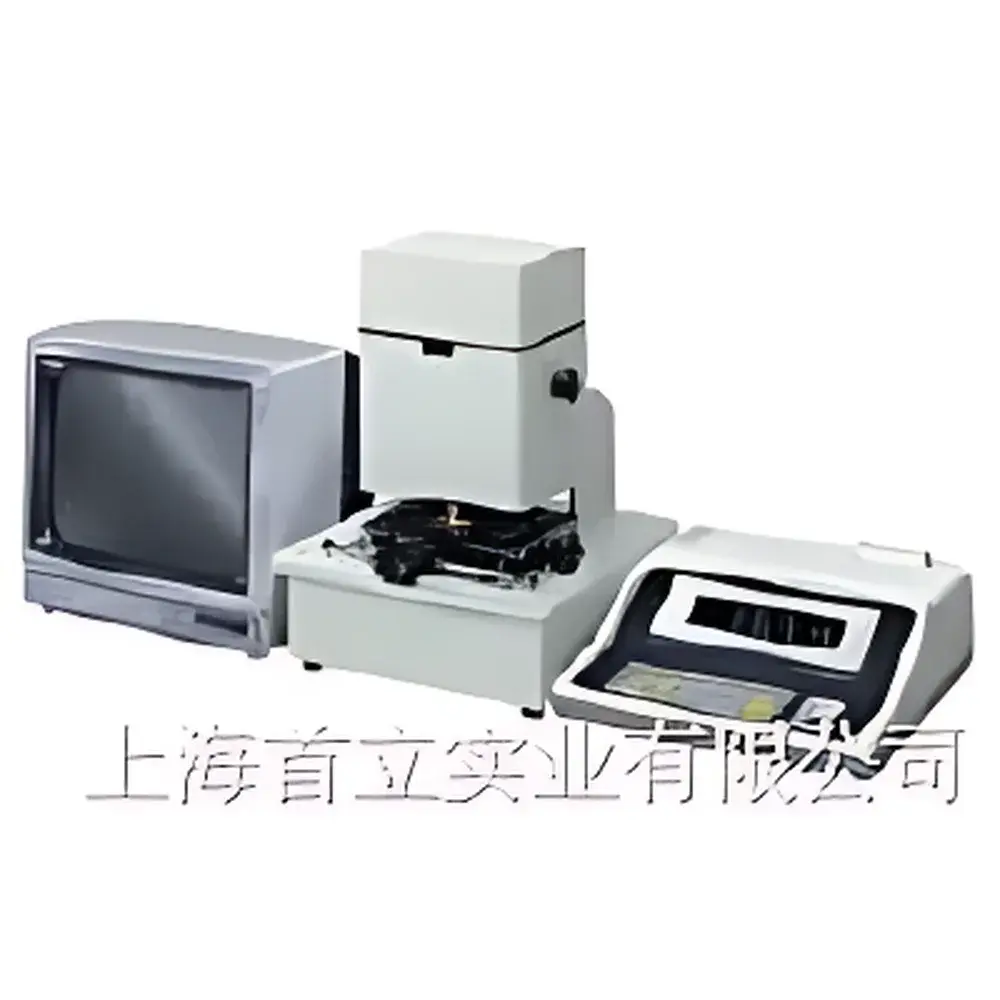
NIPPON DENSHOKU VSS-300H Micro-Area Spectrophotometric Colorimeter
| Brand | NIPPON DENSHOKU |
|---|---|
| Origin | Japan |
| Model | VSS-300H |
| Type | Benchtop Colorimeter |
| Measurement Principle | 45°/0° Illumination/Viewing Geometry |
| Spectral Range | 400–700 nm |
| Wavelength Intervals | 20 nm (standard), optional 10 nm or 5 nm |
| Measuring Apertures | φ0.1 mm, φ0.2 mm, φ0.5 mm, φ1.0 mm |
| Compliance | JIS Z 8722, ASTM E 308 |
| Light Source | 12 V / 4 A Halogen Lamp |
| Detector | Color CCD Camera |
| Display | 14" Color Monitor |
| Power Consumption | 90 W |
| Optical Unit Dimensions | 360 × 360 × 460 mm (W×D×H) |
| Measurement Unit Dimensions | 350 × 360 × 110 mm (W×D×H) |
| XY Stage | 200 × 150 mm Motorized Precision Platform |
| Software Interface | Windows-Compatible Color Management Software with RS-232C Communication |
Overview
The NIPPON DENSHOKU VSS-300H is a benchtop micro-area spectrophotometric colorimeter engineered for high-precision spatial color and density characterization of small, heterogeneous, or patterned surfaces. It operates on the 45°/0° illumination/viewing geometry—where two 45° incident light beams converge at the sample surface to form a precisely defined measurement spot, while the detector collects light vertically (0°). This configuration minimizes directional bias and ensures compliance with JIS Z 8722 and ASTM E 308 standards for reflectance and transmittance measurements. The instrument integrates a high-resolution color CCD camera that provides real-time visual feedback of the sample surface, enabling accurate positioning and focus verification prior to spectral acquisition. With selectable apertures ranging from φ0.1 mm to φ1.0 mm, the VSS-300H supports micro-scale analysis of fine features such as display subpixels, printed ink dots, thin-film coatings, and semiconductor packaging markings—applications where conventional macro-colorimeters lack sufficient spatial resolution.
Key Features
- Motorized 200 × 150 mm X-Y precision stage for repeatable positioning across large-area samples without manual re-alignment
- Real-time CCD imaging system with on-screen crosshair overlay for exact targeting of measurement points and optical focus validation
- Four interchangeable measuring apertures (φ0.1 mm, φ0.2 mm, φ0.5 mm, φ1.0 mm) to match application-specific spatial resolution requirements
- Dual-mode optical path: configurable for specular-included (SCI) and specular-excluded (SCE) reflectance measurements, supporting both diffuse and mirror-like surface evaluation
- Halogen lamp-based broadband illumination (400–700 nm) with stable thermal output and calibrated spectral power distribution
- Optional wavelength resolution enhancement: standard 20 nm sampling intervals can be upgraded to 10 nm or 5 nm for improved spectral fidelity in narrow-band applications
- Built-in support for transmission mode measurements using standardized transparent sample holders and collimated reference paths
Sample Compatibility & Compliance
The VSS-300H accommodates rigid, flexible, and semi-transparent substrates—including LCD panels, OLED modules, printed circuit boards, coated films, anodized metals, and laminated packaging materials. Its non-contact design eliminates mechanical pressure on delicate surfaces, preserving sample integrity during repeated measurements. The instrument meets key international metrological standards: spectral data processing conforms to CIE 15:2018 for tristimulus value computation; color space outputs (CIE XYZ, L*a*b*, YI, Whiteness Index) are traceable to NIST-calibrated reference standards. For regulated environments, the system supports audit-ready operation when paired with validated color management software compliant with FDA 21 CFR Part 11 requirements—including electronic signatures, user access control, and immutable measurement history logs.
Software & Data Management
The Windows-compatible color management software provides full instrument control, spectral visualization, comparative analysis, and statistical reporting. Users can define custom measurement routines—including automatic grid scanning over user-specified regions, fixed-point batch acquisition, and time-series monitoring of chromatic drift. Raw spectral data (reflectance/transmittance vs. wavelength) is exportable in CSV and ASCII formats for integration into third-party analytical platforms (e.g., MATLAB, Python-based spectral modeling tools). The software maintains hierarchical data structures with metadata tagging (operator ID, timestamp, aperture setting, illumination mode), facilitating GLP/GMP-aligned documentation workflows. Optional RS-232C interface enables direct integration into automated production line QC systems for real-time pass/fail decision logic.
Applications
- Micro-color uniformity assessment of AMOLED and micro-LED display pixels at ≥20 µm resolution
- Quantitative evaluation of inkjet-printed color patches in high-DPI proofing and packaging validation
- Spectral characterization of interference filters, anti-reflective coatings, and dichroic thin films
- Reflectance and density mapping of halftone dot gain in gravure and flexographic printing processes
- Quality control of automotive interior trim components with multi-material surfaces (e.g., stitched leather + plastic inserts)
- Transmittance profiling of optical diffusers and light-guide plates used in backlight units
FAQ
What is the smallest measurable area supported by the VSS-300H?
The instrument supports a minimum measurement aperture of φ0.1 mm, enabling spatially resolved color analysis of features down to approximately 100 µm in diameter under optimal focusing conditions.
Does the VSS-300H support measurement of fluorescent or phosphorescent materials?
No—the halogen lamp source lacks UV excitation capability, and the spectral range (400–700 nm) does not extend into the UV-A region required for fluorescence induction. Fluorescent sample evaluation requires dedicated UV-VIS spectrophotometers.
Can the system be integrated into a laboratory information management system (LIMS)?
Yes—via RS-232C serial communication and structured ASCII data output, the VSS-300H can feed measurement records directly into LIMS platforms supporting ASTM E1384 or HL7-compliant ingestion protocols.
Is calibration verification traceable to national standards?
Yes—NIPPON DENSHOKU provides factory calibration certificates traceable to JCSS-accredited reference standards; users may perform routine verification using supplied ceramic tile and neutral density reference tiles.
What maintenance is required for long-term photometric stability?
Annual lamp replacement and biannual CCD sensor dark-current recalibration are recommended; optical path alignment checks should be performed after any mechanical shock or relocation.




