
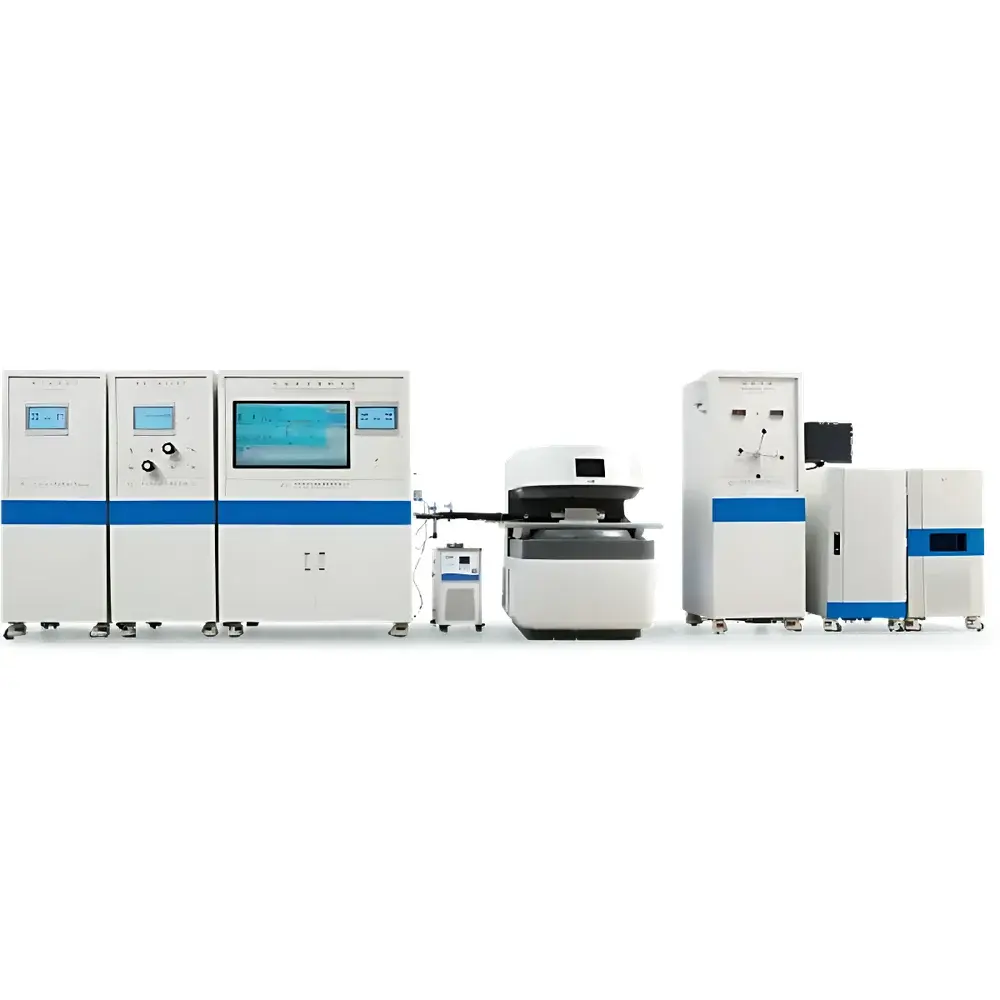
NIUMAG MacroMR12-150H-HTHP Stress-Induced Fracturing Evaluation System
| Brand | NIUMAG |
|---|---|
| Origin | Jiangsu, China |
| Instrument Type | Low-Field Nuclear Magnetic Resonance (LF-NMR) Analyzer |
| Magnetic Field Strength | 0.3 T ± 0.03 T |
| Sample Orientation | Transverse/Longitudinal |
| Magnet Configuration | C-shaped Open Design |
| Maximum Sample Dimensions (HTHP Mode) | Ø ≤ 25.4 mm × L ≤ 80 mm |
| High-Temperature/High-Pressure Capability | Yes |
| Sample Compatibility | Solid-Liquid Dual-Phase |
| Gradient System | High-Precision Active Gradient |
| Temperature Control | High-Stability Thermostatic Probe |
| Accessories | Multi-Scale Rock Core Holders, Environmental Simulation Chambers (T/P/Fluid/Gas) |
Overview
The NIUMAG MacroMR12-150H-HTHP Stress-Induced Fracturing Evaluation System is a purpose-built low-field nuclear magnetic resonance (LF-NMR) platform engineered for in situ, non-invasive characterization of fracture initiation, propagation, and fluid redistribution under controlled thermo-mechanical loading conditions. Unlike conventional static imaging or post-mortem analysis methods, this system integrates NMR relaxometry and imaging with simultaneous high-temperature (HT) and high-pressure (HP) mechanical stress application—enabling real-time quantification of pore-scale structural evolution, fluid saturation dynamics, and crack network development in geomechanical specimens. Its C-shaped open magnet architecture supports flexible sample orientation (transverse or longitudinal), facilitating direct coupling with triaxial or uniaxial loading frames. The system operates at a stable 0.3 T field strength, optimized for robust signal-to-noise ratio in heterogeneous, low-proton-density media such as tight sandstones, shales, cementitious matrices, and frozen soils—making it particularly suitable for reservoir engineering, geotechnical stability assessment, and materials science research where dynamic fracture–fluid–matrix interactions govern performance.
Key Features
- C-shaped open magnet design with 110/150 mm clear aperture, enabling seamless integration with external mechanical loading systems and accommodating core samples up to Ø150 mm in standard configuration
- High-precision thermostatic probe with active temperature stabilization (±0.1 °C), supporting experiments from sub-zero to elevated temperatures (e.g., −20 °C to 150 °C) under confining pressure
- Dual-mode acquisition capability: quantitative T2 relaxometry for pore-size distribution and bound/free water differentiation, plus 2D/3D NMR imaging for spatial mapping of fluid migration and fracture geometry
- Modular environmental chamber interface: compatible with custom-designed rock core holders that integrate fluid injection ports, pressure transducers, and strain gauges for true multi-physics simulation (stress–temperature–fluid–chemistry)
- Robust gradient subsystem enabling diffusion-weighted measurements (PFG-NMR) and velocity-encoded imaging for quantifying fluid flow within evolving fracture networks
Sample Compatibility & Compliance
The MacroMR12-150H-HTHP accommodates solid–liquid composite samples including intact and fractured rock cores (sandstone, shale, carbonate), cement paste/mortar/concrete specimens, frozen and unfrozen soils, and engineered geomaterials. It supports ASTM D4546 (swell/shrinkage of soils), ISO 17892-12 (geotechnical investigation – water content determination), and USP guidelines for analytical instrument qualification (AIQ) in regulated environments. While not FDA-cleared as a medical device, its data acquisition architecture complies with GLP/GMP-aligned audit trail requirements—including user authentication, parameter logging, and immutable raw data storage—ensuring traceability for peer-reviewed publication and regulatory submission.
Software & Data Management
Controlled via NIUMAG’s proprietary MesoMR software suite, the system provides scriptable pulse sequence editing (including CPMG, IR, SE, and stimulated echo variants), automated T2 inversion using non-negative least squares (NNLS), and voxel-wise parametric mapping. All acquisitions are timestamped and metadata-tagged (temperature, pressure, load history). Export formats include DICOM, NIfTI, CSV, and HDF5—ensuring compatibility with MATLAB, Python (NumPy/SciPy), and commercial reservoir simulators (e.g., CMG, TOUGH2). Data integrity is maintained through checksum validation and optional encryption; audit logs meet 21 CFR Part 11 electronic record requirements when deployed with validated IT infrastructure.
Applications
- Quantitative monitoring of moisture redistribution during freeze–thaw cycling in unsaturated soils and permafrost analogs, including unfrozen water content estimation and ice lens nucleation kinetics
- In situ tracking of hydration front progression, capillary transport, and microcrack coalescence in cement-based materials under thermal gradients and mechanical restraint
- Multiphase fluid saturation mapping in reservoir rocks subjected to hydraulic fracturing simulations—correlating NMR-derived permeability proxies with acoustic emission and digital image correlation (DIC) data
- Assessment of chemical degradation mechanisms (e.g., sulfate attack, carbonation) on pore structure evolution and crack path tortuosity in concrete and mortar
- Characterization of stress-dependent wettability alteration and residual saturation hysteresis in unconventional reservoir analogs under realistic burial conditions
FAQ
What sample sizes can be accommodated under high-temperature/high-pressure conditions?
Standard HTHP operation supports cylindrical samples up to Ø25.4 mm × 80 mm length. Larger diameters (up to Ø150 mm) are supported in ambient-pressure configurations using extended-length C-frame accessories.
Is the system capable of real-time imaging during mechanical loading?
Yes—continuous acquisition modes allow synchronized NMR data collection at frame rates up to 1 image per 3–5 seconds during slow-rate displacement-controlled loading, depending on resolution and SNR requirements.
Can the system quantify absolute permeability?
While not a direct permeameter, the system enables derivation of permeability proxies (e.g., SDR, Timur-Coates, and Kozeny–Carman correlations) from T2 distributions and porosity maps, validated against core flooding experiments.
Are custom pulse sequences supported?
Yes—MesoMR includes a graphical sequence editor and Python API for developing and deploying user-defined RF and gradient waveforms, subject to hardware timing constraints.
Does the system support multi-nuclear detection beyond 1H?
The base configuration is optimized for 1H detection. Optional broadband probes and amplifiers enable 19F and 23Na detection, though sensitivity and resolution are significantly reduced compared to proton mode.
Related Products






