
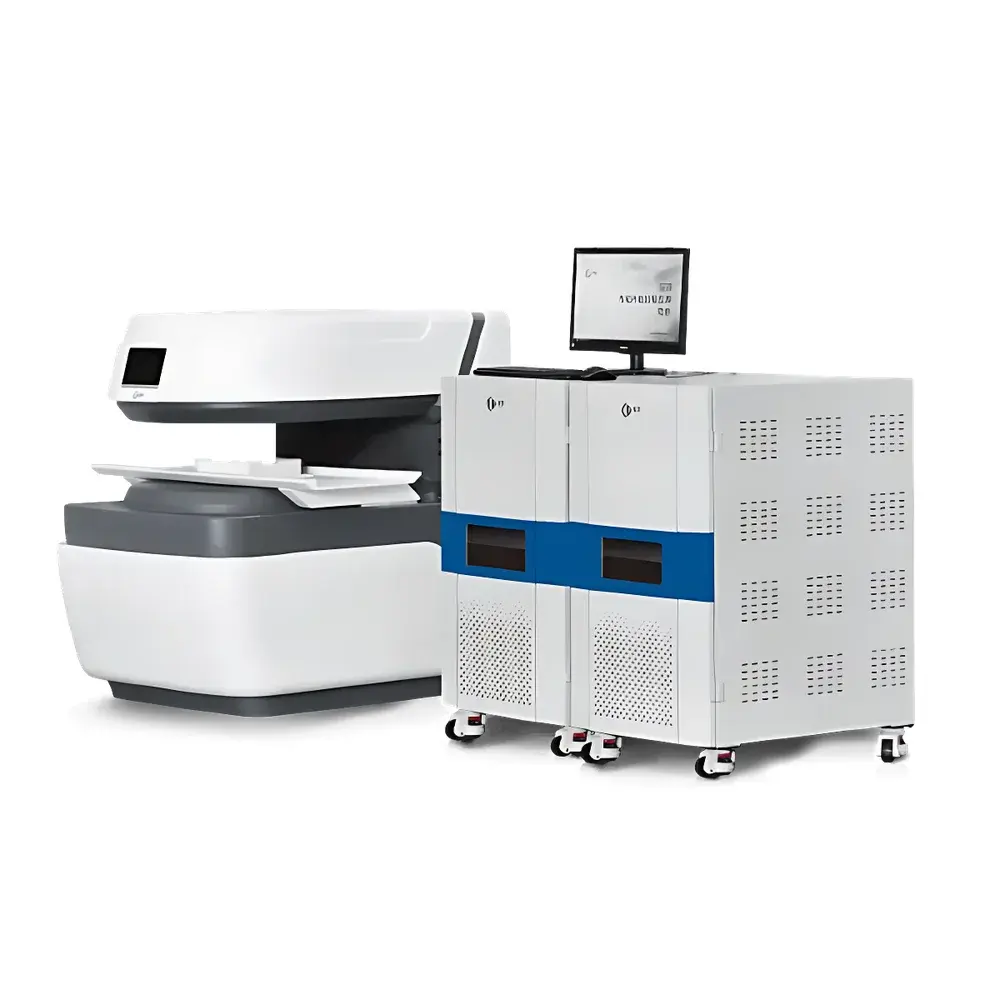
NIUMAG MacroMR12-150H-I Triaxial Low-Field Nuclear Magnetic Resonance Analyzer
| Brand | NIUMAG |
|---|---|
| Origin | Jiangsu, China |
| Manufacturer Type | Authorized Distributor |
| Origin Category | Domestic |
| Model | MacroMR12-150H-I |
| Instrument Type | Low-Field NMR Analyzer |
| Sample Type | Solid-Liquid Dual-Phase |
| Magnetic Field Strength | 0.3 T ± 0.03 T |
| Magnet Homogeneity | ≤50 ppm |
| Magnet Configuration | C-Shaped Open-Bore |
| Sample Access Direction | Transverse & Longitudinal |
| Compatible Core Diameter | 1–4 inches |
| Temperature-Controlled Probe | High-Precision, Integrated Gradient System |
| Environmental Simulation | Concurrent Triaxial Stress, Temperature, and Fluid Saturation Control |
Overview
The NIUMAG MacroMR12-150H-I Triaxial Low-Field Nuclear Magnetic Resonance Analyzer is an integrated experimental platform engineered for in situ, non-invasive characterization of rock mechanical behavior and fluid dynamics under geomechanically relevant conditions. Unlike conventional triaxial compression testers that deliver only macroscopic stress–strain curves, this system combines high-fidelity low-field NMR detection with simultaneous application of confining pressure (up to 40 MPa), axial load, and temperature control—enabling real-time quantification of microstructural evolution during deformation. Based on the physical principles of spin relaxation (T1, T2, and diffusion-weighted encoding), the instrument resolves pore-scale fluid distribution, saturation state, mobility contrast, and irreversible damage progression—including microcrack nucleation, coalescence, and percolation pathway collapse—within intact or cored reservoir rock specimens. Its 0.3 T permanent C-shaped magnet provides stable, open-access geometry ideal for integrating custom-designed triaxial cells and environmental chambers while maintaining sufficient signal-to-noise ratio for robust T2 distribution inversion and parametric mapping.
Key Features
- C-shaped open-bore magnet architecture enabling unobstructed integration of triaxial pressure vessels and multi-port fluid injection systems
- High-precision temperature-stabilized RF probe with optimized gradient performance for spatially resolved relaxometry and imaging under load
- Modular sample environment support: interchangeable core holders accommodating 1–4 inch diameter cylindrical rock samples (standard API/ISO dimensions)
- Synchronized acquisition of mechanical loading parameters (axial force, confining pressure, pore pressure) with NMR data streams via hardware-triggered timestamp alignment
- Scalable accessory ecosystem including high-pressure fluid saturation cells, resistive heating jackets, and gas-permeable membranes for CO2, CH4, or N2 exposure experiments
Sample Compatibility & Compliance
The MacroMR12-150H-I accommodates solid–liquid heterogeneous samples typical of reservoir rocks—including sandstone, carbonate, shale, coal, and synthetic porous media—with full compatibility for brine-, oil-, or supercritical fluid-saturated configurations. It supports ASTM D4546 (swell/shrinkage of clay-bearing soils), ISO 17892-12 (laboratory triaxial testing of soils), and industry-standard protocols for core analysis (API RP 40, Core Laboratories SOPs). All NMR pulse sequences comply with GLP-aligned data integrity requirements, including audit-trail-enabled parameter logging, raw FID storage, and metadata tagging per sample ID, test condition, and operator signature. The system is designed to meet essential elements of FDA 21 CFR Part 11 for electronic records where applicable in regulated research environments.
Software & Data Management
Control and analysis are executed via NIUMAG’s proprietary NMI-Studio platform, a Windows-based application supporting sequence programming (CPMG, IR, STIR, diffusion-edited), real-time visualization of T2 spectra and grayscale/parametric MRI slices, and batch processing of time-series datasets. Raw data are stored in vendor-neutral HDF5 format with embedded DICOM-compatible headers. Quantitative outputs include porosity maps, saturation-weighted T2 cutoff determination, movable-bound fluid ratio (MBFR), capillary pressure curves derived from NMR-derived pore size distributions, and dynamic permeability estimates using Timur-Coates or SDR models. Export modules support CSV, MATLAB .mat, and Paraview-compatible VTK formats for third-party simulation coupling (e.g., TOUGH2, CMG-STARS).
Applications
- Reservoir Rock Characterization: Quantitative pore structure analysis (porosity, pore size distribution, surface relaxivity), fluid typing (oil/water/gas discrimination), saturation history reconstruction, wettability assessment via spontaneous imbibition NMR
- Enhanced Oil Recovery (EOR) Process Monitoring: Real-time tracking of polymer flood front propagation, surfactant-induced wettability alteration, low-salinity waterflooding efficiency, and thermal recovery (steam soak) effects on pore-scale fluid redistribution
- Geomechanics–Fluid Flow Coupling: In situ observation of stress-dependent permeability reduction, crack-induced anisotropy, and damage zone formation during triaxial loading/unloading cycles
- Unconventional Resource Evaluation: Isothermal adsorption/desorption kinetics of CH4/CO2 in shales and coals; hydrate nucleation and dissociation dynamics; supercritical CO2 fracturing efficacy assessment
FAQ
What magnetic field strength does the MacroMR12-150H-I operate at, and why is low-field advantageous for rock analysis?
The system operates at 0.3 T (±0.03 T), a low-field regime that enhances sensitivity to surface relaxation effects and reduces susceptibility artifacts common in heterogeneous, mineral-rich rock matrices—making it ideal for quantitative T2 distribution analysis without requiring ultra-high homogeneity.
Can the instrument perform true triaxial stress states (σ₁ ≠ σ₂ ≠ σ₃), or is it limited to conventional triaxial (σ₂ = σ₃)?
The standard configuration supports conventional triaxial loading (σ₂ = σ₃ = confining pressure); advanced variants (e.g., MacroMR12-150H-HTHP) integrate biaxial lateral stress control for true triaxial capability upon request.
Is NMR data acquisition synchronized with mechanical loading signals?
Yes—hardware-level triggering ensures sub-millisecond temporal alignment between load cell readings, pressure transducer outputs, and NMR echo train acquisition timestamps, enabling precise correlation of relaxation changes with mechanical events.
Does the system support automated long-duration experiments (e.g., 72+ hour creep or imbibition tests)?
Fully supported via scheduled sequence execution, ambient temperature stabilization, and watchdog-controlled power management; raw data are continuously logged with periodic checksum verification.
Are calibration standards and reference materials provided for quantitative validation?
NIUMAG supplies traceable NMR reference phantoms (doped water/glycerol mixtures) and certified rock standards (e.g., Bentheimer sandstone plugs) with published porosity and permeability values for method validation and inter-laboratory comparison.





