
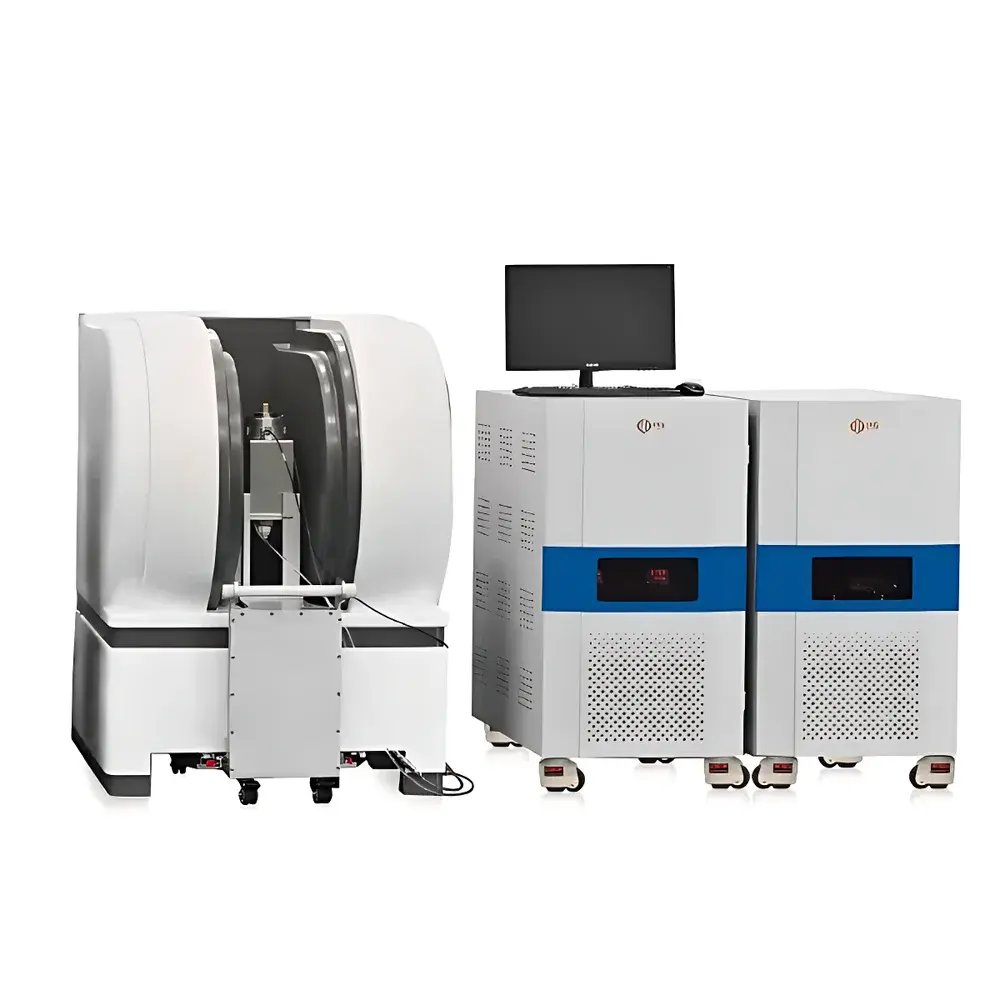
NIUMAG MacroMR12-150V-I Low-Field Nuclear Magnetic Resonance Analyzer for Unsaturated Soil Triaxial Microstructure Characterization
| Brand | NIUMAG |
|---|---|
| Origin | Jiangsu, China |
| Model | MacroMR12-150V-I |
| Magnetic Field Strength | 0.30 T ± 0.03 T |
| Magnet Homogeneity | ≤50 ppm |
| Magnet Orientation | Vertical (longitudinal sample insertion) |
| Sample Diameter Range | 25–100 mm |
| Measurement Modes | T₁/T₂ Relaxometry, Proton Density-Weighted Imaging |
| Sample Compatibility | Solid–Liquid Coupled Systems |
| Instrument Type | Low-Field NMR Spectrometer |
Overview
The NIUMAG MacroMR12-150V-I is a purpose-built low-field nuclear magnetic resonance (LF-NMR) analyzer engineered for integrated triaxial mechanical testing and microstructural characterization of unsaturated soils. Unlike conventional NMR spectrometers optimized for molecular chemistry or biomedical imaging, this system operates at 0.30 T and is specifically designed to resolve pore-scale water dynamics in geomaterials under controlled stress, temperature, and fluid-flow conditions. Its core measurement principle relies on detecting hydrogen proton spin relaxation behavior—specifically transverse (T₂) and longitudinal (T₁) relaxation times—in pore-confined water phases. Because relaxation rates are exquisitely sensitive to local magnetic field inhomogeneity, surface-to-volume ratio, and molecular mobility, the resulting T₁/T₂ spectra provide quantitative, non-invasive access to pore size distribution, water saturation state (free, capillary, bound), and real-time water migration pathways—all without sample drying, crushing, or chemical alteration. This capability bridges a critical gap between macroscopic geomechanical response and nanoscale interfacial physics, enabling direct correlation between triaxial stress–strain curves and concurrent evolution of pore water distribution.
Key Features
- Vertical-bore superconducting magnet (0.30 T ± 0.03 T) with ≤50 ppm homogeneity over a 60 mm DSV, optimized for gravity-aligned soil column experiments and compatibility with triaxial pressure cells.
- Dual-mode acquisition architecture supporting both high-fidelity T₁/T₂ relaxometry (Carr–Purcell–Meiboom–Gill and inversion recovery sequences) and proton density-weighted 2D/3D imaging with spatial resolution down to 100 µm (dependent on gradient strength and signal-to-noise ratio).
- Integrated high-stability gradient system (up to 0.5 T/m) enabling slice-selective excitation and dynamic layer-resolved monitoring of water redistribution during consolidation, freeze–thaw cycling, or permeation tests.
- Modular accessory ecosystem including temperature-controlled chambers (−40 °C to +80 °C), triaxial load frames (up to 2 MPa confining pressure), fluid injection manifolds, and gas-permeable sample holders—designed for multi-physics coupling (thermo-hydro-mechanical-chemical, THMC).
- Robust RF probe with active shielding and broadband tuning (1–30 MHz) ensures stable signal acquisition across heterogeneous soil matrices, from clay-rich sediments to coarse-grained engineered fills.
Sample Compatibility & Compliance
The MacroMR12-150V-I accommodates cylindrical soil specimens ranging from 25 mm to 100 mm in diameter and up to 200 mm in height—covering standard ASTM D4767 (consolidated-undrained triaxial), ISO 17892-9 (laboratory triaxial compression), and USP guidance for material characterization instrumentation. It supports fully hydrated, partially saturated, frozen, and chemically amended samples—including agricultural topsoil, municipal solid waste landfill cover materials, cement-stabilized dredged sediments, and polymer-modified subgrades. All hardware and firmware comply with IEC 61000-6-3 (EMC emissions) and IEC 61000-6-2 (immunity). Data acquisition workflows support audit trails and electronic signatures per FDA 21 CFR Part 11 when operated with validated software modules, facilitating GLP/GMP-aligned reporting in regulatory environmental and geotechnical studies.
Software & Data Management
Acquisition and analysis are performed using NIUMAG’s proprietary MesoMR Studio v5.x platform, which provides sequence programming, real-time spectral reconstruction, and parametric mapping (T₂ distribution histograms, PD-weighted slice stacks, diffusion-weighted contrast). Raw FID data are stored in vendor-neutral HDF5 format with embedded metadata (pulse sequence parameters, temperature logs, axial load history). Batch processing pipelines enable automated T₂ cutoff determination using iterative SVD deconvolution and constrained non-negative least squares (CNLS) fitting. Export options include CSV, MATLAB .mat, and DICOM-compliant image series for integration with third-party geomechanical modeling tools (e.g., COMSOL Multiphysics, FLAC²D). The software supports role-based user permissions, version-controlled method templates, and full traceability of calibration events—meeting requirements for ISO/IEC 17025 accredited laboratories.
Applications
- Hydrological characterization: Quantification of unfrozen water content during freezing, hysteresis in soil–water characteristic curves (SWCC), and hydraulic conductivity estimation via T₂–porosity scaling relationships.
- Thermo-mechanical coupling: In situ observation of ice lens formation, frost heave kinetics, and thaw settlement mechanisms in seasonally frozen ground and permafrost analogs.
- Stabilization performance assessment: Time-resolved monitoring of pore water displacement during grouting, electrokinetic treatment, or biocementation—correlating moisture redistribution with unconfined compressive strength development.
- Multi-field triaxial testing: Synchronous acquisition of deviatoric stress, volumetric strain, and T₂-weighted cross-sectional images during drained/undrained monotonic or cyclic loading—revealing preferential flow channeling and shear band nucleation.
- Contaminant transport modeling: Tracking tracer breakthrough profiles (e.g., saline solutions, hydrocarbon emulsions) through heterogeneous media using time-resolved relaxometry, informing reactive transport parameterization.
FAQ
Can the MacroMR12-150V-I perform true in-situ measurements inside an operational triaxial cell?
Yes—the vertical magnet geometry and modular triaxial adapter allow full integration with standard 100 mm-diameter triaxial cells. Confining pressure, backpressure, and axial load signals are synchronized with NMR acquisition via TTL-triggered data logging.
What is the minimum detectable water content for clayey soils?
Detection limit is sample-dependent but typically ≤0.5 vol% for smectite-rich clays with strong surface relaxation; accuracy improves with longer echo trains and signal averaging.
Is the system compatible with cryogenic temperature stages for sub-zero experiments?
Yes—NIUMAG offers a certified LN₂-cooled stage (-40 °C to +20 °C) with integrated thermal shielding to minimize eddy current interference and maintain field homogeneity.
How is data reproducibility ensured across different operators and laboratories?
Standardized pulse sequences, auto-tuned RF calibration routines, and built-in reference phantoms (doped water gels with known T₂) enable inter-laboratory comparability per ISO 17892-1 Annex B guidelines.
Does the system support custom pulse sequence development?
Yes—MesoMR Studio includes a C++-based sequence compiler and API for advanced users to implement diffusion-editing, multi-echo spin-echo trains, or stimulated-echo protocols tailored to specific soil physics questions.




