
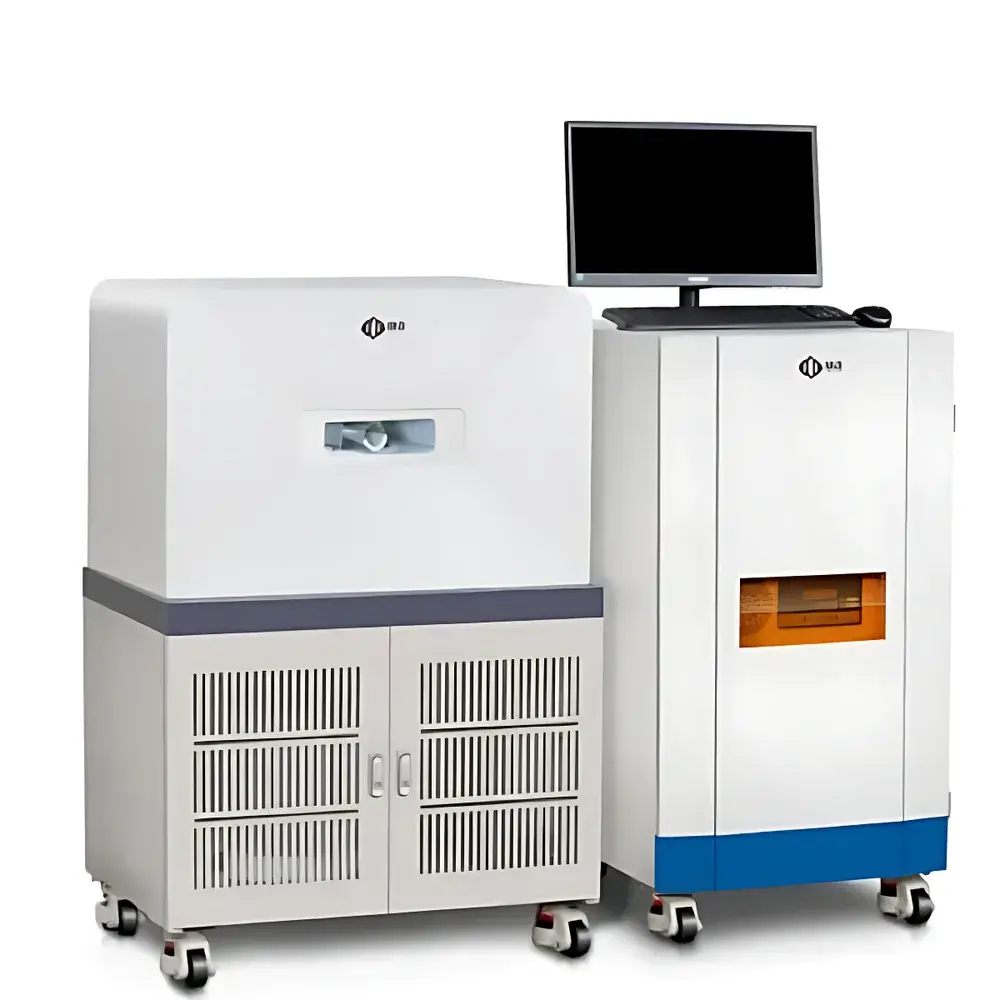
NIUMAG NMI20 Series 3D-Printed Food Moisture Analyzer
| Brand | NIUMAG |
|---|---|
| Origin | Jiangsu, China |
| Manufacturer Type | Authorized Distributor |
| Regional Classification | Domestic (PRC) |
| Model | NMI20 Series+ |
| Pricing | Upon Request |
Overview
The NIUMAG NMI20 Series 3D-Printed Food Moisture Analyzer is a benchtop low-field nuclear magnetic resonance (LF-NMR) instrument engineered for non-invasive, quantitative, and spatially resolved analysis of water and oil content in food matrices—specifically optimized for applications in additive manufacturing of food. Unlike conventional gravimetric or Karl Fischer titration methods, this system leverages proton spin relaxation physics (T1, T2, and diffusion-weighted sequences) to differentiate bound, intermediate, and free water populations, as well as oil-phase distribution, without sample destruction or chemical reagents. Its design addresses critical process challenges in 3D food printing—including moisture heterogeneity, layer adhesion stability, rheological fidelity during extrusion, and post-printing shelf-life prediction—by delivering reproducible, physics-based metrics directly correlated with texture, structural integrity, and microbial stability.
Key Features
- 60 mm vertical bore diameter accommodates diverse 3D-printed food geometries—from extruded filaments and layered gels to porous scaffolds and multi-material composites—without size-related truncation artifacts.
- Three-step imaging workflow: automatic shimming, sequence selection, and reconstruction—enabling full T2-weighted, T1-weighted, and proton density mapping in under 2 minutes per sample (dependent on relaxation times and SNR requirements).
- Dual-mode operation: quantitative relaxometry (single-point or CPMG-based T2 decay fitting) and spatially resolved 2D NMR imaging (arbitrary slice orientation, variable thickness from 1–10 mm, isotropic resolution down to 0.5 mm).
- Proprietary second-generation spectrometer platform with real-time RF pulse calibration and adaptive gradient compensation—minimizing eddy current distortion in heterogeneous, high-salt, or conductive food samples.
- Zero-consumable operation: no solvents, no standards, no calibration curves required; measurement traceability grounded in fundamental NMR parameters (Larmor frequency, echo spacing, repetition time).
Sample Compatibility & Compliance
The NMI20 Series accepts solid, semi-solid, liquid, and powdered food specimens with mass ranging from 1 g to 120 g and minimum volume ≥1 mL. It has been validated across meat analogs, hydrocolloid-based pastes (e.g., alginate, methylcellulose), chocolate melts, fruit purees, dough formulations, and plant-based protein gels. All hardware and software comply with IEC 61000-6-3 (EMC emissions) and IEC 61000-6-2 (immunity). Data acquisition protocols support audit-ready documentation aligned with GLP principles; raw FID data, processed spectra, and DICOM-compliant image stacks are stored with embedded metadata (timestamp, operator ID, pulse sequence ID, hardware configuration)—facilitating retrospective review under FDA 21 CFR Part 11–compatible environments when integrated with validated LIMS.
Software & Data Management
The bundled MestReNova-NMI and ImageLab-NMI suites provide modular analysis: T2 distribution deconvolution (using NNLS or SVD algorithms), voxel-wise water/oil ratio mapping, 3D volume rendering, and ROI-based statistical comparison across batches. Optional modules include diffusion tensor imaging (DTI) for microstructural anisotropy assessment and real-time monitoring plugins for inline process correlation. All software interfaces adhere to ISO/IEC 17025:2017 clause 7.7 (data control) and support CSV, HDF5, and NIfTI export formats. Audit trails record parameter changes, user logins, and report generation events—fully configurable for GMP-regulated R&D labs.
Applications
- Optimization of extrusion parameters (nozzle temperature, feed rate, pause duration) via real-time moisture migration tracking across printed layers.
- Evaluation of cross-linking efficiency in hydrogel-based food inks by quantifying immobilized water fraction (T2 < 10 ms).
- Stability assessment of multi-ingredient prints—e.g., identifying interfacial water redistribution between starch-rich and lipid-rich domains during storage.
- Correlation of NMR-derived water mobility indices with instrumental texture profile analysis (TPA) and sensory panel outcomes.
- Validation of drying, vacuum packaging, or controlled-humidity post-processing protocols through longitudinal T2 mapping.
FAQ
Does the NMI20 require cryogens or superconducting magnets?
No. It employs a permanent magnet operating at 0.5 T (21.3 MHz for 1H), eliminating liquid helium dependency and enabling stable, maintenance-free field homogeneity over >5 years.
Can it distinguish between ice and liquid water in frozen 3D-printed products?
Yes—through combined T2 and diffusion-weighted measurements, enabling phase discrimination based on molecular mobility differences (ice: T2 ≈ 10–50 µs; unfrozen water: T2 > 10 ms).
Is spectral editing (e.g., fat suppression) supported?
Yes—via CHESS (Chemical Shift Selective) pre-saturation pulses and IDEAL (Iterative Decomposition of water and fat with Echo Asymmetry and Least-squares estimation) reconstruction in imaging mode.
How is system performance verified post-installation?
NIUMAG provides a traceable reference phantom (doped agar gel with known T1/T2 values) and quarterly validation protocol compliant with ASTM E2824–22 (Standard Practice for Performance Verification of Low-Field NMR Analyzers).





