
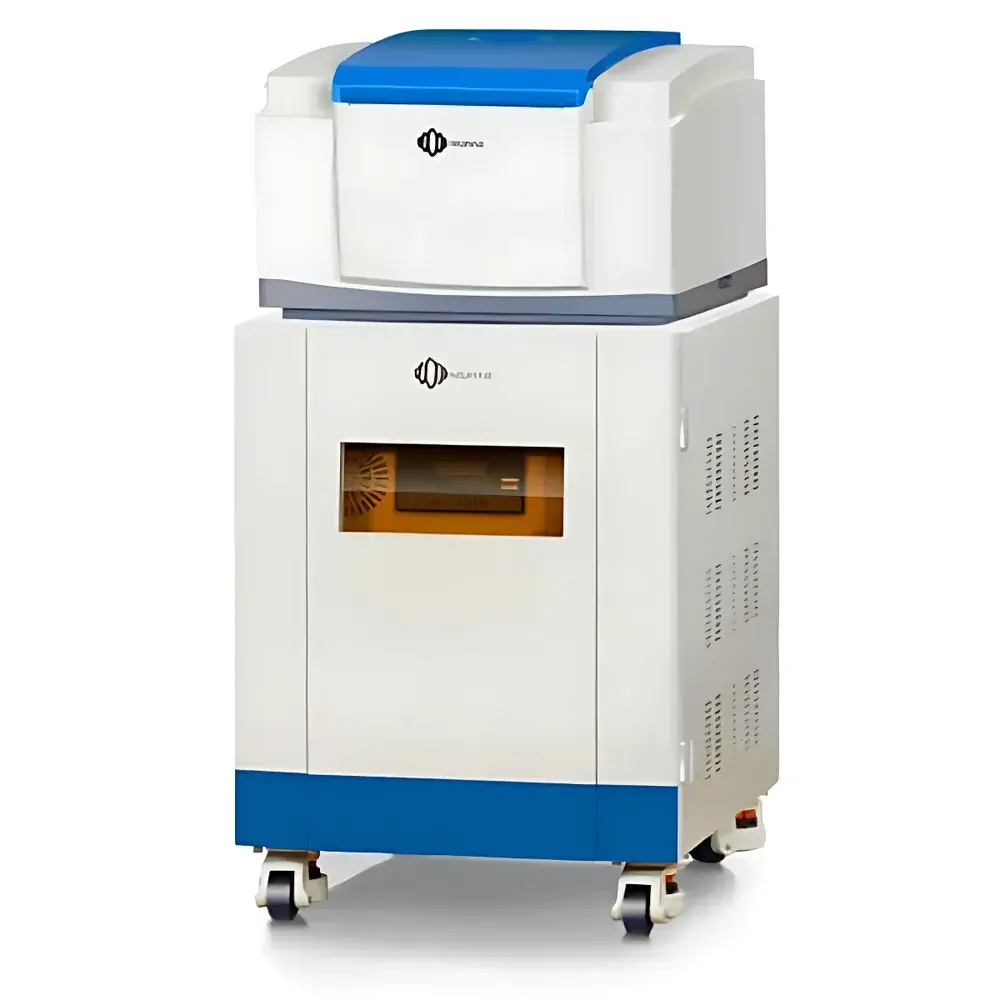
NIUMAG PQ001 Battery Electrolyte Wettability Analyzer
| Brand | NIUMAG |
|---|---|
| Origin | Jiangsu, China |
| Manufacturer Type | Authorized Distributor |
| Country of Origin | China |
| Model | PQ001 Battery Electrolyte Wettability Analyzer |
| Pricing | Available Upon Request |
| Magnetic Field Strength | 0.5 T |
| Probe Coil Diameter | 10 mm and 25 mm |
| Sample Requirement | Ferromagnetic content < 5% wt |
| Measurement Principle | Low-Field Nuclear Magnetic Resonance (LF-NMR) based on spontaneous imbibition kinetics and interfacial wetting dynamics |
Overview
The NIUMAG PQ001 Battery Electrolyte Wettability Analyzer is a purpose-built low-field nuclear magnetic resonance (LF-NMR) instrument engineered for quantitative, non-destructive assessment of electrolyte wettability in lithium-ion battery separators. Unlike conventional optical or gravimetric methods—such as contact angle measurement or capillary rise timing—the PQ001 leverages the intrinsic sensitivity of proton NMR signals to liquid-phase distribution and mobility within porous polymer matrices. It monitors real-time hydrogen signal decay during spontaneous electrolyte uptake into dry separator samples under controlled static magnetic field conditions (0.5 T), enabling direct quantification of imbibition kinetics, saturation profiles, and interfacial affinity. This physical principle aligns with fundamental capillary-driven wetting theory governed by Washburn’s equation and solid–liquid interfacial energy balance, making the PQ001 uniquely suited for R&D labs and QC environments where reproducible, material-intrinsic wettability metrics are required—not just empirical time thresholds.
Key Features
- Quantitative wettability profiling via time-resolved LF-NMR signal acquisition (T2 relaxation distribution analysis)
- Two interchangeable RF probe coils (10 mm and 25 mm inner diameter) for flexible sample sizing—from lab-scale coupons (≥1 cm²) to full-format separator strips
- Full automation of imbibition onset detection, saturation endpoint identification, and kinetic parameter extraction (e.g., imbibition rate constant, equilibrium saturation ratio)
- Non-invasive measurement: no sample coating, drying, or vacuum pretreatment required; compatible with volatile carbonate-based electrolytes (e.g., LiPF6 in EC/DMC)
- Robust architecture optimized for industrial lab environments: temperature-stabilized magnet housing, EMI-shielded RF cavity, and vibration-damped platform
- Compliance-ready data handling: audit-trail enabled software with user-level access control and electronic signature support per FDA 21 CFR Part 11 guidelines
Sample Compatibility & Compliance
The PQ001 accepts standard lithium battery separator materials—including polyolefin microporous films (PP, PE, PP/PE/PP trilayer), ceramic-coated separators, and functionalized nonwovens—provided ferromagnetic impurity content remains below 5 wt%, ensuring minimal magnetic susceptibility distortion. Samples must be flat, dry, and free of residual solvents or surfactants that alter surface energy. The system conforms to ISO/IEC 17025 general requirements for testing laboratories and supports method validation per ASTM D724–22 (Standard Test Method for Surface Wettability of Paper, Paperboard, and Other Sheet Materials by Qualitative Absorption). While not a regulatory device per se, its output parameters (e.g., normalized imbibition integral, T2-weighted saturation index) are traceable to NIST-referenced water calibration standards and routinely cited in peer-reviewed battery literature for separator qualification.
Software & Data Management
The proprietary WettaSoft™ v3.2 suite provides integrated acquisition, processing, and reporting modules. Raw FID data undergoes exponential fitting, inverse Laplace transformation, and multi-exponential deconvolution to resolve bound vs. bulk electrolyte populations. Key outputs include time-dependent saturation curves, characteristic imbibition half-times (t1/2), and comparative wettability indices across electrolyte formulations. All datasets are stored in HDF5 format with embedded metadata (operator ID, timestamp, environmental temperature/humidity, coil configuration). Export options include CSV, PDF analytical reports, and XML for LIMS integration. Software validation documentation—including IQ/OQ protocols and cybersecurity risk assessment—is available upon request for GMP-aligned facilities.
Applications
- Electrolyte formulation screening: ranking carbonate/solvent blends (e.g., FEC-modified vs. baseline EC/DEC) by separator affinity
- Separator surface modification evaluation: quantifying impact of plasma treatment, SiO2 coating, or PVDF grafting on imbibition kinetics
- Batch-to-batch consistency monitoring for separator manufacturing QA
- Accelerated aging studies: tracking wettability degradation after thermal or electrochemical stress
- Supporting DOE-driven optimization of electrode–separator–electrolyte tripartite interfaces in pouch and cylindrical cell designs
FAQ
What physical parameter does the PQ001 actually measure?
It measures the time-resolved transverse relaxation (T2) signal amplitude of 1H nuclei in electrolyte as it spontaneously penetrates a dry separator matrix—directly correlating signal intensity with local liquid volume fraction and molecular mobility.
Can the PQ001 test full-cell assemblies or only bare separators?
Only isolated separator samples are compatible; electrode layers or metal current collectors induce severe magnetic field inhomogeneity and RF shielding, precluding reliable signal acquisition.
Is calibration required before each test run?
A single reference scan using deionized water is recommended weekly to verify baseline SNR and coil tuning stability; no daily recalibration is necessary due to inherent hardware stability.
Does the instrument require cryogens or external cooling systems?
No—it operates at ambient temperature with passive magnet cooling; no liquid nitrogen or chiller connections are needed.
How does PQ001 data integrate with battery cycling performance?
Published correlations exist between PQ001-derived saturation rates and first-cycle irreversible capacity loss, as well as impedance growth during formation—enabling predictive modeling of interfacial resistance development.





