
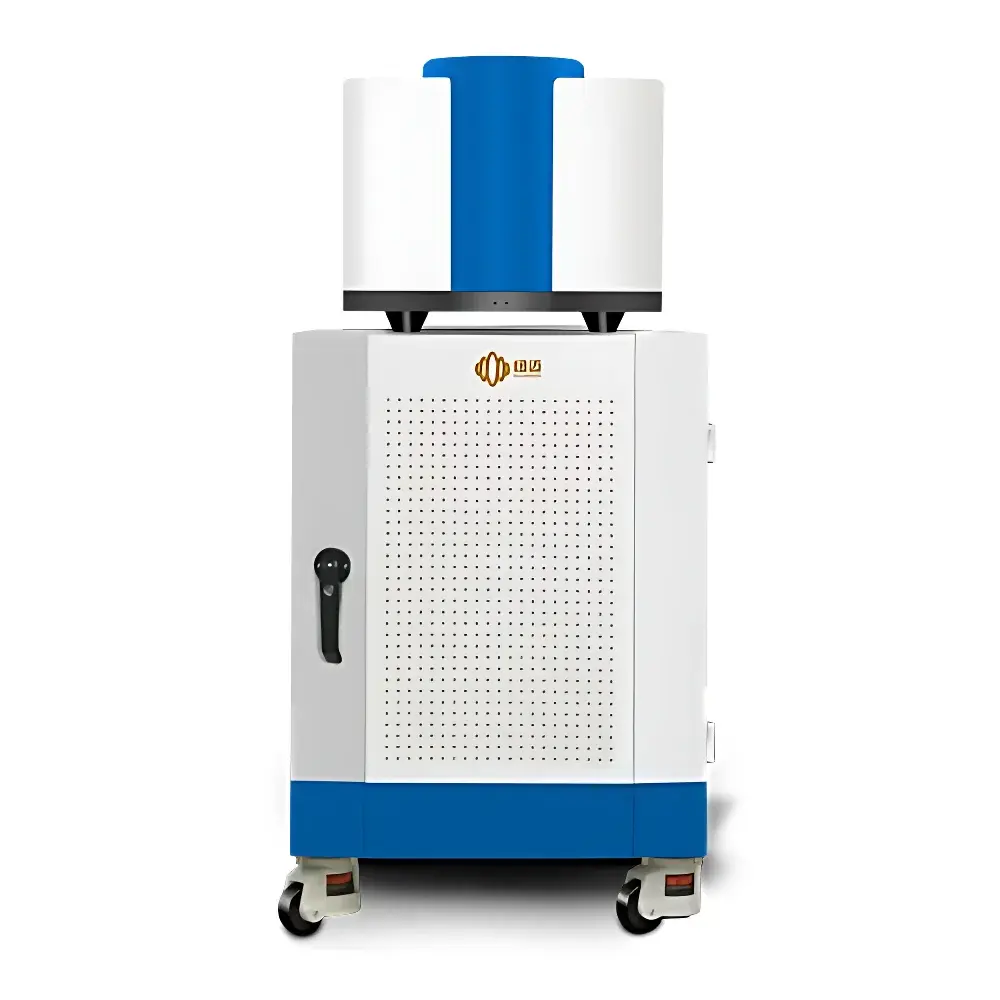
NIUMAG PQ001-KLGU Low-Field Nuclear Magnetic Resonance Wet Surface Area Analyzer
| Brand | NIUMAG |
|---|---|
| Origin | Jiangsu, China |
| Manufacturer Type | Authorized Distributor |
| Product Category | Domestic |
| Model | PQ001-KLGU |
| Instrument Type | Low-Field NMR Analyzer |
| Sample Type | Solid-Liquid Suspension |
| Magnet Type | Permanent Magnet |
| Magnetic Field Strength | 0.5 T ± 0.03 T |
| Sample Chamber Dimensions | Ø12.5 mm × H15 mm (cylindrical) |
| Magnetic Field Homogeneity | ≤30 ppm over H-volume |
| Measurement Time per Sample | ≤3 min |
| Wet Specific Surface Area Repeatability | RSD ≤1.0% |
| Probe Options | Multiple coil diameters available for varied sample viscosities and concentrations |
| Sample Preparation | None required |
Overview
The NIUMAG PQ001-KLGU Low-Field Nuclear Magnetic Resonance (LF-NMR) Wet Surface Area Analyzer is an engineered solution for quantifying the wet specific surface area of particulate materials directly in their dispersed state—without drying, degassing, or vacuum treatment. Unlike conventional gas adsorption techniques (e.g., BET nitrogen physisorption), which characterize only dry powder surfaces and fail to reflect interfacial behavior in real-world formulations, this instrument leverages the fundamental contrast in transverse relaxation times (T₂) between water molecules bound to particle surfaces and those existing as bulk-like mobile phase. By acquiring and deconvoluting multi-exponential T₂ decay curves, the system calculates the fraction of immobilized water—directly proportional to accessible wet surface area—enabling precise, non-invasive assessment under native suspension conditions. Designed for routine industrial QC and R&D environments, it operates at a stable 0.5 T permanent magnetic field with homogeneity ≤30 ppm over the defined H-volume, ensuring high reproducibility across repeated measurements.
Key Features
- Zero-sample-prep workflow: No drying, grinding, evacuation, or chemical derivatization required—ideal for heat-sensitive, hygroscopic, or aggregation-prone particles.
- Rapid analysis cycle: Full acquisition, processing, and report generation completed within ≤3 minutes per sample.
- Robust solid–liquid compatibility: Validated for suspensions ranging from low-viscosity aqueous dispersions to highly concentrated pastes (>60 wt% solids) and shear-thinning non-Newtonian systems.
- Geometry-agnostic measurement: Accepts irregularly shaped particles, agglomerates, fibers, and porous granules without size limitation—only constrained by the standard Ø12.5 mm × 15 mm cylindrical sample volume.
- Modular probe architecture: Interchangeable RF coils (e.g., 10 mm, 15 mm, 25 mm diameter) enable optimization for signal-to-noise ratio across diverse sample volumes, viscosities, and magnetic susceptibility distributions.
- Stable permanent magnet platform: Eliminates cryogen dependency, power fluctuations, and field drift—ensuring long-term calibration integrity and minimal operational overhead.
Sample Compatibility & Compliance
The PQ001-KLGU accommodates a broad spectrum of industrially relevant particulate systems, including pigment dispersions (TiO₂, carbon black, iron oxides), polymer fillers (CaCO₃, talc, silica), pharmaceutical excipients, battery cathode/anode slurries, and ceramic precursors. Its wet-surface-area output is traceable to first-principles NMR physics—not empirical correlations—supporting method validation under GLP and GMP frameworks. While not a regulated medical device, its data structure and audit trail capabilities align with FDA 21 CFR Part 11 requirements when deployed with compliant software configurations. Method development adheres to ASTM E2821–22 (Standard Guide for NMR Characterization of Colloidal Dispersions) and ISO/IEC 17025–2017 principles for measurement uncertainty estimation. All hardware components meet CE electromagnetic compatibility (EMC) Directive 2014/30/EU and Low Voltage Directive 2014/35/EU standards.
Software & Data Management
The embedded NIUMAG NMR Analysis Suite provides intuitive acquisition control, automated T₂ inversion using non-negative least squares (NNLS) algorithms, and customizable wet surface area calibration models. Raw FID and processed T₂ spectra are stored in vendor-neutral HDF5 format, enabling third-party integration via Python API. The software supports multi-user role-based access, electronic signatures, version-controlled method templates, and full audit logs—including operator ID, timestamp, parameter changes, and raw data hash verification. Export options include CSV, PDF reports with metadata embedding, and direct LIMS connectivity via OPC UA or RESTful webhooks. Calibration curves may be built using reference materials with certified wet surface areas (e.g., NIST-traceable silica dispersions), with uncertainty propagation documented per ISO/IEC Guide 98-3.
Applications
- Optimizing pigment dispersion protocols in coatings, inks, and plastics—correlating wet surface area with gloss, opacity, and rheological stability.
- Monitoring batch-to-batch consistency of functional fillers in composite manufacturing—detecting subtle changes in surface treatment or agglomeration state.
- Accelerating formulation screening for battery electrode slurries—quantifying binder-particle interaction efficiency prior to drying and calendaring.
- Validating surfactant efficacy in pharmaceutical nanosuspensions—assessing coverage uniformity and colloidal stability under physiological pH and ionic strength.
- Supporting quality release testing in high-value specialty chemicals—replacing destructive, time-intensive BET or titration-based methods with a non-destructive, in-process compatible alternative.
FAQ
How does LF-NMR differentiate bound water from free water?
It exploits the orders-of-magnitude difference in transverse relaxation rate (R₂ = 1/T₂) between water protons experiencing restricted motion near particle interfaces (short T₂, typically <1 ms) and those in the bulk liquid phase (long T₂, >100 ms). Multi-exponential fitting resolves these populations quantitatively.
Can the instrument measure absolute wet surface area without calibration?
No. Absolute quantification requires a system-specific calibration curve derived from reference materials with known wet surface area, established via gravimetric water adsorption or validated orthogonal methods.
Is temperature control available during measurement?
Yes—optional Peltier-based temperature regulation (±0.1 °C) is supported across the range of 5–60 °C to assess thermal effects on dispersion stability and hydration layer dynamics.
What sample volume is required for reliable results?
Minimum fill height is 10 mm within the standard Ø12.5 mm tube (≈1.2 mL); optimal signal-to-noise is achieved at 12–15 mm fill height.
Does high ionic strength interfere with measurement accuracy?
Elevated salt concentrations shorten overall T₂ but do not compromise differential resolution between bound and free water phases—provided the T₂ separation remains ≥2:1, which is maintained up to 3 M NaCl in typical pigment systems.





