
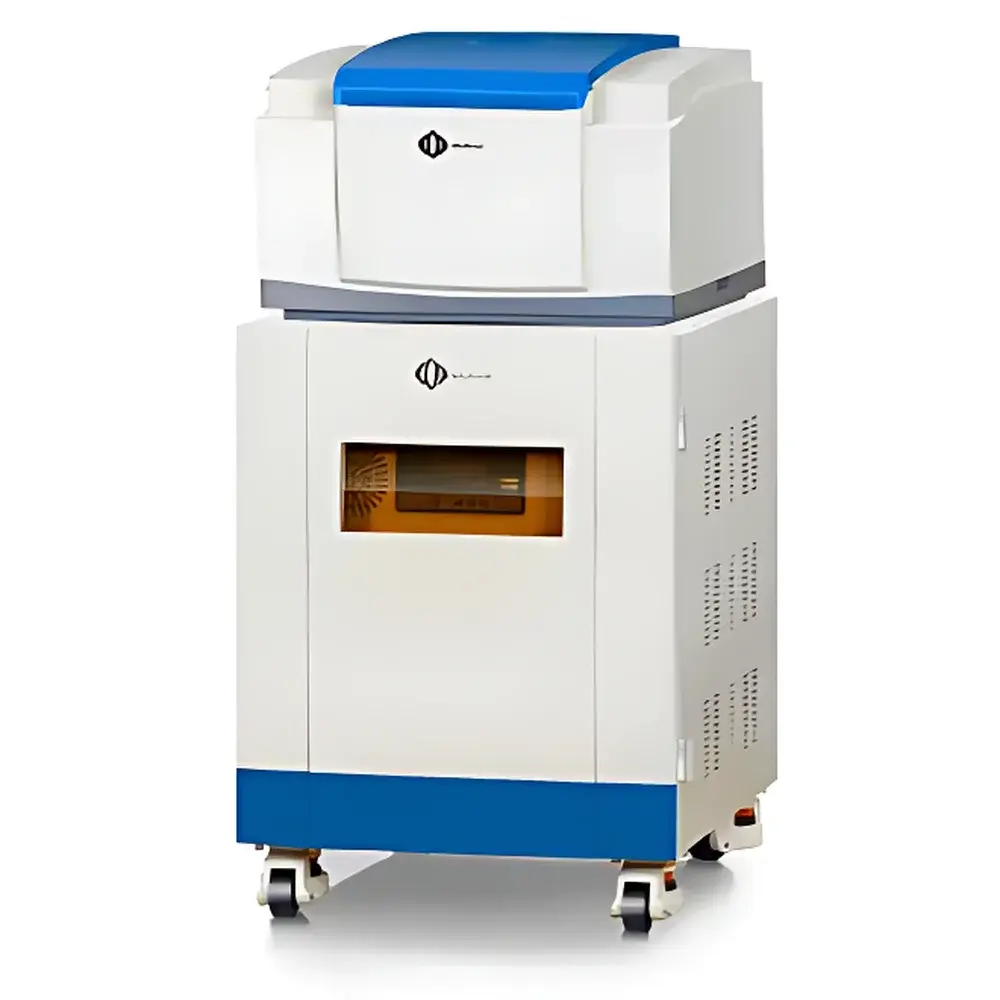
NIUMAG PQ001+ Low-Field Nuclear Magnetic Resonance Relaxometry Analyzer for Contrast Agent Characterization
| Brand | NIUMAG |
|---|---|
| Origin | Jiangsu, China |
| Manufacturer Type | Authorized Distributor |
| Regional Classification | Domestic (China) |
| Model | PQ001+ |
| Instrument Type | Low-Field NMR Relaxometer |
| Sample Compatibility | Solid-Liquid Dual-Mode |
| Pricing | Upon Request |
Overview
The NIUMAG PQ001+ is a purpose-built low-field nuclear magnetic resonance (NMR) relaxometer engineered exclusively for quantitative characterization of magnetic resonance imaging (MRI) contrast agents. Unlike clinical MRI scanners—where T1 and T2 relaxation times are inferred indirectly from image intensity gradients—the PQ001+ employs direct time-domain NMR pulse sequences (e.g., inversion recovery for T1, Carr–Purcell–Meiboom–Gill for T2) to measure longitudinal and transverse relaxation rates (R1 = 1/T1, R2 = 1/T2) with high reproducibility. Operating at a stable 0.5 T permanent magnet field, the system delivers robust signal-to-noise ratio (SNR) for aqueous suspensions, colloidal dispersions, and heterogeneous biological samples—including ex vivo tumor tissues and cell lysates—without requiring cryogenic cooling or superconducting infrastructure. Its compact footprint and modular design support integration into QC laboratories, academic core facilities, and pharmaceutical development suites where regulatory-grade repeatability and method traceability are essential.
Key Features
- 0.5 T permanent magnet with long-term field homogeneity (<±10 ppm over 20 mm DSV) and passive temperature stabilization (±0.05 °C)
- Dual-mode RF probe: Solenoid transmit/receive coil optimized for 1H detection at 21.3 MHz; integrated low-noise preamplifier (NF < 1.2 dB) mounted directly within the coil housing to minimize signal degradation
- Fully digital spectrometer architecture based on FPGA-controlled pulse generation, 16-bit ADC sampling (up to 100 MS/s), and real-time digital filtering
- Modular sample handling: Accommodates standard 10 mm and 15 mm OD glass tubes; optional temperature-controlled sample holder (range: 5–60 °C, ±0.2 °C stability)
- Compliance-ready firmware: Supports audit trail logging, user access levels, and electronic signature capability aligned with GLP and FDA 21 CFR Part 11 principles
Sample Compatibility & Compliance
The PQ001+ supports both liquid-phase (e.g., Gd-DTPA, Fe3O4 nanoparticles in buffer, MnCl2 solutions) and semi-solid biological matrices (e.g., minced tumor tissue homogenates, centrifuged cell supernatants, hydrogel-embedded contrast agents). Its solenoid coil geometry ensures uniform B1 excitation across heterogeneous samples, minimizing artifacts from susceptibility gradients. All measurement protocols adhere to ASTM E2857–22 (“Standard Practice for Determination of Relaxivity of MRI Contrast Agents Using NMR Relaxometry”) and ISO/IEC 17025:2017 requirements for calibration traceability. System validation includes daily reference standard checks using standardized doped water phantoms (T1 = 1.24 s @ 25 °C, T2 = 0.21 s @ 25 °C).
Software & Data Management
The Delphi-based NMIQ software suite provides a validated, wizard-driven interface for method setup, acquisition control, and multi-exponential decay fitting (mono-, bi-, and tri-exponential models). Raw FID and CPMG echo train data are stored in vendor-neutral HDF5 format with embedded metadata (pulse sequence parameters, instrument ID, operator, timestamp, environmental conditions). Built-in reporting modules generate PDF/CSV outputs compliant with internal SOPs and regulatory submissions, including relaxivity (r1/r2, mM−1s−1) calculations referenced to molar metal concentration (ICP-MS or UV-Vis verified). Data integrity safeguards include write-once storage mode, automatic backup to network drives, and configurable retention policies.
Applications
- Quantitative relaxivity profiling of paramagnetic (Gd3+, Mn2+) and superparamagnetic (Fe3O4) contrast agents under physiologically relevant pH and ionic strength conditions
- Structure–function correlation studies: Assessing impact of ligand chelation stability, nanoparticle surface coating, and aggregation state on R1/R2 ratios
- Batch-to-batch consistency testing for GMP-compliant contrast agent manufacturing
- Ex vivo relaxation mapping of resected tumor specimens to correlate T2 shortening with iron oxide nanoparticle uptake
- Cellular relaxometry: Measuring intracellular accumulation kinetics via T2 changes in labeled macrophages or stem cells
FAQ
Does the PQ001+ require liquid helium or external cryogens?
No. It uses a permanent magnet system operating at ambient temperature with no consumables or cryogenic maintenance.
Can it measure both r1 and r2 relaxivity simultaneously?
Yes—sequential T1 and T2 acquisitions are automated within a single workflow, with concentration normalization applied post-processing using imported ICP-MS or UV-Vis quantification data.
Is the software compliant with 21 CFR Part 11 for regulated environments?
The system supports electronic signatures, role-based access control, and audit-trail-enabled operation when deployed with validated IT infrastructure and documented procedures.
What sample volume is required for reliable T2 measurement?
Minimum recommended volume is 0.5 mL for 10 mm OD tubes; optimal SNR is achieved with 1.0–1.5 mL of homogeneous suspension.
How is magnet field drift compensated during long-term experiments?
Real-time field-frequency lock is maintained via a built-in deuterium reference channel, enabling >8-hour unattended acquisition stability.





