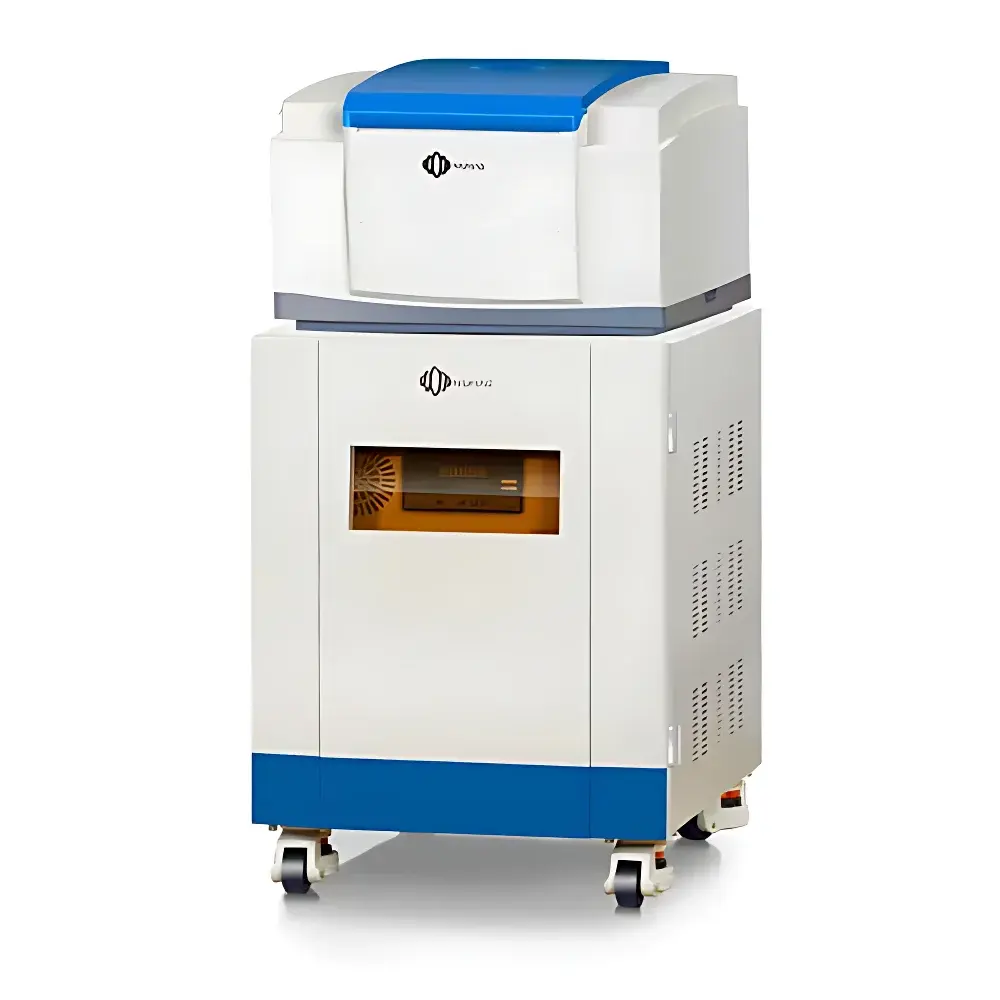
NIUMAG PQ001-spinF Benchtop NMR Analyzer for Fiber Oil Content Measurement
| Brand | NIUMAG |
|---|---|
| Origin | Shanghai, China |
| Manufacturer Type | Authorized Distributor |
| Country of Origin | China |
| Model | PQ001-spinF |
| Quotation | Upon Request |
| Magnet Type | Permanent Magnet |
| Static Magnetic Field Strength | 0.5 ± 0.08 T |
| Larmor Frequency | 21.3 MHz |
| Probe Coil Diameter | 25 mm |
| Effective Sample Volume | Ø25 mm × H25 mm |
| Minimum Detectable Mass (Soybean Oil) | 1 mg |
| Max. Sample Dimensions | Ø ≤ 25 mm, Height < 25 mm |
| Oil Content Range (Fibers) | 0.07–100 wt% |
| Linearity (R²) | > 0.999 |
| Repeatability (Relative Standard Deviation) | RSD < 6% |
Overview
The NIUMAG PQ001-spinF is a compact, benchtop nuclear magnetic resonance (NMR) analyzer engineered specifically for rapid, non-destructive quantification of oil content in synthetic and natural fibers. It operates on the principle of pulsed NMR relaxation time measurement—specifically the transverse relaxation decay (T₂) of hydrogen protons in triglyceride molecules—enabling direct correlation between signal amplitude and oil mass fraction without chemical extraction or calibration standards. Unlike solvent-based gravimetric methods (e.g., ASTM D2257), this instrument delivers real-time, in-line compatible analysis with no sample preparation, zero reagent consumption, and full compliance with green analytical chemistry principles. Designed for integration into QC laboratories and production line environments, the PQ001-spinF meets the functional requirements of ISO 17025-accredited testing facilities when operated under documented SOPs and routine performance verification protocols.
Key Features
- Optimized permanent magnet system delivering stable 0.5 ± 0.08 T field homogeneity over the active volume, ensuring high signal-to-noise ratio and long-term baseline stability without cryogen or power-intensive electromagnets.
- Dedicated 25 mm diameter RF probe coil with uniform excitation profile, calibrated for fiber geometries conforming to Ø ≤ 25 mm and height < 25 mm—matching standard fiber bundle and yarn sample holders used in textile manufacturing.
- Integrated spin-echo pulse sequence (CPMG) optimized for short-T₂ species typical of bound and free oil phases in polyamide, polyester, and acrylic fibers.
- Factory-calibrated oil quantification algorithm validated against reference gravimetric data across 0.07–100 wt% range, achieving R² > 0.999 and repeatability RSD < 6% under controlled temperature (25 ± 1 °C) and humidity (40–60% RH) conditions.
- Rugged industrial enclosure rated IP54, designed for operation in ambient factory environments with minimal electromagnetic interference shielding requirements.
Sample Compatibility & Compliance
The PQ001-spinF accepts solid, semi-solid, and loosely packed fiber samples—including staple fibers, spun yarns, and woven/nonwoven fabric swatches—without crushing, drying, or solvent treatment. Sample geometry constraints (Ø ≤ 25 mm, H < 25 mm) align with ASTM D123 and ISO 2060 sampling guidelines for textile materials. The instrument supports GLP-compliant workflows through audit-trail-enabled software logging (user ID, timestamp, parameter set, raw FID/T₂ data export). While not FDA 21 CFR Part 11-certified out-of-the-box, it is configurable for 21 CFR Part 11 compliance via optional electronic signature modules and encrypted database backends. All firmware and software updates are traceable and version-controlled per IEC 62304 requirements for medical-grade embedded systems.
Software & Data Management
The proprietary NIUMAG SpinF software features an English-language GUI structured into three modular zones: (1) Measurement Setup Panel (pulse sequence selection, number of scans, echo spacing, repetition time), (2) Real-Time Signal Display (FID decay curve, T₂ spectrum, amplitude histogram), and (3) Results Dashboard (oil content %, T₂ distribution parameters, pass/fail status against user-defined limits). Data export supports CSV, TXT, and HDF5 formats for downstream statistical process control (SPC) integration. Batch reporting templates comply with ISO/IEC 17025 clause 7.8.2 for result validation and uncertainty estimation. Raw NMR data files retain full metadata—including magnet temperature, probe tuning status, and RF power calibration history—for retrospective QA review.
Applications
- Quality control of oil application uniformity during fiber spinning and drawing processes.
- Verification of lubricant dosage consistency in nylon 6, PET, and PTT filament production lines.
- Stability assessment of oil migration during heat-setting, dyeing, and thermal aging tests.
- Method transfer from wet chemistry (e.g., Soxhlet extraction per ISO 6866) to NMR for accelerated release testing.
- Supporting sustainability initiatives by eliminating chlorinated solvents and reducing lab waste generation.
FAQ
What sample preparation is required prior to measurement?
No preparation is required—samples are placed directly into the cylindrical sample tube; no drying, grinding, or solvent extraction is necessary.
Can the PQ001-spinF differentiate between free oil and chemically bound lubricants?
Yes—the multi-exponential T₂ analysis resolves distinct proton populations corresponding to mobile (free) and immobilized (bound) oil fractions, enabling functional differentiation beyond total oil content.
Is temperature control integrated into the system?
The instrument includes a passive thermal stabilization module maintaining probe temperature within ±1 °C; external air-conditioning or chiller integration is recommended for environments exceeding 30 °C ambient.
How often does the system require recalibration?
Annual factory recalibration is recommended; daily performance verification using a certified reference oil phantom (provided) ensures ongoing accuracy per ISO/IEC 17025 clause 7.7.1.
Does the software support automated report generation for regulatory submissions?
Yes—customizable PDF reports include instrument ID, operator ID, calibration certificate references, raw data links, and uncertainty statements compliant with ISO/IEC 17025 Annex A.3.
Related Products