
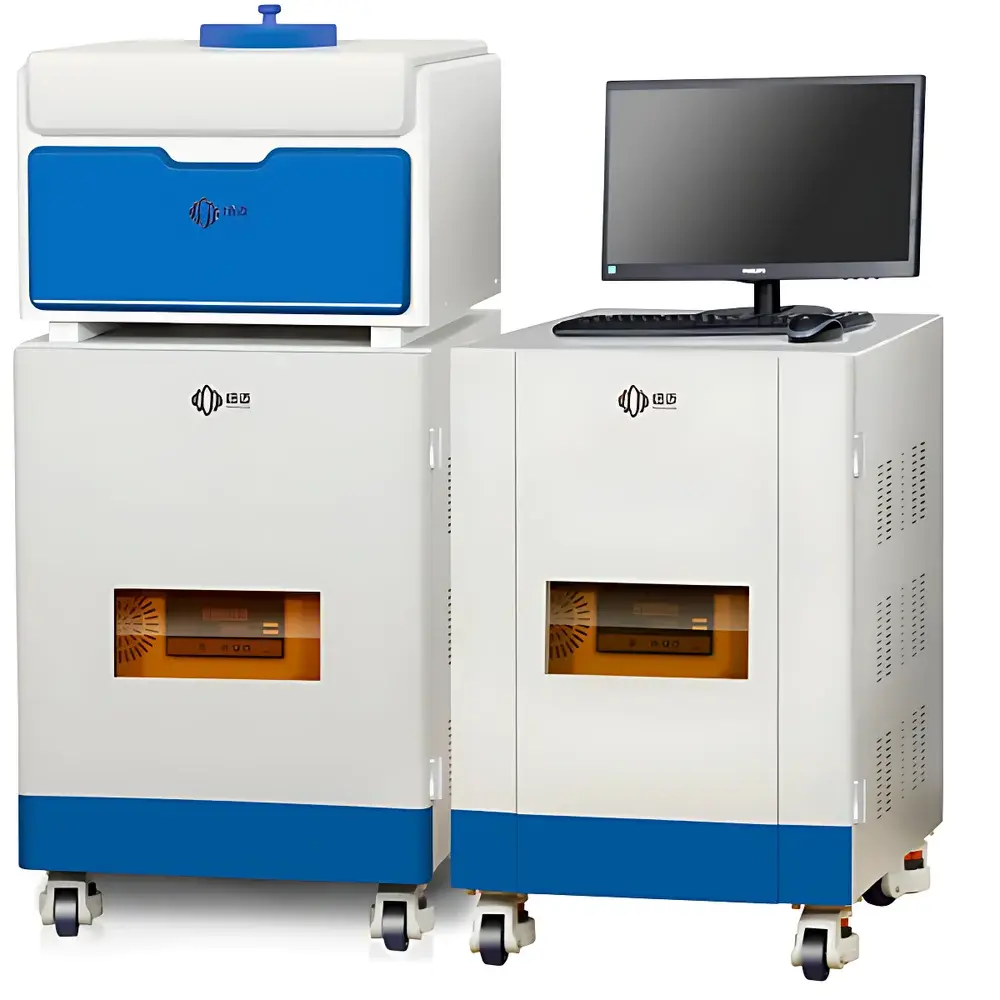
NIUMAG VTMR Low-Field Nuclear Magnetic Resonance Crosslink Density Analyzer for ABS
| Brand | NIUMAG |
|---|---|
| Origin | Jiangsu, China |
| Manufacturer Type | Authorized Distributor |
| Regional Classification | Domestic (China) |
| Model | VTMR |
| Instrument Type | Low-Field NMR Analyzer |
| Sample Type | Solid-Liquid Compatible |
| Operating Mode | Pulsed Fourier Transform |
| Magnet Type | Permanent Magnet |
| Magnetic Field Strength | 0.5 ± 0.05 T |
| Effective Sample Detection Volume | Ø8.5 mm × H20 mm |
| Temperature Control Range | Ambient to 130 °C (Standard) / Ambient to 180 °C (Optional) |
| Measurement Time | ≤2 min per sample |
| Imaging Capability | Optional |
Overview
The NIUMAG VTMR Low-Field Nuclear Magnetic Resonance Crosslink Density Analyzer is a specialized benchtop NMR system engineered for quantitative microstructural characterization of thermoplastic elastomers and multiphase polymer systems—particularly acrylonitrile-butadiene-styrene (ABS) copolymers. It operates on the physical principle of spin-spin (T₂) relaxation analysis in low-field (<0.5 T) permanent magnet environments. By detecting the transverse relaxation behavior of hydrogen nuclei (1H) in mobile vs. immobilized polymer segments—especially within the polybutadiene rubber phase—the instrument enables non-invasive, physics-based quantification of crosslink density, segmental mobility distribution, and phase heterogeneity. Unlike destructive or equilibrium-based methods (e.g., solvent swelling, DSC, or chemical titration), this technique requires no calibration standards, solvents, or sample derivatization, making it compliant with green analytical chemistry principles and suitable for routine QC and R&D laboratories operating under GLP or ISO/IEC 17025 frameworks.
Key Features
- Quantitative crosslink density determination: Derived from multi-exponential T₂ decay fitting, correlating relaxation time distributions with network chain mobility and crosslink junction density in rubber domains.
- Sub-2-minute measurement cycle: Enabled by optimized pulse sequences (e.g., CPMG) and high signal-to-noise ratio detection at 21.3 MHz (1H Larmor frequency at 0.5 T), supporting high-throughput screening.
- Non-destructive & reusable sampling: No chemical modification, heating degradation, or mass loss—samples retain integrity for repeated measurements across aging, curing, or thermal cycling studies.
- Integrated temperature control: Standard ambient-to-130 °C capability (optional extension to 180 °C) allows real-time monitoring of vulcanization kinetics, thermal curing profiles, and post-cure relaxation dynamics.
- Modular hardware architecture: Designed for field-upgradability—including optional NMR imaging (NMR-MRI) module for spatial mapping of rubber dispersion homogeneity, void formation, or interfacial delamination in ABS blends.
Sample Compatibility & Compliance
The VTMR accommodates solid, semi-solid, and gel-phase samples within a cylindrical detection volume of Ø8.5 mm × 20 mm height—ideal for molded ABS pellets, extruded strands, compression-molded plaques, and powder compacts. Its solid-liquid compatibility extends utility to swollen gels, plasticized formulations, and composite systems containing fillers or nanomaterials. The system complies with IEC 61000-6-3 (EMC emission standards) and meets mechanical safety requirements per GB/T 29821 (Chinese national standard for NMR instrumentation). While not FDA-registered, its data acquisition architecture supports audit trails and user access controls compatible with 21 CFR Part 11 readiness when deployed with validated LIMS integration. Method validation protocols align with ASTM D6246 (Standard Guide for NMR Spectroscopy in Polymer Characterization) and ISO 17283 (Plastics — Determination of crosslink density by NMR).
Software & Data Management
Controlled via NIUMAG’s proprietary NMIQ v4.x software suite, the VTMR provides full sequence programming (pulse width, repetition time, echo spacing), automated T₂ inversion using non-negative least-squares (NNLS) algorithms, and batch processing for comparative analysis across sample sets. Raw FID data is stored in vendor-neutral formats (e.g., ASCII, HDF5), enabling third-party spectral processing (e.g., MATLAB, Python SciPy). The software includes built-in reporting templates aligned with ISO/IEC 17025 documentation requirements—featuring metadata logging (operator ID, timestamp, calibration status, environmental conditions), uncertainty estimation per measurement, and PDF export with digital signature support. Optional cloud synchronization enables centralized method library management across multi-site R&D networks.
Applications
- Quantitative assessment of crosslink density evolution during ABS thermoforming, electron-beam irradiation, or peroxide-initiated grafting.
- Determination of rubber phase content and dispersion uniformity in ABS/SAN blends—correlating with impact strength and melt viscosity.
- In-process monitoring of competitive plasticizer migration or moisture uptake in ABS-based medical device housings.
- Stability evaluation of flame-retardant ABS formulations under accelerated thermal aging (85 °C/85% RH).
- Correlation of T₂ relaxation components with DMA tan δ peaks to resolve glass transition breadth and secondary relaxations in multiphase architectures.
FAQ
What physical parameter does the VTMR measure to infer crosslink density?
It measures the transverse relaxation time (T₂) distribution of 1H spins in the rubber phase; shorter average T₂ values correlate with increased restriction of chain mobility due to covalent crosslinks.
Can the VTMR distinguish between chemical and physical crosslinks in ABS?
No—it reports effective network density based on motional restriction. Physical entanglements and hydrogen bonding contribute to apparent crosslink density; complementary techniques (e.g., FTIR, SAXS) are recommended for bond-type differentiation.
Is calibration required before each test?
No absolute calibration is needed; however, daily system performance verification using a reference polymer standard (e.g., crosslinked PDMS) is recommended per ISO/IEC 17025 quality assurance protocols.
Does the instrument support ASTM or ISO-compliant reporting?
Yes—preconfigured report templates include traceable instrument parameters, raw decay curves, NNLS-derived T₂ spectra, and statistical summaries compliant with ASTM D6246 Annex A2 and ISO 17283 Clause 8.
Can the VTMR analyze filled or carbon-black-reinforced ABS compounds?
Yes, though high-loading conductive fillers (>20 wt%) may attenuate RF penetration; empirical validation against mechanical testing is advised for such formulations.
Related Products





