
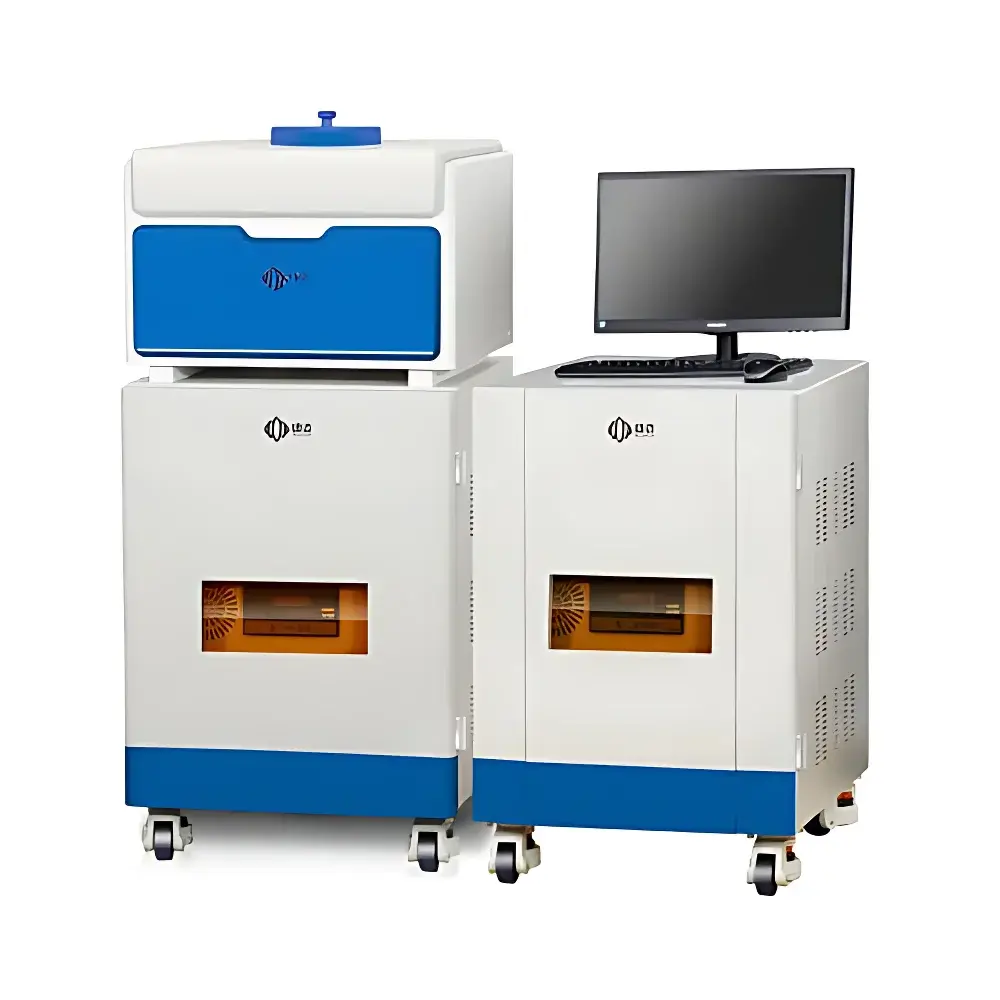
NIUMAG VTMR20-010V-T Low-Field Variable-Temperature Nuclear Magnetic Resonance Analyzer
| Brand | NIUMAG |
|---|---|
| Origin | Jiangsu, China |
| Manufacturer Type | Authorized Distributor |
| Product Category | Domestic |
| Model | VTMR20-010V-T |
| Instrument Type | Low-Field NMR Analyzer |
| Sample Type | Solid-Liquid Dual-Phase Compatible |
| Sensitivity | 100 ppm (in water reference) |
| Resolution | 0.999 (dimensionless correlation coefficient for T₂ fitting) |
Overview
The NIUMAG VTMR20-010V-T is a purpose-engineered low-field nuclear magnetic resonance (NMR) analyzer integrating precise temperature control with high-stability permanent magnet architecture. Operating at a static magnetic field of 0.5 ± 0.08 T (corresponding to a Larmor frequency of 21.3 MHz for 1H), the system employs pulsed NMR techniques—including CPMG (Carr–Purcell–Meiboom–Gill) and inversion-recovery sequences—to quantitatively characterize spin relaxation dynamics (T₁, T₂, and T₂*) in heterogeneous and temperature-sensitive samples. Unlike high-field NMR spectrometers, this instrument is optimized for routine, non-destructive, and quantitative analysis in industrial R&D and quality assurance laboratories where robustness, reproducibility, and operational simplicity are prioritized over spectral resolution. Its core application domain spans polymer science, food physical chemistry, petrophysics, and functional materials research—particularly where thermal transitions, phase behavior, pore-scale fluid dynamics, or molecular mobility must be tracked across controlled temperature gradients.
Key Features
- Integrated variable-temperature probe with programmable range from 35 °C to 130 °C (±0.5 °C stability), enabling kinetic and thermodynamic profiling of phase transitions and relaxation processes.
- Optimized 10 mm diameter RF coil with homogeneous B₁ field over Ø8.5 mm × H25 mm effective detection volume—ensuring consistent signal excitation and reception across solid, semi-solid, and liquid-phase samples.
- Modular hardware architecture supporting configuration-specific upgrades: optional T₁/T₂ mapping modules, enhanced thermal shielding, or custom sample holders for irregular geometries.
- Permanent magnet system with passive temperature compensation, eliminating cryogen dependency and minimizing long-term field drift (<0.01% per hour under stabilized conditions).
- Calibration traceable to ISO/IEC 17025-accredited reference standards for relaxation time measurement, supporting GLP-compliant reporting workflows.
Sample Compatibility & Compliance
The VTMR20-010V-T accepts solid, semi-crystalline, gel, emulsion, and low-viscosity liquid samples without chemical labeling or destructive preparation. It complies with IEC 61000-4 electromagnetic compatibility requirements and meets mechanical safety standards per GB/T 29821–2013 (equivalent to ISO 13857). While not intended for clinical or diagnostic use, its measurement protocols align with ASTM D6299 (precision and bias in precision testing), ISO 10427 (NMR-based porosity determination in rocks), and USP (principles of relaxation-based material characterization). Data acquisition and processing adhere to ALCOA+ principles (Attributable, Legible, Contemporaneous, Original, Accurate, Complete, Consistent, Enduring, Available), facilitating audit readiness for GMP and ISO 9001 environments.
Software & Data Management
Control and analysis are performed via NIUMAG’s proprietary MesoMR Studio v4.x software suite, featuring a validated, 21 CFR Part 11–ready mode with electronic signatures, role-based access control, and immutable audit trails for all parameter changes, calibration events, and report generation. The platform supports batch-mode acquisition across up to 20 discrete temperature points, automatic T₂ distribution deconvolution using NNLS (non-negative least squares), and export of raw FID data in Bruker-compatible format (.fid) or ASCII for third-party modeling (e.g., MATLAB, Python SciPy). All reports include metadata embedding (temperature setpoint, dwell time, echo spacing, number of scans), ensuring full experimental traceability.
Applications
- Polymer Science: Crosslink density quantification in vulcanized rubber via T₂ relaxation; glass transition temperature (Tg) mapping through temperature-dependent mobility shifts; aging assessment of reclaimed elastomers.
- Food Science: Quantitative water-phase distribution (bound/free/mobile) across thermal ramps; ice crystallization kinetics during freeze-thaw cycles; starch retrogradation monitoring.
- Energy Geoscience: Porosity and hydrocarbon saturation estimation in tight sandstone and shale cores under simulated reservoir temperatures; wettability index derivation from T₁/T₂ ratio trends.
- Materials Engineering: Solvent diffusion in epoxy resins; plasticizer migration kinetics in PVC films; hydration state evolution in cementitious systems.
- Pharmaceutical Excipients: Polymorph stability screening; moisture sorption isotherm modeling; amorphous content verification in spray-dried powders.
FAQ
What is the minimum detectable sample mass for reliable T₂ quantification?
For homogeneous liquid samples (e.g., water/glycerol mixtures), reproducible T₂ values are obtainable with ≥0.3 g within the defined detection volume. For heterogeneous solids (e.g., rubber compounds), ≥1.2 g is recommended to ensure statistical confidence in multi-component decay analysis.
Can the system perform real-time in-situ monitoring during heating ramps?
Yes—the instrument supports continuous acquisition mode with 10–60 s temporal resolution per spectrum, synchronized to temperature ramp rate (programmable from 0.1 to 5 °C/min). Data points are timestamped and georeferenced to thermal history.
Is the magnet homogeneity sufficient for quantitative multi-exponential fitting?
The magnet delivers ≤10 ppm homogeneity over the 10 mm DSV, validated by field mapping with a Hall probe array. This enables robust separation of ≥3 distinct T₂ components with <5% relative error in amplitude weighting under standard operating conditions.
Does the system support user-defined pulse sequences?
Custom sequence loading is restricted to pre-validated methods within the MesoMR Studio framework. Advanced users may request OEM-level sequence development under NIUMAG’s Application Support Program, subject to hardware timing constraints and safety interlock validation.
How is temperature calibration verified?
Each unit undergoes dual-point calibration (at 50 °C and 100 °C) using NIST-traceable Pt100 sensors embedded in the probe housing. Certificate of Calibration is provided with initial delivery and recommended annually per ISO/IEC 17025 guidelines.
Related Products




