
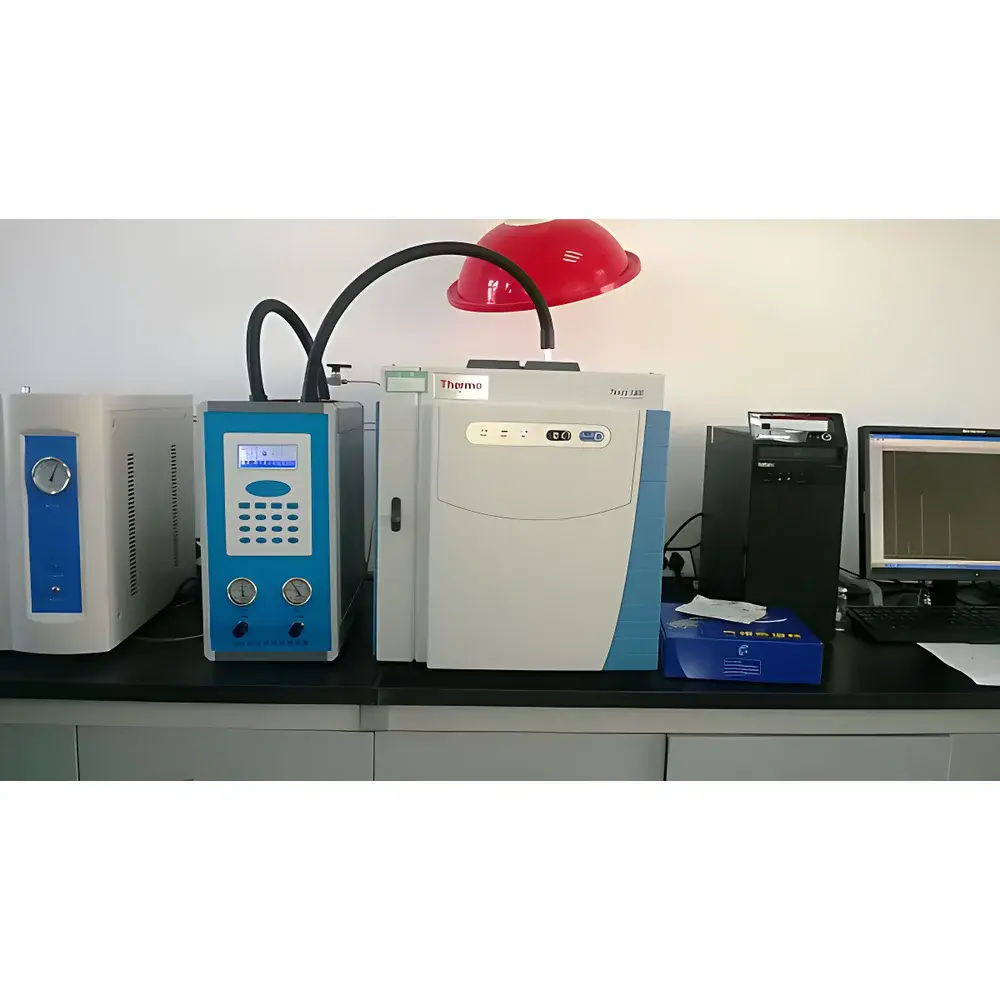
North分Sanpu AHS-610 Headspace Sampler Coupled with Thermo TRACE 1300 Gas Chromatograph for VOC Analysis in Drinking Water
| Brand | North分Sanpu |
|---|---|
| Origin | Beijing, China |
| Manufacturer Type | Manufacturer |
| Country of Origin | Domestic (China) |
| Model | AHS-610 Headspace Autosampler + Thermo TRACE 1300 GC |
| Temperature Control Range | 400 °C |
| Heating Rate | 40 °C/min |
| Cooling Rate | from 450 °C to 50 °C in ~5 min |
| Carrier Gas Flow Range & Control | 0–1200 mL/min |
| Carrier Gas Pressure Range & Control | 0–16 psi |
| Injector Maximum Operating Temperature | 400 °C |
| Injector Pressure Setting Range | 0–970 kPa |
| Injector Total Flow Setting Range | 0–1200 mL/min |
Overview
This integrated analytical system comprises the Thermo Scientific™ TRACE™ 1300 Gas Chromatograph and the North Sanpu AHS-610 Headspace Autosampler, engineered specifically for the quantitative determination of volatile organic compounds (VOCs) — particularly chloroform (CHCl₃) and carbon tetrachloride (CCl₄) — in drinking water matrices. The method is fully aligned with GB 5749–2006 Hygienic Standard for Drinking Water, which mandates routine monitoring of these regulated disinfection by-products (DBPs). The system operates on the principle of static headspace gas chromatography: aqueous samples are heated in sealed vials to establish phase equilibrium between the liquid and vapor phases; the equilibrated headspace gas is then automatically transferred to the GC inlet via pressurized loop injection. This approach eliminates solvent use, minimizes matrix interference, and enhances reproducibility compared to liquid–liquid extraction or purge-and-trap techniques.
Key Features
- Automated, programmable headspace sampling with precise temperature control (range: ambient to 400 °C; heating rate up to 40 °C/min; rapid cooling from 450 °C to 50 °C in approximately 5 minutes)
- Robust GC platform featuring split/splitless injection, electronic pressure control (EPC) for carrier gas (0–16 psi / 0–970 kPa), and total flow regulation (0–1200 mL/min)
- High-temperature injector capable of sustained operation at 400 °C, compatible with thermally stable capillary columns such as DB-624 (30 m × 0.32 mm × 1.8 µm)
- Modular architecture supporting method transfer, multi-method scheduling, and unattended overnight operation
- Compliance-ready design with configurable audit trails and user access levels — suitable for laboratories operating under GLP or ISO/IEC 17025 frameworks
Sample Compatibility & Compliance
The system is validated for direct analysis of untreated or filtered drinking water samples (typically 10 mL volume in 22-mL crimp-top vials). It meets the performance criteria specified in GB 5749–2006 for chloroform and carbon tetrachloride (detection limits ≤ 0.002 mg/L and ≤ 0.0002 mg/L respectively, depending on column and detector configuration). Method robustness has been verified across diverse municipal source waters, including surface water-derived and groundwater-derived supplies. While not certified to EPA Method 524.2 or ISO 10301:2021 out-of-the-box, the hardware architecture supports full implementation of these standards with appropriate column selection, calibration protocols, and QC sample integration. All operational parameters — temperature ramps, pressure setpoints, flow rates, and timing sequences — are digitally recorded and exportable for regulatory review.
Software & Data Management
Chromatographic data acquisition and processing are performed using Thermo Scientific Chromeleon™ Chromatography Data System (CDS) 7.3 or later. The software provides full instrument control for both the TRACE 1300 GC and AHS-610 sampler, enabling synchronized method development and sequence execution. Features include peak integration with retention time locking, automated calibration curve generation (linear or quadratic), and batch report generation compliant with LIMS export formats (e.g., .csv, .pdf, .xml). Audit trail functionality logs all user actions, parameter modifications, and sequence edits — satisfying requirements for 21 CFR Part 11 compliance when deployed with appropriate server infrastructure and electronic signature validation.
Applications
- Routine surveillance of regulated VOCs in public drinking water supplies per national hygiene standards
- Verification of disinfection process efficacy and DBP formation kinetics in water treatment plants
- Investigation of industrial contamination incidents involving chlorinated solvents
- Method development and validation studies for emerging halogenated VOCs (e.g., bromoform, dibromochloromethane)
- Supporting environmental compliance reporting under local water quality ordinances
FAQ
Is this system compliant with Chinese national drinking water testing standards?
Yes — the method configuration described herein fulfills the technical requirements of GB 5749–2006 for chloroform and carbon tetrachloride quantification.
Can the AHS-610 be used with GC systems from other manufacturers?
The AHS-610 features standard 1/16″ stainless-steel tubing connections and TTL/RS-232 interfaces, enabling integration with most commercial GC platforms upon protocol alignment.
What detector is recommended for optimal sensitivity in drinking water VOC analysis?
A micro-electron capture detector (µECD) is strongly recommended for halogenated compounds due to its sub-pg-level detection capability and selectivity for electronegative analytes.
Does the system support unattended multi-vial analysis?
Yes — the AHS-610 accommodates up to 120 sample vials in a single carousel, with customizable incubation and equilibration times per vial.
Are calibration standards and reference materials included?
No — certified aqueous VOC standards (e.g., AccuStandard® or Spex CertiPrep® traceable solutions) must be procured separately and prepared following ISO Guide 35 and CLSI EP29-A protocols.





