
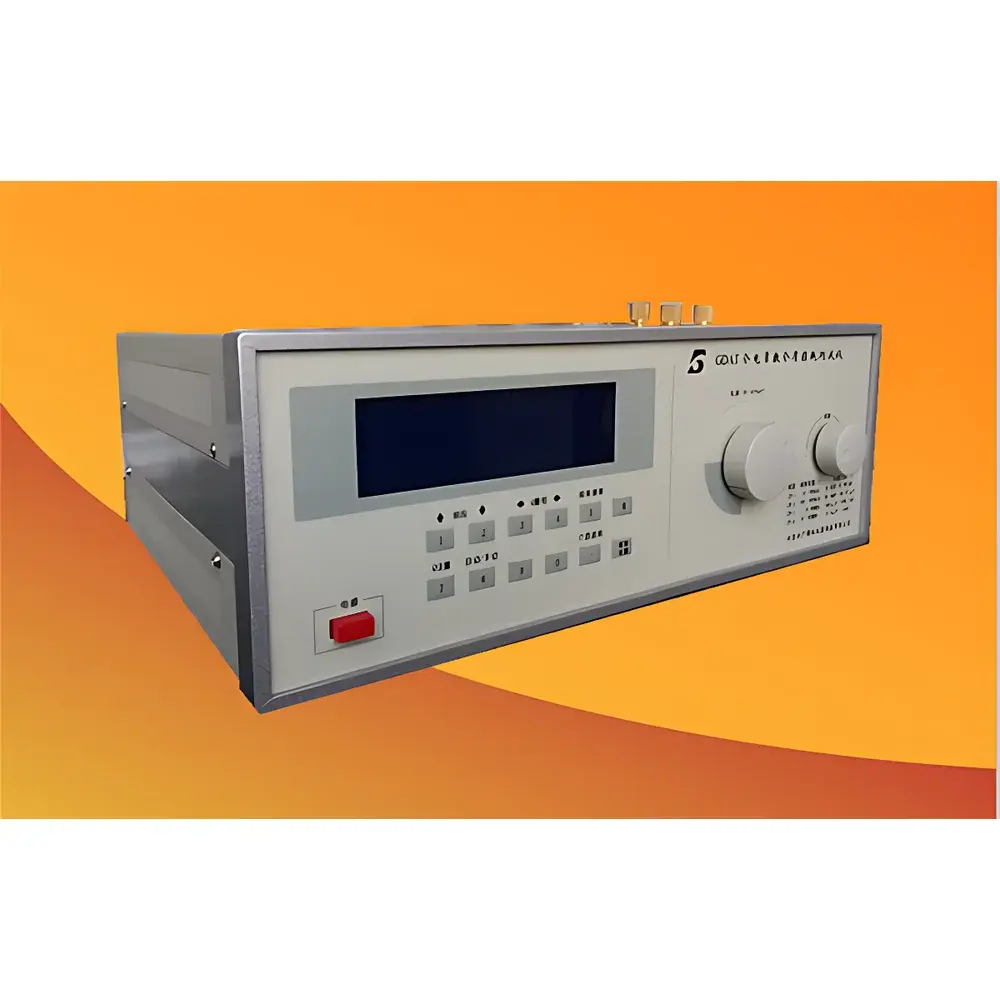
North Guangjingyi GDAT-S Low-Frequency Dielectric Constant and Impedance Analyzer
| Brand | North Guangjingyi / All Precision Instrument |
|---|---|
| Origin | Beijing, China |
| Manufacturer Type | OEM Manufacturer |
| Model | GDAT-S |
| Frequency Range | 20 Hz – 1 MHz |
| Basic Impedance Accuracy | ±0.05% |
| Display | 4.3″ TFT LCD (480×RGB×272) |
| Operating Interface | English & Chinese selectable |
| Measurement Speed | 13 ms/test (≥10 kHz) |
| DC Bias Source | ±5 V / ±50 mA internal |
| AC Signal Level | 10 mV–2 Vrms, 100 μA–20 mA |
| Input Impedance Options | 30 Ω / 50 Ω / 100 Ω |
| Data Storage | Internal non-volatile memory (100 setups, 201 results), USB host support (GIF, setup files, CSV) |
| Interfaces | RS232C, USB, LAN, HANDLER, GPIB (optional), DCI (optional for external bias control) |
Overview
The North Guangjingyi GDAT-S Low-Frequency Dielectric Constant and Impedance Analyzer is a precision LCR/impedance measurement instrument engineered for high-reproducibility characterization of dielectric properties, complex permittivity (ε′, ε″), loss tangent (tan δ), and material impedance across the low-frequency spectrum (20 Hz to 1 MHz). Unlike dedicated capacitance meters or basic LCR testers, the GDAT-S employs a four-terminal-pair (Kelvin) measurement architecture with vector voltage-current sensing to isolate parasitic effects and deliver traceable, calibrated impedance data under controlled AC excitation and optional DC bias conditions. Its core measurement principle relies on sinusoidal signal synthesis, synchronous demodulation, and real-time phase-sensitive detection—enabling accurate determination of both magnitude and phase angle (θ) of complex admittance (Y) and impedance (Z), from which dielectric constant (εr) and dissipation factor are derived using standardized electrode geometry and sample thickness inputs. Designed for R&D labs, QC departments in ceramics, polymer, and thin-film manufacturing, and academic materials science facilities, the GDAT-S supports ASTM D150, IEC 60250, and ISO 257-3 compliant test protocols when configured with parallel-plate or guarded-electrode fixtures.
Key Features
- High-resolution frequency sweep capability: 20 Hz to 1 MHz with 10 mHz minimum step resolution and ±0.01% frequency accuracy
- Dual-mode operation: Standard LCR mode for passive component evaluation and dedicated dielectric mode for εr/tan δ calculation with user-defined geometric correction factors
- Integrated DC bias source: ±5 V / ±50 mA internal programmable source; optional DCI interface supports external bias up to 120 A for magnetic core or ferroelectric testing
- Auto-level control (ALC) with dual-range AC signal stabilization: Ensures consistent excitation amplitude across wide impedance ranges, critical for low-loss dielectric measurements
- Configurable source impedance: Selectable 30 Ω, 50 Ω, or 100 Ω output resistance to match fixture characteristics and minimize reflection errors
- 10-point list sweep functionality: Programmable scanning of frequency, AC voltage/current, or DC bias—each point independently configurable for pass/fail binning
- Transformer and balance test modes: Supports multi-winding device characterization including DCR, mutual inductance (M), turns ratio (N), leakage inductance (Lk), and inter-winding capacitance
- Real-time V/I monitoring: On-screen display of actual applied voltage and sensed current during measurement, enabling immediate verification of signal integrity and contact reliability
- Rugged benchtop form factor: Compact dimensions (280 × 88 × 370 mm, 5 kg) with front-panel USB host port and rear-panel HANDLER/GPIB/LAN interfaces for integration into automated test systems
Sample Compatibility & Compliance
The GDAT-S is compatible with standard dielectric test fixtures—including parallel-plate, concentric-ring, and guarded-electrode configurations—as well as SMD component test clips and custom probe stations. It supports solid, liquid, and semi-solid samples when paired with appropriate electrodes and temperature-controlled stages (not included). For regulatory compliance, the instrument’s measurement traceability aligns with national metrological standards (JJG 835–2019 in China) and supports documentation workflows required under GLP and GMP environments. While the analyzer itself does not carry CE or UKCA certification, its analog signal chain and digital processing meet IEC 61000-4 immunity requirements for laboratory-grade instrumentation. Data logging includes timestamped metadata (date/time, operator ID, fixture ID, calibration status), and all internal storage adheres to FAT32 file system conventions for interoperability with LIMS and ELN platforms.
Software & Data Management
The GDAT-S operates without proprietary PC software dependency—full functionality is accessible via its embedded touchscreen interface. However, it supports bidirectional communication via USB Virtual COM, RS232C, or LAN (TCP/IP) using SCPI-1999 command set, enabling seamless integration with LabVIEW, Python (PyVISA), MATLAB, or custom QA/QC reporting tools. Measurement results—including primary/secondary parameter pairs, sweep traces, and binning statistics—are exportable in CSV format directly to USB flash drives. Internal non-volatile memory retains up to 100 instrument configuration profiles and 201 sequential test records with full parameter context. Audit trail features include automatic logging of calibration events (OPEN/SHORT/Load), firmware version, and last system reset time—facilitating FDA 21 CFR Part 11 readiness when deployed with validated electronic signature and access control layers at the host system level.
Applications
- Quality control of polymer films, ceramic substrates, and insulating coatings for εr uniformity and moisture-induced dielectric drift
- Characterization of battery separator materials and solid electrolytes under variable DC bias and temperature
- Development of tunable dielectrics and relaxor ferroelectrics requiring low-frequency dispersion analysis (Cole-Cole plots)
- Verification of transformer insulation integrity and winding capacitance in power electronics modules
- Evaluation of printed circuit board (PCB) laminate dielectric loss at signal integrity-relevant frequencies (e.g., 100 kHz–1 MHz)
- Academic research in soft matter physics, where low-frequency polarization mechanisms (interfacial, dipolar, ionic conduction) dominate dielectric response
- Calibration reference for lower-cost handheld LCR meters in metrology labs
FAQ
What is the minimum measurable capacitance and maximum impedance supported by the GDAT-S?
The instrument supports capacitance from 0.00001 pF to 9.99999 F and impedance magnitude from 0.00001 Ω to 99.9999 MΩ, with basic accuracy maintained across the full range under specified ALC and calibration conditions.
Can the GDAT-S perform temperature-dependent dielectric measurements?
Yes—the instrument provides stable, low-noise excitation and synchronized triggering outputs (HANDLER port) to coordinate with external environmental chambers and temperature controllers, enabling scripted multi-point thermal sweeps.
Is firmware upgrade supported, and how is it performed?
Firmware updates are delivered as .bin files via USB drive; the update process is initiated from the System menu and requires no external software or PC connection.
Does the GDAT-S support IEEE 488.2 (GPIB) commands for legacy automation systems?
Yes—GPIB is available as an optional hardware module (order code: GDAT-S-GPIB), fully compliant with SCPI-1999 and supporting standard *IDN?, *RST, and MEASure commands.
How often must the instrument be recalibrated to maintain specification accuracy?
Annual calibration is recommended for ISO/IEC 17025-compliant operations; however, daily OPEN/SHORT compensation and periodic load calibration (using certified standards) ensure continued confidence between formal calibrations.



