
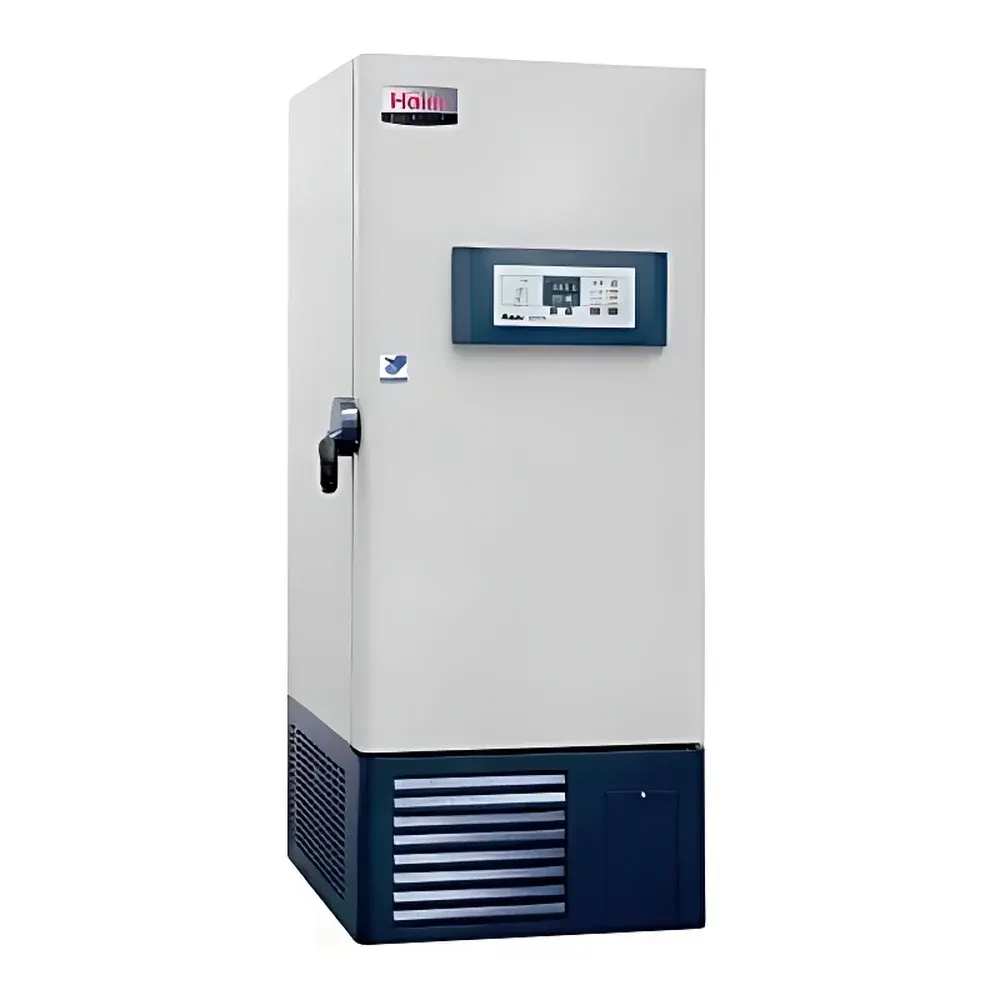
Ultra Low Temperature Freezer DW-86L386 – 386L Vertical Cryogenic Storage Cabinet
| Key | Capacity: 386 L |
|---|---|
| Temperature Range | −40 °C to −86 °C |
| Uniformity | <6 °C |
| Noise Level | <49 dB(A) |
| Power Consumption | 1000 W |
| Compliance | China NMPA Medical Device Registration Certificate (Class II) |
Overview
The DW-86L386 is a vertically oriented ultra-low temperature (ULT) freezer engineered for long-term cryopreservation of biologics—including primary cells, stem cell lines, plasma, serum, DNA/RNA extracts, and tissue specimens—at sustained temperatures down to −86 °C. It operates on a dual-compressor direct-cooling architecture with mixed hydrofluoroolefin (HFO)-based refrigerant blends, eliminating ozone-depleting substances while maintaining thermodynamic efficiency under ambient conditions up to 32 °C. The cabinet meets the thermal stability requirements defined in ISO 13732-1 for cold storage equipment used in biomedical laboratories and complies with China’s NMPA Class II medical device regulatory framework (Registration No. available upon request), supporting GLP-aligned sample integrity protocols.
Key Features
- Dual-Compressor Refrigeration System: Two independent hermetic reciprocating compressors (800 W each) provide redundancy and load balancing—ensuring continuous operation during compressor cycling or partial failure without compromising setpoint stability.
- Multi-Layer Sealing Architecture: Four foam-insulated inner doors plus one outer door form a four-stage sealing system; opening any single inner door minimally affects adjacent compartments, reducing cold loss by up to 35% compared to single-door ULT freezers.
- Enhanced Thermal Insulation: Vacuum Insulation Panels (VIPs) integrated into side and rear walls, combined with fluorine-free polyurethane foam (ODP = 0, GWP < 10), deliver superior R-value per unit thickness and reduce overall energy demand.
- Low-Noise Engineering: Vibration-damped refrigerant piping, optimized condenser airflow routing, and acoustic enclosure design collectively limit operational noise to <49 dB(A) at 1 m—suitable for shared laboratory environments requiring acoustic compliance per ISO 7779.
- Intelligent Monitoring & Protection: Real-time monitoring of evaporator/condenser temperatures, compressor current draw, ambient temperature, door status, and sensor health enables predictive diagnostics. All alarms—including high-temperature deviation (>±3 °C), voltage fluctuation (>±10% of 220 V), power interruption, filter clogging, and low backup battery—are logged with timestamps and support remote relay output (dry contact).
Sample Compatibility & Compliance
The DW-86L386 accommodates standard cryogenic storage formats: up to 240 × 2-inch cryovials using optional rack-and-box configurations. Its internal chamber (620 × 550 × 1310 mm) supports modular shelving with 50 kg load capacity per shelf, enabling flexible layout adaptation for vial racks, cryoboxes, or custom trays. All internal surfaces are constructed from electrogalvanized steel with color-coated finish for corrosion resistance and ease of decontamination. The unit conforms to IEC 61000-6-2/6-4 for electromagnetic immunity and emissions, and its temperature uniformity (<6 °C across working volume at −80 °C setpoint) aligns with ASTM F2607–19 Annex A1 for performance verification of ULT freezers used in clinical specimen banking.
Software & Data Management
While the base configuration includes a microprocessor-controlled interface with LED numeric display and password-protected parameter access, optional data logging modules (USB-enabled chart recorder) support audit-trail-capable temperature history capture compliant with FDA 21 CFR Part 11 when paired with validated software. Alarm events are stored locally for ≥30 days with time/date stamping; remote alarm signaling via normally open (NO) relay allows integration into centralized building management systems (BMS) or laboratory information management systems (LIMS). Firmware supports user-defined alarm thresholds and hysteresis settings for fine-grained environmental control.
Applications
- Long-term archival storage of human biospecimens in biobanks and translational research centers
- Cryopreservation of induced pluripotent stem cells (iPSCs) and embryonic stem cell lines under GMP-adjacent workflows
- Stabilization of temperature-sensitive reagents, monoclonal antibodies, and viral vectors prior to QC release testing
- Backup cold chain assurance for vaccine development labs operating under WHO prequalification guidelines
- Supporting ISO/IEC 17025-accredited testing laboratories requiring documented thermal stability for reference material storage
FAQ
What is the minimum ambient temperature at which the DW-86L386 achieves −86 °C?
The unit reaches and maintains −86 °C at rated performance under ambient conditions up to 32 °C (N-class climate rating), as verified per IEC 60068-3-4.
Does the freezer support validation documentation for IQ/OQ/PQ protocols?
Yes—factory calibration certificates, temperature mapping templates, and alarm log export functions are provided to facilitate installation qualification (IQ), operational qualification (OQ), and performance qualification (PQ) in regulated environments.
Can external CO₂ or liquid nitrogen (LN₂) backup systems be integrated?
Optional CO₂ and LN₂ failover interfaces are available as factory-installed accessories, enabling seamless transition during extended power outages per ISO 20387 biobanking continuity standards.
Is the unit suitable for use in cleanroom-adjacent spaces?
With its low particulate emission profile (no internal fans or air circulation ducts) and non-shedding interior surfaces, the DW-86L386 is compatible with ISO 14644-1 Class 8 (100,000) environments when installed with appropriate clearance and ventilation.
How often does manual defrosting need to be performed?
Defrost cycles are required only when frost accumulation exceeds 5 mm on evaporator surfaces—typically every 6–12 months depending on door-open frequency and ambient humidity; no scheduled downtime is mandated.
Related Products




