
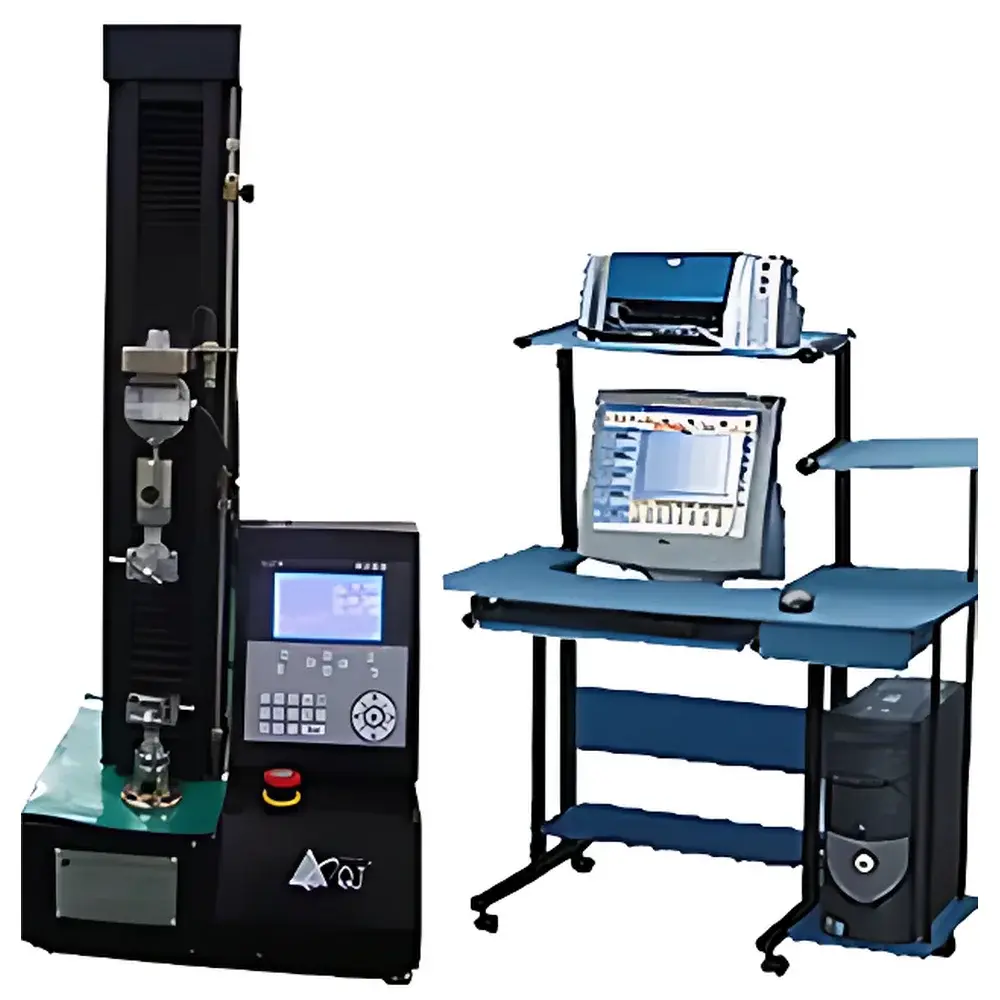
North Guangjingyi HMLS-1000 Tensile Strength Tester for Flexible Foam and Sponge Materials
| Brand | North Guangjingyi / All Precision Instrument |
|---|---|
| Origin | Beijing, China |
| Manufacturer Type | OEM Manufacturer |
| Country of Origin | China |
| Model | HMLS-1000 |
| Price | USD 3,500 (FOB Beijing) |
| Load Accuracy | ±1% of reading (optional ±0.5%) |
| Load Resolution | 1/30,000 full scale |
| Test Speed Range | 0.05–500 mm/min |
| Speed Accuracy | ±1% of set value |
| Displacement Accuracy | ±1% (optional ±0.5%) |
| Effective Tensile Travel | ≥850 mm (customizable) |
| Effective Test Width | 400 mm (550 mm optional) |
| Overload Protection | Automatic shutdown at >110% of rated capacity |
| Safety Limit | Electronic end-stop protection |
| Crosshead Return | Programmable auto-return to initial position post-test |
Overview
The North Guangjingyi HMLS-1000 Tensile Strength Tester is a dedicated electromechanical universal testing system engineered for the mechanical characterization of flexible polymeric foam materials—including polyurethane (PU), ethylene-vinyl acetate (EVA), latex, and reticulated foams—under uniaxial tensile loading. Based on the principle of controlled displacement-driven force measurement, the instrument applies calibrated axial tension via a precision ball-screw-driven crosshead while simultaneously acquiring real-time load and displacement data. Its design adheres to core international standards governing soft cellular material testing, including ISO 1798:1997, GB/T 6344–2008, GB/T 10808–2006, and ASTM D3574 (for comparative reference). The system delivers high reproducibility in determining tensile strength, elongation at break, modulus at specified strain (e.g., 10%, 25%, 50%), and tear resistance—parameters critical for quality control in cushioning, packaging, automotive seating, medical mattress, and footwear manufacturing.
Key Features
- Precision load cell with selectable accuracy options: standard ±1% full-scale error or high-accuracy ±0.5% option for GLP-compliant validation studies.
- High-resolution displacement sensing (1/30,000 full-scale resolution) enabling precise strain tracking even at low deformation rates.
- Wide-speed motorized drive system (0.05–500 mm/min) with closed-loop speed feedback, ensuring stable velocity control across orders of magnitude—essential for rate-dependent viscoelastic response evaluation.
- Modular frame architecture supporting customizable test width (400 mm standard; 550 mm optional) and extended travel (>850 mm), accommodating large-format foam slabs and multi-layer laminates.
- Dual-stage safety system: programmable electronic limit switches prevent over-travel, while hardware-based overload cutoff (triggered at 110% of rated capacity) safeguards both operator and transducer integrity.
- Intuitive manual and automated return protocol: crosshead automatically retracts to pre-test origin after completion, reducing operator intervention and improving throughput in batch testing environments.
Sample Compatibility & Compliance
The HMLS-1000 accommodates standardized dumbbell-shaped, dog-bone, or rectangular specimens per ISO 1798 and GB/T 6344, with clamping options for pneumatic, wedge, or serrated grips optimized for low-modulus, compressible substrates. Specimen thickness up to 50 mm is supported without modification. The system is validated for use in laboratories operating under ISO/IEC 17025-accredited quality management systems. While not certified as FDA 21 CFR Part 11 compliant out-of-the-box, its data acquisition firmware supports audit-trail-ready output files (CSV, XML) suitable for integration into validated LIMS or ELN platforms used in regulated medical device foam qualification workflows.
Software & Data Management
The instrument operates with embedded firmware and PC-based control software compatible with Windows 10/11. Real-time graphical display includes synchronized load–displacement curves, stress–strain conversion (with user-defined cross-sectional area input), and automatic calculation of ASTM/ISO-mandated metrics: tensile strength (MPa), elongation at break (%), and secant modulus. Raw data export is available in ASCII-delimited formats for third-party statistical analysis (e.g., JMP, Minitab) or regulatory submission packages. Software supports test method templates, user-level access control (admin/operator), and digital signature logging—facilitating alignment with internal SOPs and external audit requirements.
Applications
- Quality assurance of flexible foam batches in Tier-1 automotive seating suppliers verifying compliance with OEM specifications (e.g., Ford WSS-M99P1111-A, GMW16219).
- R&D evaluation of novel bio-based foams for packaging sustainability initiatives, quantifying mechanical trade-offs between density reduction and tensile resilience.
- Medical device component validation, including pressure-relieving mattress cores tested per ISO 10993-10 biocompatibility mechanical preconditioning protocols.
- Academic research on time–temperature superposition behavior of thermoplastic elastomer foams using controlled-rate tensile creep-recovery sequences.
- Third-party certification labs performing accredited testing to GB/T 6344–2008 for domestic market entry clearance in China’s furniture and bedding sectors.
FAQ
Does the HMLS-1000 comply with ISO 1798:1997 for flexible foam tensile testing?
Yes—the mechanical configuration, grip geometry, and data reporting structure conform to the dimensional, procedural, and calculation requirements defined in ISO 1798:1997.
Can the system perform tear testing per GB/T 10808–2006?
Yes—when equipped with trapezoidal or constant-rate tear fixtures (available as optional accessories), it meets the force and displacement resolution criteria specified in GB/T 10808–2006.
Is calibration traceable to national metrology institutes?
Load cell calibration certificates are provided with NIM (National Institute of Metrology, China) traceability; users may request UKAS or DAkkS-traceable recalibration services through authorized partners.
What is the recommended maintenance interval for the ball-screw drive system?
Lubrication and backlash verification are recommended every 500 operational hours or annually—whichever occurs first—to maintain speed accuracy and positional repeatability.
Can test reports be generated in bilingual (English/Chinese) format?
Yes—the software supports customizable report templates with dual-language field labels and automatic translation of standard parameter names per ISO/GB conventions.



