
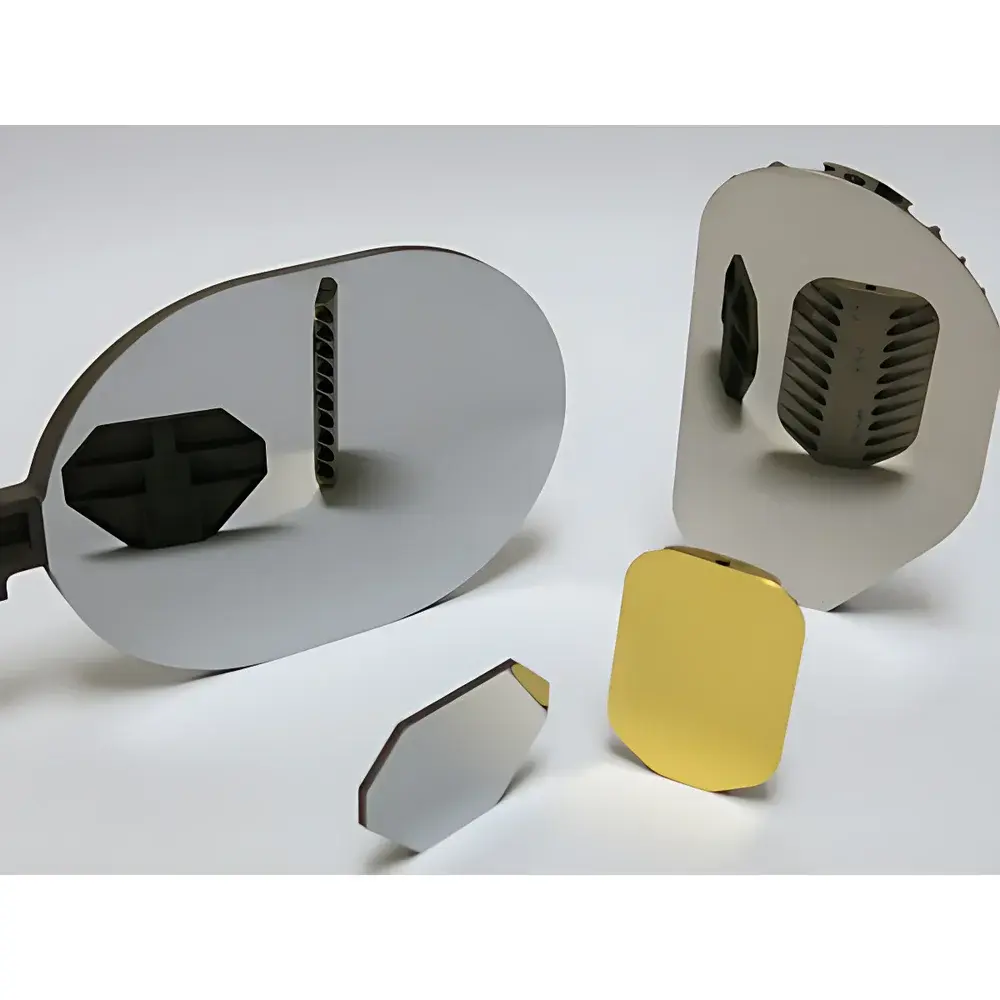
Novanta Cambridge Technology High-Precision Laser Galvanometer Mirror
| Brand | Novanta |
|---|---|
| Origin | United Kingdom |
| Manufacturer Type | Authorized Distributor |
| Origin Category | Imported |
| Model | High-Precision Laser Galvanometer Mirror |
| Price | Upon Request |
Overview
The Novanta Cambridge Technology High-Precision Laser Galvanometer Mirror is a core optical component engineered for ultra-stable, high-bandwidth beam steering in industrial, medical, and scientific laser systems. Designed to operate within resonant or servo-driven galvanometric scanners, these mirrors serve as the dynamic reflective interface between the laser source and the target surface—enabling precise spatial control of focused laser energy. The mirror’s performance is fundamentally governed by its substrate material’s density, elastic modulus, thermal conductivity, and damping characteristics, all of which directly influence scan fidelity, settling time, resonance frequency, and long-term dimensional stability under thermal load. Cambridge Technology leverages two primary substrate platforms—single-crystal silicon and beryllium—to meet divergent application requirements across speed, weight, thermal management, and environmental robustness.
Key Features
- Two substrate options: high-purity monocrystalline silicon and aerospace-grade beryllium—each optimized for distinct dynamic and thermal regimes
- Silicon substrates deliver excellent stiffness-to-density ratio, superior thermal conductivity (~150 W/m·K), and low coefficient of thermal expansion (CTE ≈ 2.6 × 10⁻⁶ /°C), making them ideal for cost-sensitive, high-reproducibility OEM applications
- Beryllium substrates offer the highest specific stiffness (elastic modulus/density) among all machinable metals—enabling resonant scan frequencies exceeding 10 kHz with sub-millisecond settling times
- Customizable lightweighting architectures: precision-machined slotting and honeycomb backside structures preserve mechanical rigidity while minimizing rotational inertia
- ISO 14001-certified beryllium processing ensures full compliance with occupational health and environmental safety standards; all beryllium components undergo rigorous surface passivation and containment protocols
- Pre-shipment coating customization available—including narrowband high-reflectivity dielectric stacks and broadband metallic coatings—tailored to laser wavelength, polarization, and power density requirements
Sample Compatibility & Compliance
These mirrors are compatible with standard galvanometer motor shafts (e.g., M3, M4, or custom thread interfaces) and integrate seamlessly into Cambridge Technology’s CRS (Continuous Resonant Scanner), GTS (General Purpose Tilting Scanner), and LTS (Low-Inertia Tilt Scanner) platforms. All mirrors conform to RoHS Directive 2011/65/EU and REACH Regulation (EC) No. 1907/2006. Beryllium-based mirrors comply with ISO 14001:2015 for environmental management and OSHA 1910.1000 permissible exposure limits (PELs) for beryllium particulates. End-of-life disposal must follow Novanta’s certified recycling protocol—direct landfill disposal is strictly prohibited per IEC 62321-7-2 and WEEE Directive 2012/19/EU guidelines.
Software & Data Management
While the mirror itself is a passive optical element, its specification data—including substrate CTE, thermal diffusivity, coating reflectance curves (R > 99.8% at design wavelengths), and mass moment of inertia—is fully integrated into Cambridge Technology’s ScanLab-compatible configuration databases. These parameters feed into scanner system modeling tools (e.g., MATLAB-based galvo dynamics simulators, Zemax OpticStudio beam propagation models) used for predicting positional error, thermal lensing effects, and closed-loop bandwidth limitations. Traceable calibration reports—including spectral reflectance measurements (per ASTM E430-17) and surface flatness verification (λ/10 @ 633 nm per ISO 10110-5)—are provided with each shipment and archived in accordance with FDA 21 CFR Part 11–compliant electronic record systems upon request.
Applications
- Ultrafast laser micromachining (UV, green, IR): enabling <5 µm feature resolution in PCB drilling, semiconductor scribing, and thin-film ablation
- CO₂ laser-based additive manufacturing and cutting: supporting 9.3–10.6 µm beam delivery with >99.5% reflectance and <0.1 nm RMS wavefront distortion
- Ophthalmic photodisruption (e.g., femtosecond LASIK): requiring sub-arcsecond pointing stability and minimal thermal drift over multi-hour procedures
- Confocal and multiphoton microscopy scanning: where visible/NIR broadband mirrors (Al or Ag-coated) maintain polarization fidelity across 450–7000 nm
- 3D laser scanning and LIDAR beam steering: leveraging beryllium’s low mass for high-duty-cycle raster and vector scanning patterns
FAQ
What is the maximum recommended average power density for silicon vs. beryllium mirrors?
Silicon mirrors are rated for continuous-wave (CW) operation up to 10 kW/cm² at 1064 nm (with appropriate cooling); beryllium mirrors support up to 15 kW/cm² under identical conditions due to higher thermal conductivity and lower absorption.
Can custom aperture shapes or mounting holes be machined post-coating?
No—mechanical modification after optical coating compromises adhesion and spectral performance. All geometry customization must be completed prior to coating deposition.
Is vacuum-compatible mounting available?
Yes. Mirror mounts with Vespel® SP-21 or aluminum 6061-T6 carriers, qualified to UHV (<10⁻⁹ mbar) per ISO 14040, are offered as optional accessories.
Do you provide spectral reflectance measurement reports?
Yes. Each mirror ships with a NIST-traceable spectrophotometric report covering 200–12,000 nm, measured on a PerkinElmer Lambda 1050+ with integrating sphere attachment.
How does beryllium toxicity affect field service or end-user handling?
Intact, passivated beryllium mirrors pose no inhalation or dermal hazard during normal operation. Only machining, grinding, or abrasive cleaning generates hazardous dust—activities strictly reserved for Novanta-certified facilities.



