
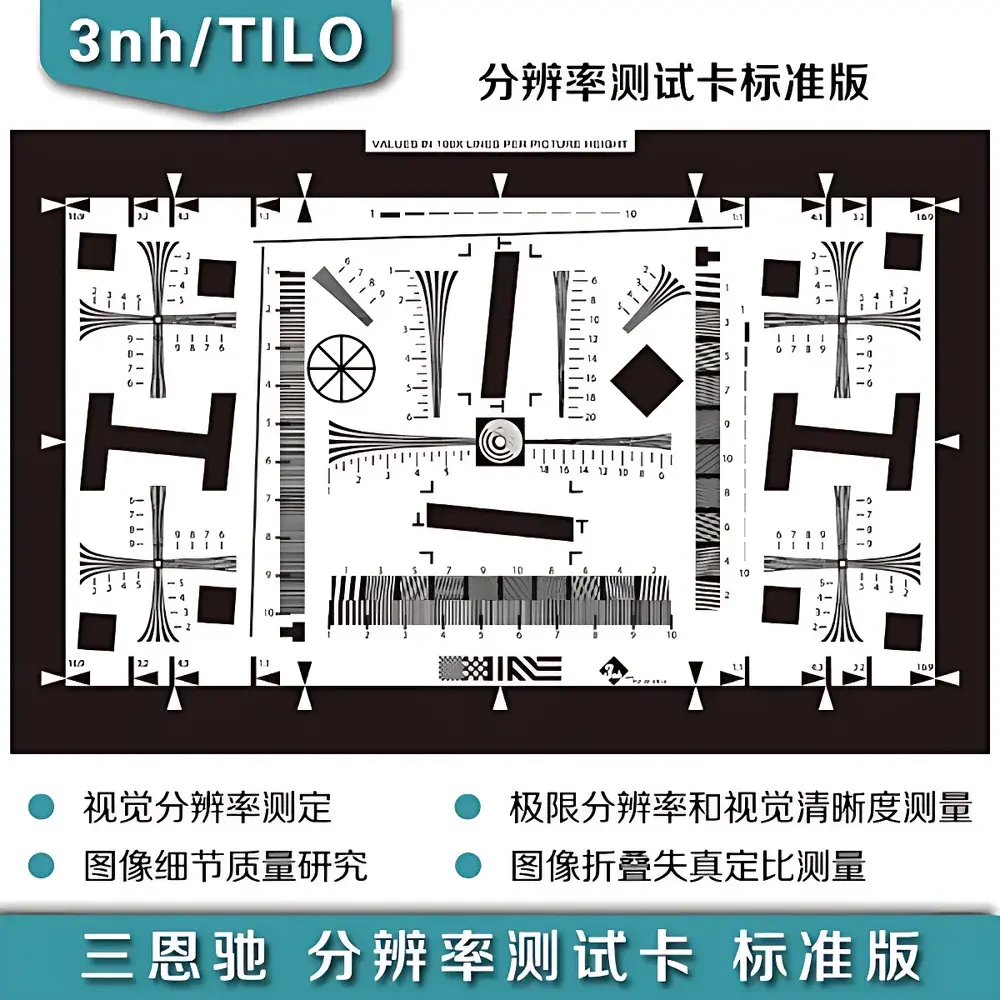
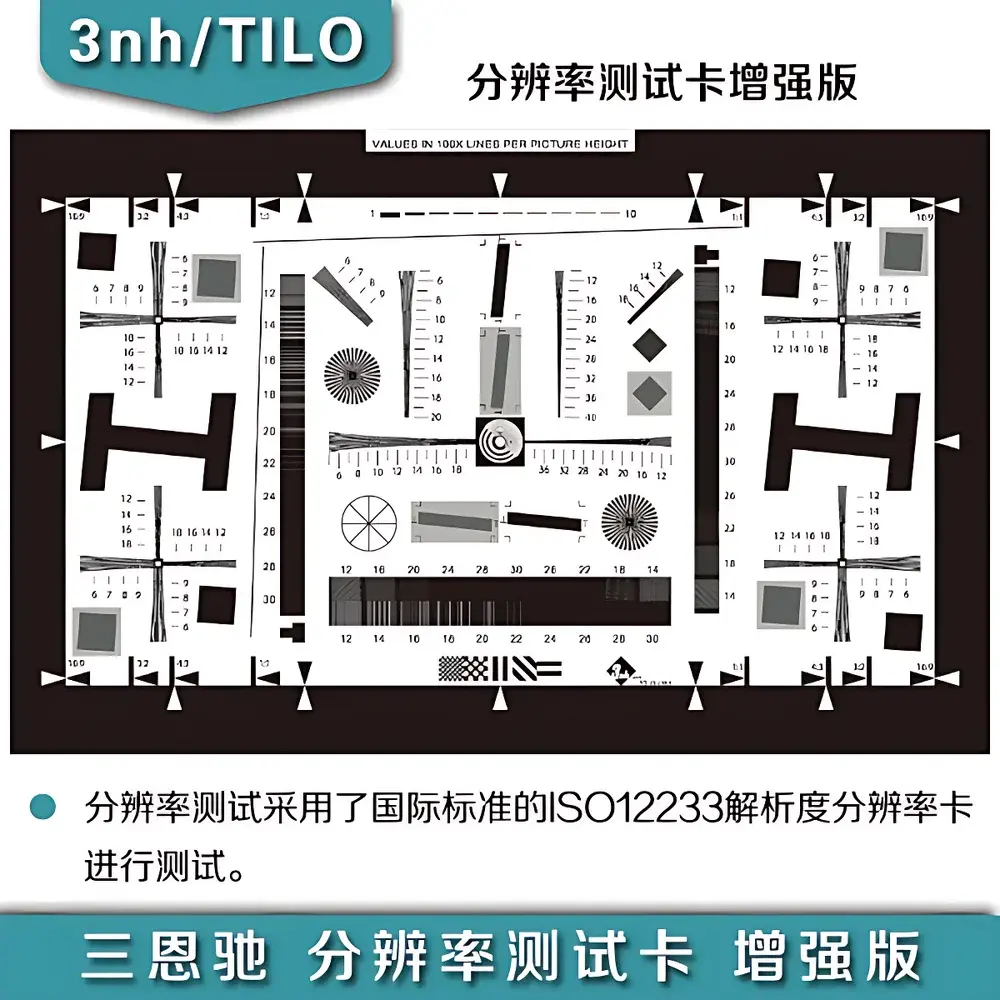
NQ-10-800A ISO 12233 Resolution Test Chart (8× Magnification) by 3nh
| Brand | 3nh |
|---|---|
| Origin | Jiangsu, China |
| Manufacturer Type | Direct Manufacturer |
| Country of Origin | China |
| Model | NQ-10-800A |
| Price | USD 945 (approx.) |
Overview
The NQ-10-800A ISO 12233 Resolution Test Chart is a precision-engineered optical calibration standard designed for objective assessment of spatial resolution performance in digital imaging systems. Based on the internationally recognized ISO 12233:2017 standard, this chart features high-contrast, photolithographically defined line pairs and slanted-edge targets optimized for modulation transfer function (MTF) analysis. Its 8× magnification configuration enables rigorous evaluation of high-resolution sensors—particularly those used in industrial machine vision, scientific CMOS/CCD cameras, smartphone camera modules, and metrology-grade imaging systems. The chart’s design supports both visual inspection and automated software-based MTF calculation via edge spread function (ESF) and line spread function (LSF) derivation. Unlike printed test charts with inherent dot gain or registration error, the NQ-10-800A utilizes stable, dimensionally invariant substrate material and certified line width tolerances to ensure measurement repeatability across laboratory, production line, and R&D environments.
Key Features
- Compliant with ISO 12233:2017 Annex E (Slanted-Edge Method) and Annex F (Line-Pair Method), enabling traceable MTF quantification from 0.1 to 200 lp/mm.
- 8× magnification scale factor applied to target geometry—designed to match common telecentric lens magnifications and sensor pixel pitch requirements for sub-micron resolution validation.
- High-optical-density black chrome-on-glass substrate ensures >OD 4.0 contrast ratio and minimal light scatter, critical for low-noise MTF measurement.
- Integrated magnetic mounting system allows rapid, repeatable positioning on ferromagnetic fixtures without adhesive residue or mechanical clamping distortion.
- Calibration-certified feature placement accuracy ±0.5 µm over full active area (100 mm × 100 mm), verified via interferometric metrology.
- Non-hygroscopic, thermally stable quartz-glass base minimizes dimensional drift under controlled lab conditions (20–25 °C, 40–60% RH).
Sample Compatibility & Compliance
The NQ-10-800A is compatible with all standard C-mount, F-mount, and M42 optical interfaces when used with appropriate adapters. It supports full-frame, APS-C, 1-inch, and 1/2.5-inch format sensors. The chart is routinely deployed in ISO/IEC 17025-accredited laboratories for camera module qualification per IEC 62676-5 (surveillance cameras) and JEITA CP-3409 (mobile imaging). Its physical construction meets RoHS Directive 2011/65/EU and conforms to packaging and handling requirements outlined in ISO 10110-7 for optical elements. While not a measuring instrument per se, its use forms part of documented verification protocols required under ISO 9001:2015 clause 7.1.5 (monitoring and measuring resources) and FDA 21 CFR Part 11–compliant image validation workflows.
Software & Data Management
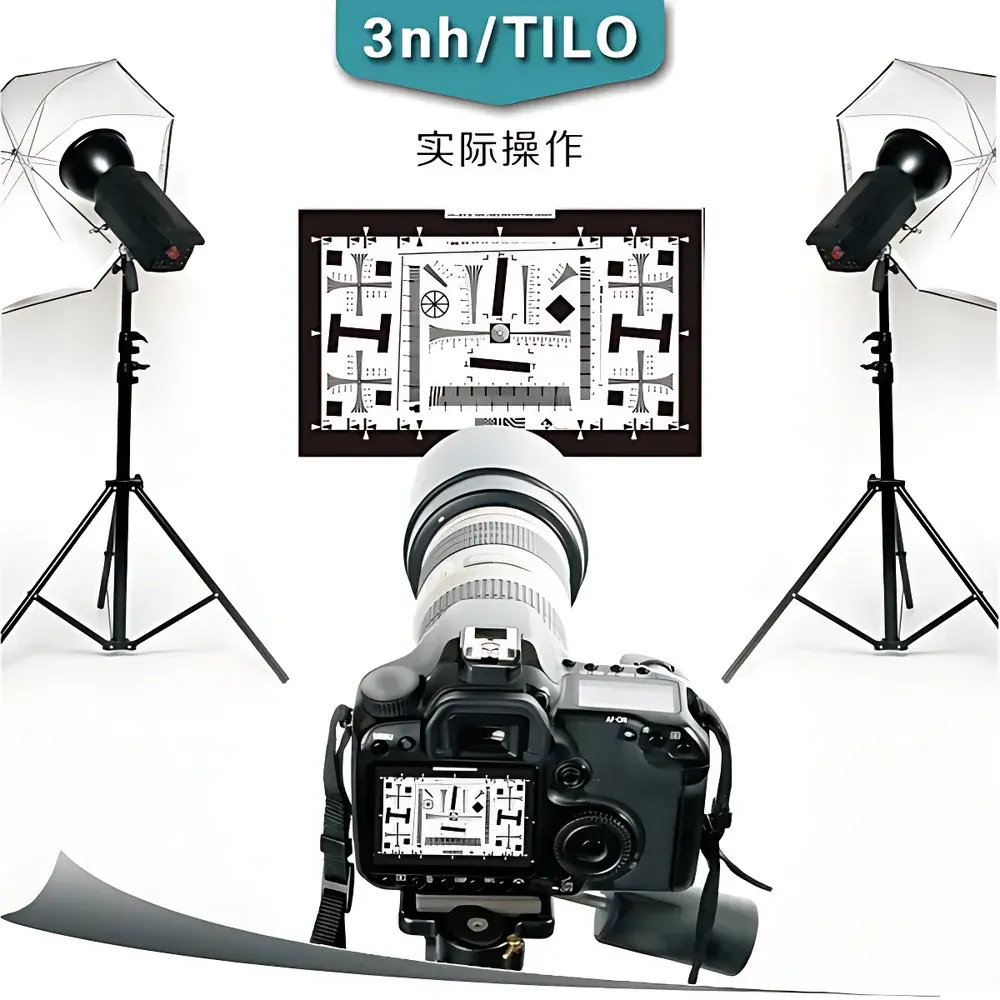
The NQ-10-800A integrates seamlessly with industry-standard MTF analysis platforms including Imatest Master v5.3+, DxO Analyzer, and MATLAB-based custom pipelines using ISO 12233-compliant slanted-edge algorithms. Raw image capture must be performed in linear RAW mode (no gamma correction or demosaicing applied) to preserve native sensor response. The chart includes fiducial markers for automated ROI alignment and perspective distortion correction. Audit trails—including exposure time, lens focus distance, illumination uniformity (measured via separate flat-field reference), and environmental temperature logs—must accompany each MTF dataset to satisfy GLP/GMP documentation requirements. Exported MTF curves are generated in SVG and CSV formats for inclusion in formal test reports and regulatory submissions.
Applications
- Factory-line verification of autofocus calibration stability across temperature cycling (−10 °C to +60 °C).
- MTF mapping across image field curvature for telecentric lens characterization in semiconductor wafer inspection systems.
- Resolution benchmarking of multispectral and NIR-sensitive sensors used in agricultural drone imaging payloads.
- Validation of deconvolution algorithm performance in computational photography R&D.
- Periodic requalification of metrology-grade cameras prior to ISO 17025 proficiency testing.
- Supporting technical due diligence during camera module supplier audits per AEC-Q200 and IATF 16949 frameworks.
FAQ
Is the NQ-10-800A suitable for evaluating lenses with f/1.0 aperture?
Yes—its high-contrast target design and calibrated edge sharpness allow accurate MTF measurement even at wide apertures, provided diffraction-limited illumination and vibration-isolated mounting are maintained.
Does the chart include NIST-traceable calibration documentation?
No—3nh provides a manufacturer’s certificate of conformance to ISO 12233 geometric specifications; third-party NIST-traceable calibration requires separate metrology service engagement.
Can it be used under LED illumination with 5000K CCT?
Yes—provided illumination uniformity across the chart surface is ≥95% (measured via flat-field reference), and spectral power distribution avoids strong UV or deep IR emission that may affect sensor QE.
What is the recommended working distance for optimal MTF acquisition?
Minimum 300 mm from sensor plane to chart surface, with collimated illumination and telecentric relay optics preferred for field-flatness-critical applications.
Is the magnetic backing compatible with aluminum optical breadboards?
No—the magnet requires ferromagnetic surfaces; stainless steel or mild steel mounting plates are recommended for secure fixation.




