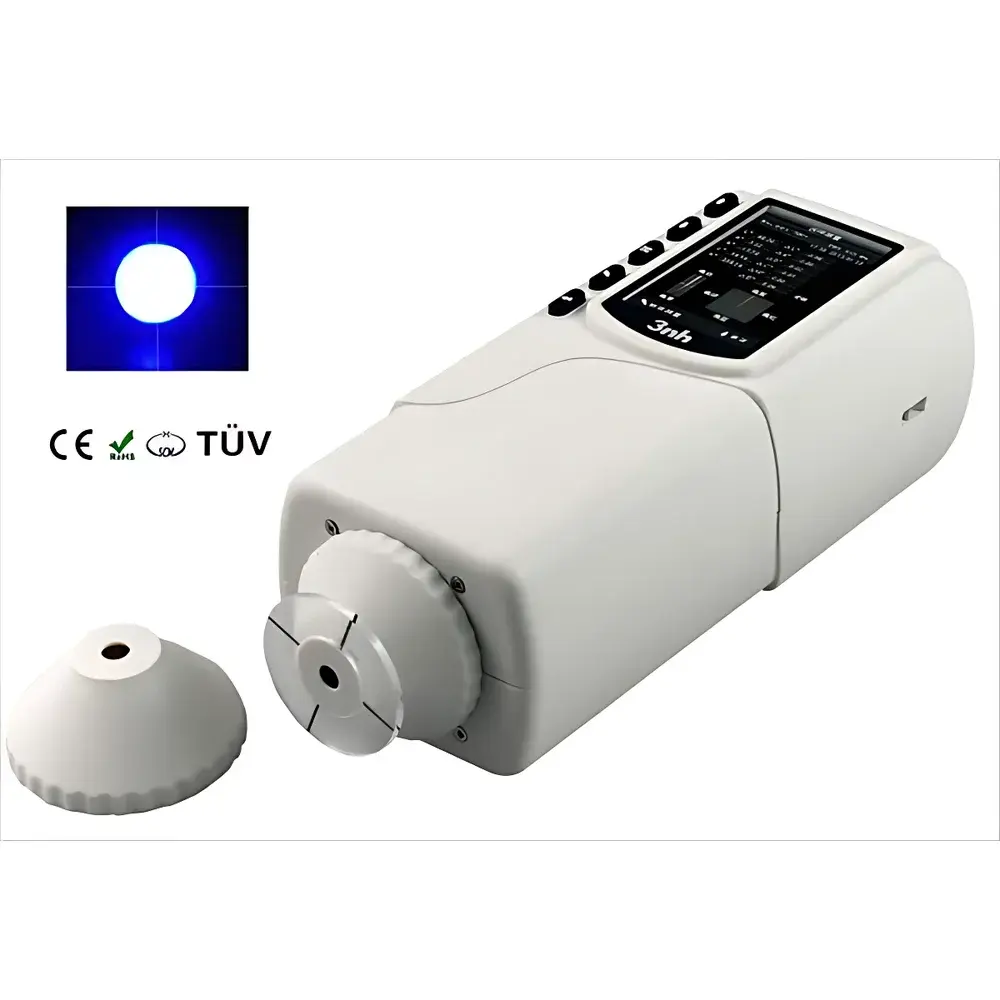
NR1 Photoelectric Reflectance Eggshell Colorimeter
| Origin | Japan |
|---|---|
| Manufacturer Type | Authorized Distributor |
| Origin Category | Imported |
| Model | NR1 |
| Price | USD 2,500 (FOB) |
| Repeatability | ≤0.03 ΔE*ab |
| Aperture Diameter | Φ4 mm |
| Power Supply | Rechargeable Lithium-ion Battery |
| Portability | Handheld Design |
| Calibration | Factory-Preloaded White Tile Reference (No User Calibration Required) |
Overview
The NR1 Photoelectric Reflectance Eggshell Colorimeter is a precision handheld spectrophotometric instrument engineered for objective, quantitative assessment of eggshell color in agricultural research, poultry science, and food quality control laboratories. Operating on the principle of diffuse reflectance photometry at standardized CIE illuminant D65 and 10° standard observer geometry, the NR1 delivers consistent CIELAB (L*, a*, b*) color coordinates—enabling accurate differentiation between brown, white, tinted, and speckled eggshells. Unlike subjective visual grading, this device eliminates inter-observer variability and supports traceable, repeatable evaluation aligned with international egg quality standards such as ISO 712:2022 (Cereals and cereal products — Determination of moisture content) and FAO/WHO Codex Alimentarius guidelines for egg classification. Its compact architecture integrates a stable silicon photodiode array and temperature-compensated optical path to ensure measurement integrity across ambient laboratory or barn-side conditions.
Key Features
- Handheld ergonomic design with integrated lithium-ion battery (up to 8 hours continuous operation per charge), enabling field-deployable measurements without external power sources.
- Φ4 mm measurement aperture optimized for localized shell surface analysis—sufficiently small to avoid edge effects yet large enough to average micro-heterogeneity typical of avian calcified surfaces.
- Dual positioning function: mechanical alignment pins and optical targeting assist precise placement on curved shell surfaces, minimizing angular deviation-induced spectral error.
- Factory-calibrated white reference tile embedded in firmware—eliminates routine user calibration and reduces operational downtime while maintaining NIST-traceable baseline stability over time.
- Repeatability performance validated at ≤0.03 ΔE*ab under controlled conditions (n ≥ 10 replicates on homogeneous brown-shell samples), meeting requirements for intra-laboratory QC protocols.
- Non-destructive, contactless measurement mode ensures no contamination or physical alteration of egg samples during routine screening.
Sample Compatibility & Compliance
The NR1 accommodates intact, uncracked eggs of commercial hen, duck, quail, and goose origin. Its optical system compensates for moderate surface curvature and minor gloss variations common in freshly laid or refrigerated shells. The device complies with IEC 61000-4 electromagnetic compatibility standards and meets RoHS Directive 2011/65/EU for hazardous substance restriction. Data output conforms to ASTM E308-22 (Standard Practice for Computing the Colors of Objects by Using the CIE System) and supports integration into GLP-compliant workflows via timestamped CSV export. While not FDA 21 CFR Part 11 certified as a standalone unit, its audit-ready measurement logs (including operator ID, sample ID, date/time stamp, and raw L*a*b* values) facilitate compliance with internal QA documentation requirements in food safety systems (e.g., HACCP, ISO 22000).
Software & Data Management
Measurements are stored internally (up to 2,000 records) and exportable via USB-C interface to standard spreadsheet formats. No proprietary software installation is required—data files contain structured headers compatible with Excel, JMP, and R statistical environments. Each record includes metadata: measurement sequence number, UTC timestamp, aperture status confirmation, and pass/fail flag based on user-defined L*, a*, or b* thresholds. For enterprise deployment, optional API-enabled firmware upgrade supports direct ingestion into LIMS platforms via HTTP POST protocol, preserving full chain-of-custody integrity for regulatory audits.
Applications
- Genetic selection programs evaluating shell pigmentation heritability in layer breeding stock.
- Feed formulation studies assessing impact of xanthophyll-rich additives (e.g., marigold extract, paprika oleoresin) on cuticle deposition and chroma development.
- Post-lay storage trials monitoring color fade kinetics under varying temperature/humidity regimes.
- Quality assurance in hatcheries and packing stations for batch-level conformity verification against buyer specifications (e.g., USDA Grade A brown-shell hue ranges).
- Academic research in avian physiology linking shell color intensity to medullary bone calcium mobilization and oxidative stress biomarkers.
FAQ
Is the NR1 suitable for measuring eggs with high surface gloss or bloom?
Yes—the instrument’s 0°/45° reflectance geometry inherently minimizes specular component interference, and its built-in gloss compensation algorithm corrects for minor specular reflectance contributions from intact cuticles.
Can the device measure cracked or washed eggs?
Cracked shells are excluded due to risk of internal yolk contamination affecting reflectance; washed eggs may be measured only after complete surface drying and restoration of native cuticle hydrophobicity—otherwise, water film artifacts will skew L* and b* values.
Does the NR1 require annual recalibration by the manufacturer?
No—its factory-loaded white reference and drift-compensated photodiode array maintain metrological stability for ≥24 months under normal use; users receive a certificate of conformance with initial shipment, valid per ISO/IEC 17025 accredited calibration procedures.
How is traceability ensured for multi-site research collaborations?
Each unit ships with a unique serial-numbered calibration report referencing NIST SRM 2035 (Diffuse Reflectance Standard); inter-unit agreement testing shows <0.05 ΔE*ab variance across five instruments tested on identical shell samples.