
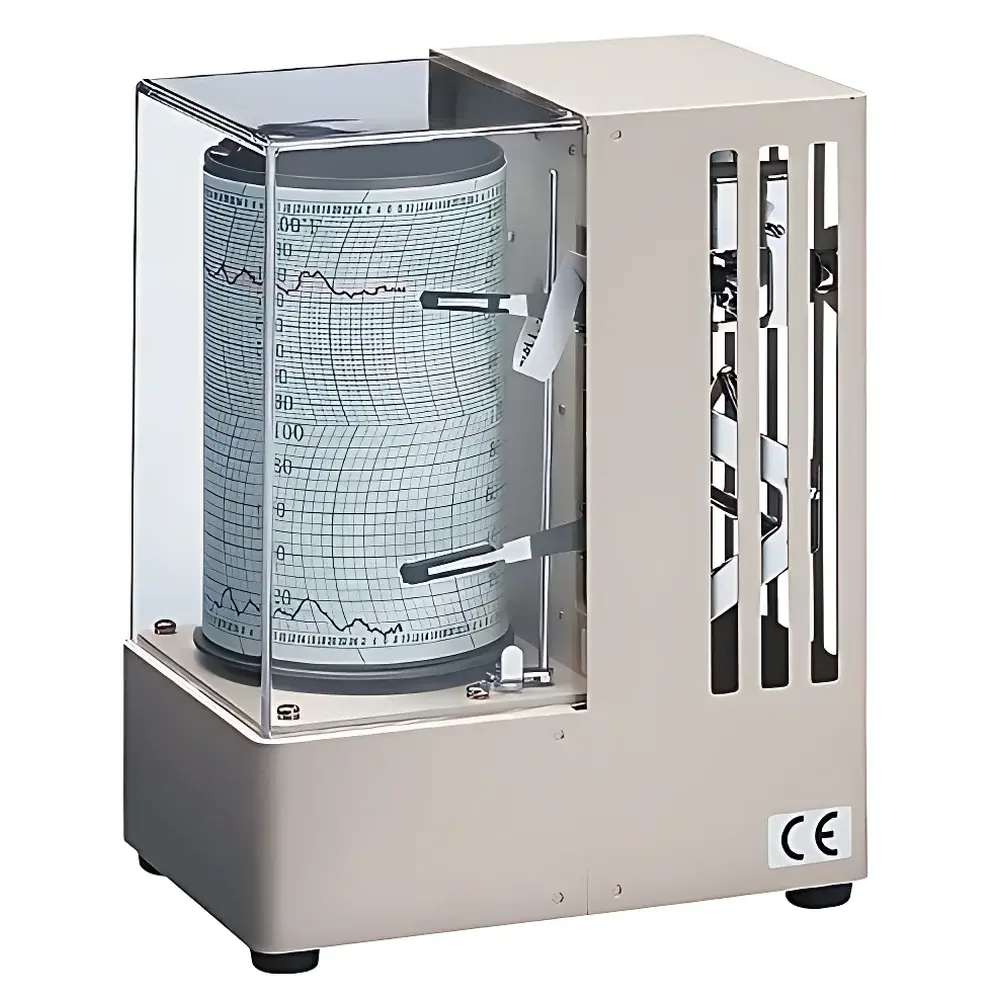
Oakton Minidrum Mechanical Thermohygrometer
| Brand | Oakton |
|---|---|
| Model | 08369-70 |
| Origin | USA |
| Instrument Type | Mechanical Thermohygrometer |
| Humidity Range | 5–90% RH |
| Temperature Range | –6 to 40°C (22 to 104°F) |
| Humidity Accuracy | ±5% RH (10–90% RH), ±7% RH (5–10% RH) |
| Temperature Accuracy | ±2°C (±3.6°F) |
| Sensor Type | Human Hair Bundle (Hygrometric), Aged Bimetallic Strip (Thermometric) |
| Chart Speed | Constant 2-hour rotation cycle (7-day chart, 172 hours) |
| Chart Dimensions | 9.2 × 20.8 cm (3⅝" × 8³⁄₁₆") |
| Response Time | ~15 min to 45% step change |
| Power | 1 × AA battery (6 months typical life) |
| Dimensions (W×H×D) | 15.2 × 18.7 × 9.8 cm (6" × 7³⁄₈" × 3⁷⁄₈") |
| Compliance | Designed for GLP-aligned environmental monitoring |
Overview
The Oakton Minidrum Mechanical Thermohygrometer is a self-contained, analog recording instrument engineered for long-term, unattended ambient environmental monitoring in laboratories, storage facilities, archives, museums, pharmaceutical stability chambers, and cleanroom support areas. Unlike electronic digital loggers, the Minidrum operates on purely mechanical principles—leveraging hygroscopic expansion/contraction of a preconditioned human hair bundle coupled to a precision-machined lever system for relative humidity (RH) measurement, and thermal expansion of an aged bimetallic strip for temperature indication. These passive sensing elements drive a quartz-regulated drum mechanism that rotates at a fixed 2-hour interval, ensuring consistent chart advancement without reliance on microprocessors or firmware. Its design prioritizes operational continuity, minimal maintenance, and immunity to electromagnetic interference—making it suitable for environments where power instability, data security constraints, or regulatory preference for non-digital archival records apply.
Key Features
- Dual-sensor mechanical architecture: Human hair hygrometer (calibrated per ISO 4677-2:2019 Annex A) paired with a thermally aged bimetallic thermometer for stable, drift-compensated readings.
- Quartz-controlled drum drive: Provides precise 2-hour rotational increments over a full 7-day (172-hour) chart cycle—eliminating timing variability inherent in spring-driven alternatives.
- Corrosion-resistant acrylic housing with positive-latch cover: Protects chart paper and writing mechanism from dust, incidental impact, and ambient condensation while enabling rapid chart replacement.
- Long-duration battery operation: Single AA alkaline cell powers the quartz oscillator and drive motor for up to six months under typical use conditions—no external power supply or charging infrastructure required.
- Inherent audit trail: Continuous analog chart recording provides tamper-evident, time-stamped physical documentation compliant with FDA 21 CFR Part 11 “paper record” equivalency provisions when retained as original media.
- Field-serviceable consumables: Includes two dual-color felt-tip pens (blue/red), one pre-loaded 7-day chart, and user-replaceable components including spare pens (Cat. No. 09376-01) and chart rolls (Cat. No. 08369-61, 08369-56).
Sample Compatibility & Compliance
The Minidrum is intended for ambient air monitoring only—not for direct immersion, high-velocity airflow, or corrosive gas exposure. It meets functional requirements outlined in ISO 14644-3 (cleanroom environmental monitoring), ASTM E742–22 (mechanical hygrothermograph application guidance), and EU GMP Annex 15 (verification of environmental controls). While not electronically calibrated, its sensor performance aligns with Class II mechanical hygrometers per ISO 7726:2009. The instrument requires periodic verification using saturated salt solutions (e.g., LiCl for 11.3% RH, MgCl₂ for 33% RH, NaCl for 75% RH) and certified reference thermometers per ISO/IEC 17025-accredited procedures. Charts are archived as primary records under GLP and internal quality systems requiring hard-copy traceability.
Software & Data Management
The Oakton Minidrum does not incorporate digital electronics, firmware, or connectivity interfaces—therefore no software installation, driver configuration, or cloud synchronization is involved. Data acquisition is entirely analog: RH and temperature values are inscribed directly onto chemically treated chart paper via dual-pen scribing. Users digitize records post-hoc using flatbed scanners and optical character recognition (OCR)-enabled annotation tools or manual transcription into LIMS or Excel-based trend logs. Chart interpretation follows standardized interpolation between 5% RH and 2°C graduations. For regulated environments, scanned charts must be stored with metadata (location, operator ID, verification date) and protected against unauthorized modification per 21 CFR Part 11 Subpart B §11.10(d).
Applications
- Pharmaceutical stability testing chambers (ICH Q1A–Q1E): Continuous 7-day ambient condition logging during accelerated and long-term studies.
- Museum and archival storage vaults: Passive monitoring of RH excursions that risk parchment desiccation or mold propagation.
- GLP-compliant laboratory environmental logs: Standby recording during power outages or as backup instrumentation during electronic system maintenance windows.
- Teaching laboratories: Demonstrating fundamental psychrometric principles and mechanical transduction without dependence on digital abstraction layers.
<liCold chain validation support: Supplemental verification of temperature/humidity profiles in staging areas prior to active data logger deployment.
FAQ
What is the recommended recalibration frequency for the Minidrum?
Per ASTM E742–22, mechanical thermohygrometers should undergo functional verification at least quarterly using NIST-traceable saturated salt standards and reference thermometers. Full sensor replacement is advised every 3–5 years depending on cumulative exposure history.
Can the Minidrum operate reliably below 5% RH or above 90% RH?
Operation outside 5–90% RH is not recommended. Below 5% RH, hair bundle hysteresis increases measurement uncertainty; above 90% RH, transient hygroscopic over-extension may depress indicated RH by 7–10% until equilibrium reestablishes after ~3 weeks at ≤80% RH.
Is the chart paper compatible with standard laboratory archiving protocols?
Yes—chart paper is acid-free, lignin-free, and rated for ≥25-year archival stability per ANSI/NISO Z39.48–1992. Each chart includes batch-coded manufacturing dates and conforms to ISO 12100 mechanical safety guidelines for paper handling.
How is temperature and humidity data physically recorded?
Two independent scribing arms—one actuated by the hair-lever system (RH), the other by the bimetallic coil (temperature)—simultaneously inscribe continuous traces onto a rotating cylindrical chart. Graduations are printed at 5% RH and 2°C intervals.
Does the Minidrum meet FDA 21 CFR Part 11 requirements?
As a non-electronic, non-networked device producing original analog records, it satisfies Part 11’s definition of “paper records” (§11.3). When maintained with controlled access, dated chart changes, and secure physical storage, it fulfills predicate rule requirements for record retention in FDA-regulated settings.



