
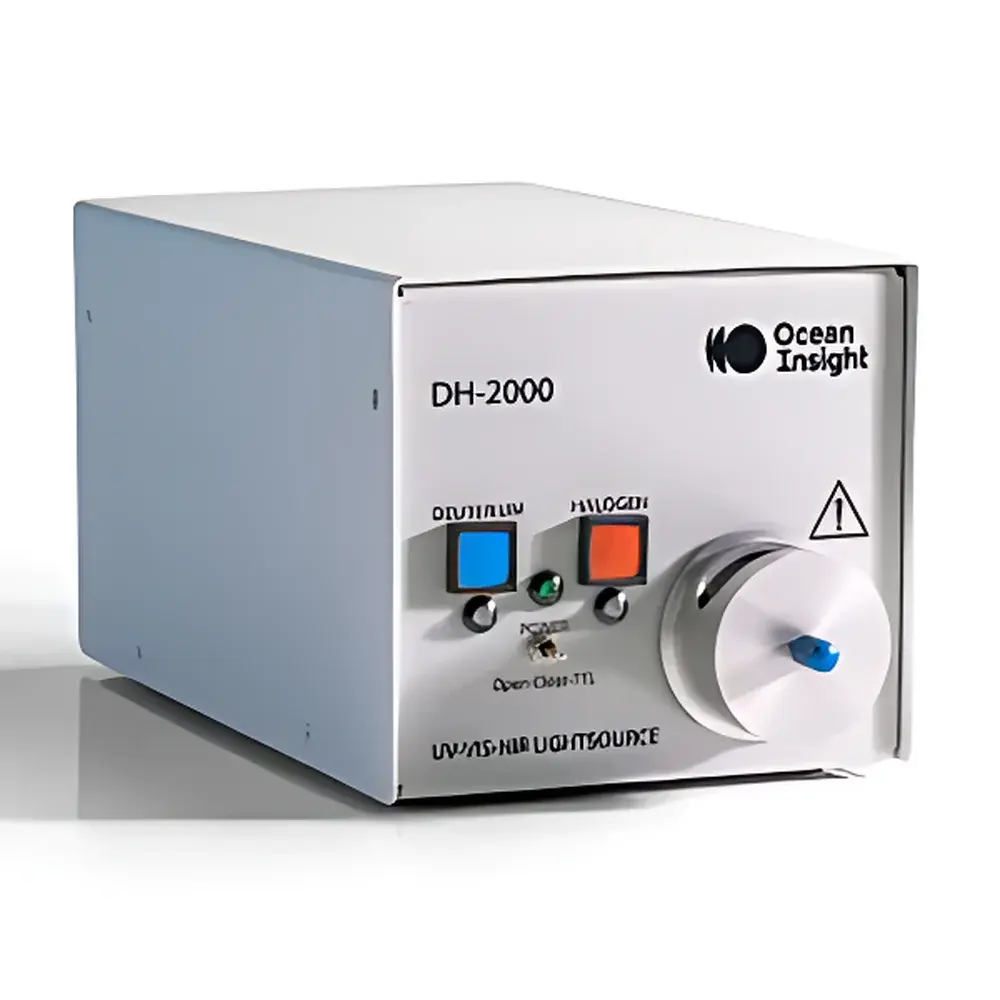
Ocean Optics DH-2000-BAL Balanced Deuterium-Tungsten Halogen Light Source
| Brand | Ocean Optics |
|---|---|
| Origin | Imported |
| Manufacturer Type | Manufacturer |
| Model | DH-2000-BAL |
| Light Source Type | Deuterium + Tungsten-Halogen Hybrid |
| Illumination Mode | External Illumination |
| Wavelength Range | 215–2000 nm |
| Deuterium Lamp Range | 215–400 nm |
| Tungsten-Halogen Lamp Range | 360–2000 nm |
| Power Consumption | 25 W (D₂), 20 W (W-Hal), Max. 190 W |
| Warm-up Time | 40 min (D₂), 20 min (W-Hal) |
| Dimensions | 150 × 135 × 319 mm |
| Weight | 3.8 kg |
| Operating Temperature | 5–35 °C |
| Humidity | 5–95% RH (non-condensing at 40 °C) |
| Stability | <0.01% per hour (intensity drift), <5 × 10⁻⁶ peak-to-peak (0.1–10 Hz) |
| Certifications | CE, VDI/VDE 0160, EN 61010 |
Overview
The Ocean Optics DH-2000-BAL Balanced Deuterium-Tungsten Halogen Light Source is an engineered broadband illumination system designed for high-fidelity spectral measurements across the ultraviolet, visible, and near-infrared (UV-VIS-NIR) regions—from 215 nm to 2000 nm. Unlike conventional deuterium-tungsten halogen hybrid sources, the DH-2000-BAL integrates proprietary dichroic filtering technology directly into the optical path to actively balance spectral irradiance between the two lamp outputs. This architecture eliminates the characteristic D-alpha emission line at ~656 nm—a persistent artifact in standard deuterium lamps that causes localized saturation, compromises dynamic range, and introduces systematic errors in absorbance, reflectance, and quantum yield quantification. By suppressing this discrete emission while preserving continuous spectral output, the DH-2000-BAL delivers a smooth, stable, and radiometrically consistent irradiance profile—enabling accurate baseline correction, improved signal-to-noise ratio (SNR) in UV regions, and reliable cross-wavelength calibration without iterative integration time adjustments.
Key Features
- Proprietary dichroic beam-combining optics that dynamically equalize relative intensity contributions from deuterium (215–400 nm) and tungsten-halogen (360–2000 nm) emitters
- Elimination of the D-alpha line at 656.1 nm—removing spectral distortion that otherwise necessitates complex post-acquisition correction or compromises photometric accuracy
- Stable broadband output with intensity drift <0.01% per hour and low-frequency noise <5 × 10⁻⁶ peak-to-peak (0.1–10 Hz)
- Optimized thermal management enabling continuous operation within ambient temperatures of 5–35 °C and humidity up to 95% RH (non-condensing)
- Independent lamp control: deuterium lamp ignition voltage 350 V, operating voltage 85 V/0.3 A; tungsten-halogen voltage adjustable from 4.5 to 11.5 V
- CE-marked and compliant with EN 61010 (safety requirements for electrical equipment for measurement, control, and laboratory use) and VDI/VDE 0160 (electromagnetic compatibility for industrial environments)
Sample Compatibility & Compliance
The DH-2000-BAL is compatible with all standard fiber-coupled spectrometers—including Ocean Insight’s HR4000-CG-UV-VIS, QE Pro, and Maya2000 Pro—as well as third-party systems requiring SMA 905 input. It supports both free-space and fiber-optic illumination configurations, with recommended use of UV-grade fused silica fibers (e.g., Ocean Insight’s QP400-2-SR) to maintain transmission integrity below 250 nm. The source meets essential regulatory expectations for analytical instrumentation used in GLP- and GMP-aligned laboratories: its stable output facilitates traceable wavelength and radiometric calibration, and its low temporal drift supports long-duration kinetic studies compliant with ASTM E308 (computing tristimulus values) and ISO 13406-2 (display luminance uniformity testing). While not intrinsically FDA 21 CFR Part 11–certified, its deterministic output behavior and hardware-level stability support audit-ready data acquisition when integrated with validated software platforms.
Software & Data Management
The DH-2000-BAL operates as a standalone hardware light source and does not require embedded firmware or driver-based control. Its analog intensity stability eliminates dependency on digital feedback loops, thereby reducing susceptibility to communication latency or protocol mismatch in automated setups. For synchronization with spectrometer acquisition, users may employ TTL triggering via optional external interfaces. When paired with Ocean Insight’s OceanView or OmniDriver SDK, the source enables script-driven experimental workflows—including timed lamp activation, sequential UV/VIS/NIR measurement protocols, and intensity normalization routines. All spectral data generated using the DH-2000-BAL retain inherent radiometric consistency, simplifying post-processing steps such as dark-current subtraction, stray-light correction, and reference-beam ratioing in transmission or reflectance mode.
Applications
- High-accuracy absorbance and transmittance measurements in pharmaceutical QC (e.g., USP spectrophotometric assay validation)
- Material reflectance and colorimetry across extended spectral ranges (ISO/CIE standard illuminants A, B, C, D65)
- Calibration of hyperspectral imaging systems requiring flat-field illumination from UV through NIR
- Photochemical reaction monitoring where D-alpha-induced photoexcitation must be excluded
- Environmental sensor validation—including dissolved organic carbon (DOC) and nitrate detection in water quality analysis
- Thin-film thickness characterization via spectroscopic ellipsometry with minimized spectral artifacts
FAQ
Does the DH-2000-BAL require periodic recalibration?
No—its optical balancing is achieved passively via fixed dichroic filters; no user-accessible calibration routine is required. However, annual verification against a NIST-traceable reference lamp is recommended for metrologically critical applications.
Can the deuterium and tungsten-halogen lamps be operated independently?
Yes—the unit features separate on/off switches and independent power regulation circuits, allowing selective activation for UV-only or VIS-NIR-only experiments.
What is the expected lifetime of each lamp?
Deuterium lamp: ≥1,000 hours; tungsten-halogen lamp: ≥2,000 hours under nominal operating conditions (voltage stabilized, ambient temperature controlled).
Is the DH-2000-BAL compatible with pulsed or gated detection systems?
Yes—its DC-stable output supports external TTL triggering for synchronized acquisition; however, it does not provide internal pulse modulation capability.
Why is UV-grade fiber recommended?
Standard silica fibers exhibit significant solarization-induced attenuation below 250 nm; UV-enhanced fibers maintain >80% transmission at 215 nm over extended exposure durations, preserving spectral fidelity in the far-UV region.






