
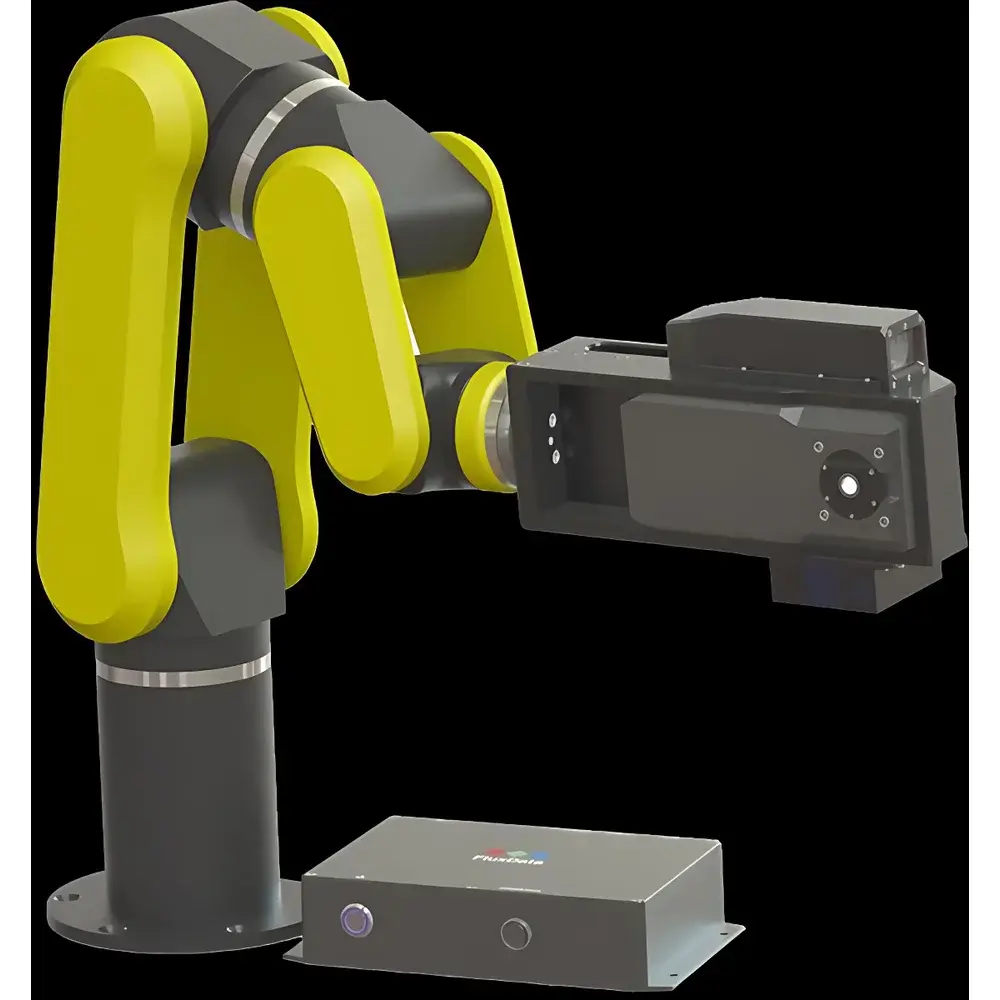
Ocean Optics FD-D8R SCI/SCE Non-Contact Spectrophotometric Color Measurement System
| Brand | Ocean Optics |
|---|---|
| Origin | USA |
| Manufacturer Type | Original Equipment Manufacturer (OEM) |
| Product Origin | Imported |
| Model | FD-D8R |
| Product Category | Spectrophotometric Colorimeter |
| Instrument Type | In-Line |
| Optical Geometry | d/8° Integrating Sphere |
| Light Source | Pulsed LED |
| Spectral Range | 400 nm – 700 nm |
| Repeatability | 0.01 ΔE*ab |
Overview
The Ocean Optics FD-D8R SCI/SCE Non-Contact Spectrophotometric Color Measurement System is an industrial-grade, in-line spectrophotometer engineered for high-speed, non-contact color quantification in demanding manufacturing environments. Based on the CIE 15:2018-compliant d/8° integrating sphere geometry, the FD-D8R captures reflectance spectra across the full visible range (400–700 nm) using a pulsed LED illumination source and a thermally stabilized silicon photodiode array detector. Its optical architecture supports both Specular Component Included (SCI) and Specular Component Excluded (SCE) measurement modes—enabling precise differentiation between total color appearance (e.g., for formulation matching) and surface-appearance-relevant color (e.g., for gloss-sensitive quality control). The system’s core innovation lies in its monolithic sensor head: all optical components—including illumination optics, collection optics, and the 50-mm-diameter integrating sphere—are fully integrated and hermetically sealed within a rugged, chemically resistant housing featuring a replaceable sapphire viewport. This design eliminates alignment drift, prevents contamination of internal optics, and ensures long-term calibration stability without routine recalibration.
Key Features
- True non-contact operation with fixed working distance (1.0–2.0 mm), eliminating mechanical wear and enabling measurement of heat-sensitive, soft, or moving surfaces
- Dual-mode spectral acquisition: simultaneous or selectable SCI and SCE measurements per CIE 15:2018 and ISO 7724-1
- High-speed spectral capture: full 400–700 nm spectrum acquired in 300,000 parts per day in synchronized production lines
- Compact, IP65-rated sensor head with sapphire window (Vickers hardness ≥2000 HV) for resistance to abrasion, solvents, and cleaning agents
- Flexible integration via high-flex USB 2.0 cable (up to 5 m) and TCP/IP client/server architecture for PLC, SCADA, or MES connectivity
- No external fiber optics or alignment-sensitive components—optical path is factory-aligned and permanently sealed
Sample Compatibility & Compliance
The FD-D8R accommodates diverse sample geometries—including curved, textured, recessed, or small-area targets—as small as 2 × 2 mm, thanks to its fixed-focus optical design and optional custom illumination zones (e.g., Ø50 mm). It is validated for use with plastics, painted metals, coated papers, textiles, and powder-coated surfaces under ambient lighting or controlled booth conditions. Regulatory compliance includes adherence to ASTM E308 (computing tristimulus values from spectral data), ISO 11664-4 (CIE colorimetric observers), and ISO 12647-2 (graphic technology process control). For regulated industries, raw spectral data export (ASCII .csv) and metadata logging support audit-ready documentation aligned with GLP and GMP principles; optional firmware enables time-stamped measurement logs with user ID and instrument serial number traceability.
Software & Data Management
The FD-D8R operates with Ocean Insight’s OceanView SpectraSuite software (Windows/Linux/macOS), providing real-time spectral visualization, CIE XYZ, L*a*b*, L*C*h°, and ΔE*ab calculations, plus tolerance-based pass/fail classification against master standards. All spectral data are stored with embedded calibration coefficients, measurement mode flags (SCI/SCE), and environmental metadata (timestamp, temperature, humidity if external sensors are connected). The system supports automated data streaming via TCP/IP to SQL databases or cloud platforms (e.g., AWS IoT Core, Azure IoT Hub) using standard JSON payloads. For enterprise deployment, API access (RESTful + Python SDK) enables custom dashboard integration, SPC charting, and statistical process monitoring—fully compatible with FDA 21 CFR Part 11 requirements when paired with validated electronic signature workflows.
Applications
- In-line color verification of automotive interior trim, exterior body panels, and injection-molded components during high-speed assembly
- Real-time batch-to-batch consistency monitoring in paint, ink, and pigment manufacturing
- Automated sorting of recycled plastic flakes by polymer type and color grade in material recovery facilities
- Quality gate inspection of printed packaging, labels, and flexible films on rotary gravure or flexo presses
- Robotic-guided color validation of medical device housings and pharmaceutical blister packaging under cleanroom conditions
- Integration with vision-guided robotic arms for multi-point color mapping of complex 3D surfaces (e.g., consumer electronics casings)
FAQ
What standards does the FD-D8R comply with for color measurement?
It conforms to CIE 15:2018 (d/8° geometry), ISO 7724-1 (colorimetry), ASTM E308 (spectral data conversion), and ISO 11664-4 (CIE standard observer functions).
Can the FD-D8R measure samples with high gloss or metallic effects?
Yes—its dual SCI/SCE capability allows separation of diffuse and specular contributions, critical for evaluating gonio-apparent materials when used with appropriate mounting fixtures.
Is calibration required after installation?
No routine field calibration is needed; the sensor is shipped with NIST-traceable factory calibration. Optional annual verification kits (certified ceramic tiles) support ISO/IEC 17025-compliant maintenance.
How is the system protected against contamination in harsh production environments?
The sapphire viewport is chemically inert and scratch-resistant; the sealed optical cavity prevents ingress of dust, oil mist, or solvent vapors—validated per IEC 60529 IP65.
Does the FD-D8R support custom spectral weighting or proprietary color spaces?
Yes—via OceanView’s scripting interface (Python/Lua), users can define custom illuminants, observers, and color difference formulas beyond CIEDE2000.



