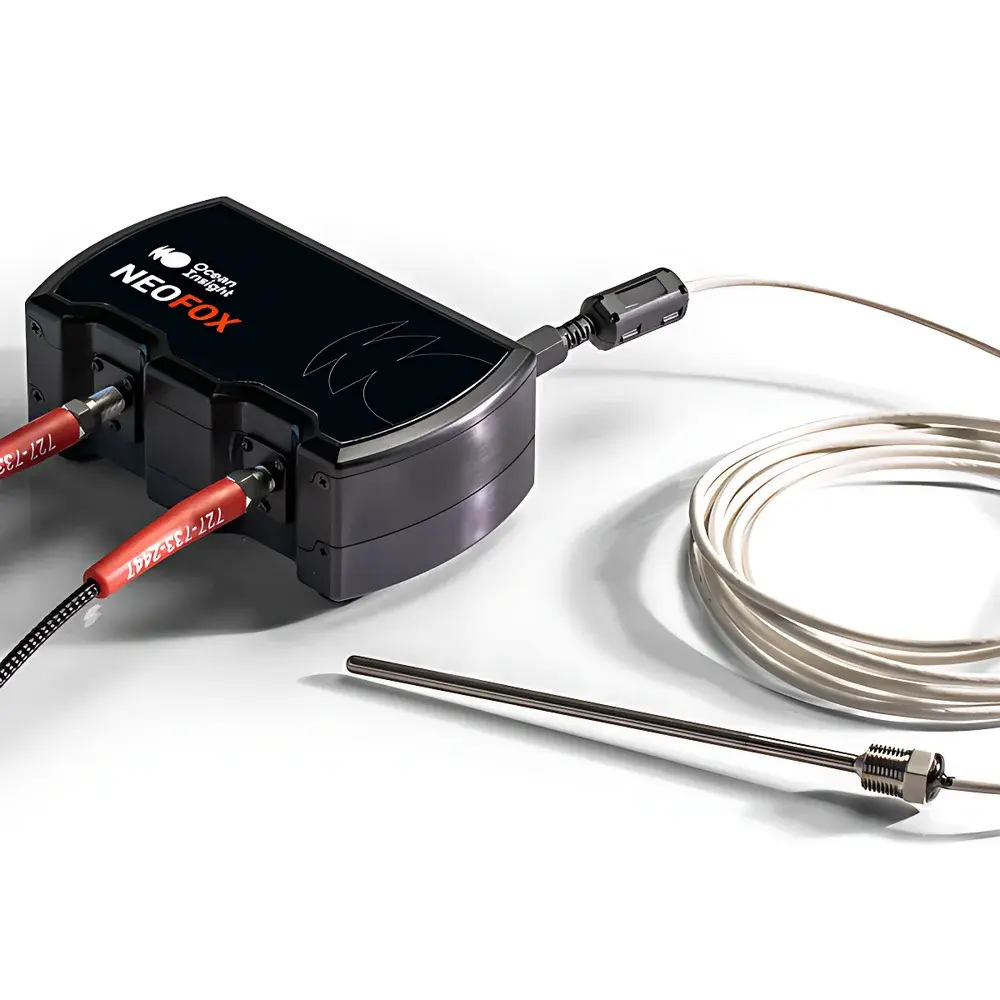
Ocean Optics NeoFox Optical Oxygen Sensor
| Brand | Ocean Optics |
|---|---|
| Origin | Imported |
| Manufacturer | Ocean Optics, Inc. |
| Model | NeoFox |
| Measurement Principle | Fluorescence Quenching (Phase-Modulation) |
| Accuracy | ±0.1–0.5% O₂ (full scale) |
| Resolution | 0.005–0.20% O₂ |
| Probe Coating | Sol-Gel or Polymer-Based Oxygen-Sensitive Luminescent Layer |
| Interface | USB/RS-232 |
| Software | NeoFox Data Acquisition & Control Suite (v4.0+) |
| Compliance | CE, RoHS, ISO/IEC 17025-compatible operation environment |
| Operating Temperature | 0–50 °C |
| Pressure Range | Ambient to 3 bar (absolute), optional high-pressure variants available |
Overview
The Ocean Optics NeoFox is a phase-modulation-based optical oxygen sensor engineered for high-stability, non-consumptive dissolved and gaseous oxygen measurement across demanding industrial, environmental, and bioprocess applications. Unlike electrochemical sensors—whose anodes degrade over time and whose measurements drift due to electrolyte depletion—the NeoFox employs solid-state luminescent sensing films that undergo reversible fluorescence quenching in the presence of molecular oxygen. This photophysical interaction is quantified via lifetime decay analysis at modulated excitation frequencies, delivering inherent immunity to signal drift, electrode poisoning, and flow-rate dependency. The system comprises a fiber-optic-coupled probe (e.g., NeoFox-KIT), a compact interrogation unit, and dedicated software for real-time calibration, dynamic range optimization, and multi-channel synchronization. Its design supports both liquid-phase (dissolved O₂ in aqueous or organic media) and headspace/gas-phase measurement without cross-sensitivity to CO₂, H₂S, or volatile organic compounds—making it suitable for long-term unattended deployment in fermentation tanks, wastewater treatment basins, food packaging headspaces, and marine monitoring buoys.
Key Features
- Non-invasive & non-consumptive sensing: No oxygen is consumed during measurement; sample integrity remains fully preserved—critical for low-volume biological assays and microaerobic culture studies.
- Robust solid-state probe architecture: Sensing elements are immobilized within sol-gel or polymer matrices directly coated onto optical fibers or planar substrates—resistant to mechanical abrasion, biofouling, and chemical corrosion in saline, acidic, or alkaline environments.
- Temperature-compensated phase-lifetime detection: Built-in NTC thermistor enables real-time thermal correction per ASTM D8083-22 guidelines, minimizing temperature-induced uncertainty across 0–50 °C operating range.
- Field-configurable dynamic range: Software-selectable measurement modes support ultra-low O₂ (0–0.1% v/v) for anaerobic process control or high-range (0–100% v/v) for combustion safety monitoring—without hardware modification.
- Plug-and-play fiber-optic interface: Standard SMA 905 connectors enable rapid probe interchangeability; fiber lengths up to 10 m maintain signal fidelity with <±0.02% O₂ repeatability (n=50, 24 h).
- GLP-compliant data handling: NeoFox software supports audit-trail-enabled user accounts, electronic signatures, and 21 CFR Part 11–compatible metadata tagging for regulated QC/QA workflows.
Sample Compatibility & Compliance
The NeoFox sensor demonstrates broad compatibility across heterogeneous sample matrices: aqueous solutions (including seawater and fermentation broths), viscous slurries (e.g., activated sludge, cosmetic emulsions), gas mixtures (N₂/O₂/CO₂ blends), and headspace vapors above packaged foods or pharmaceuticals. Its optical transduction mechanism eliminates interference from redox-active species (e.g., Fe²⁺, ascorbate), chloride ions, or hydrogen sulfide—common failure modes for Clark-type electrodes. All NeoFox probes are manufactured under ISO 9001-certified processes and conform to IEC 61326-1 (EMC) and IEC 61000-6-2/6-3. When deployed in validated systems, the platform meets analytical requirements outlined in USP , EP 2.2.43, and ISO 5814 for dissolved oxygen determination.
Software & Data Management
The NeoFox Data Acquisition & Control Suite (v4.0+) provides native support for Windows OS and integrates seamlessly with LabVIEW™, MATLAB®, and OPC UA industrial automation frameworks. Key capabilities include automated multi-point calibration using certified gas standards (e.g., NIST-traceable zero and span gases), real-time derivative analysis for onset-of-deoxygenation detection, programmable duty cycling to extend probe service life in continuous monitoring scenarios, and configurable alarm thresholds with email/SNMP alerting. Raw phase-lifetime datasets are stored in HDF5 format with embedded metadata (timestamp, temperature, probe ID, calibration history), enabling traceability for FDA 21 CFR Part 11–governed environments. Export options include CSV, Excel, and PDF report generation with customizable branding and compliance footers.
Applications
- Biopharmaceutical upstream processing: Dissolved oxygen profiling in single-use bioreactors and perfusion systems.
- Food & beverage quality assurance: Headspace O₂ monitoring in modified-atmosphere packaging (MAP) lines.
- Environmental monitoring: In-situ DO mapping in estuarine sediments, aquaculture ponds, and wastewater oxidation ditches.
- Chemical process safety: Oxygen concentration tracking in inerted reactors and solvent recovery vessels.
- Academic research: Hypoxia modeling in 3D cell cultures and microfluidic organ-on-chip platforms.
- Marine instrumentation: Integration into CTD rosettes and autonomous underwater vehicles (AUVs) for ocean deoxygenation studies.
FAQ
Does the NeoFox require periodic recalibration?
Yes—though significantly less frequently than electrochemical sensors. A two-point calibration (zero and span) is recommended every 3–6 months under stable conditions, or after probe cleaning or exposure to extreme pH/temperature events.
Can NeoFox probes be sterilized?
Probe tips with silicone or fluoropolymer coatings tolerate autoclaving (121 °C, 20 min) and ethylene oxide (EtO) treatment; sol-gel-coated variants are compatible with gamma irradiation (up to 25 kGy) per ISO 11137.
Is the system compatible with hazardous area classifications?
The NeoFox interrogation unit is rated Class I, Division 2 (CID2); intrinsically safe probe variants (ATEX II 2G Ex ib IIB T4 Gb) are available upon request for Zone 1/2 deployments.
How does pressure affect measurement accuracy?
Standard probes assume ambient pressure; for applications >1.5 bar absolute, optional pressure-compensated models integrate MEMS barometric sensors and apply Henry’s law corrections in real time.
What is the typical probe service life?
Under continuous operation in clean aqueous media, sol-gel-coated probes maintain specification performance for ≥24 months; polymer-coated variants exceed 36 months in gas-phase monitoring.