
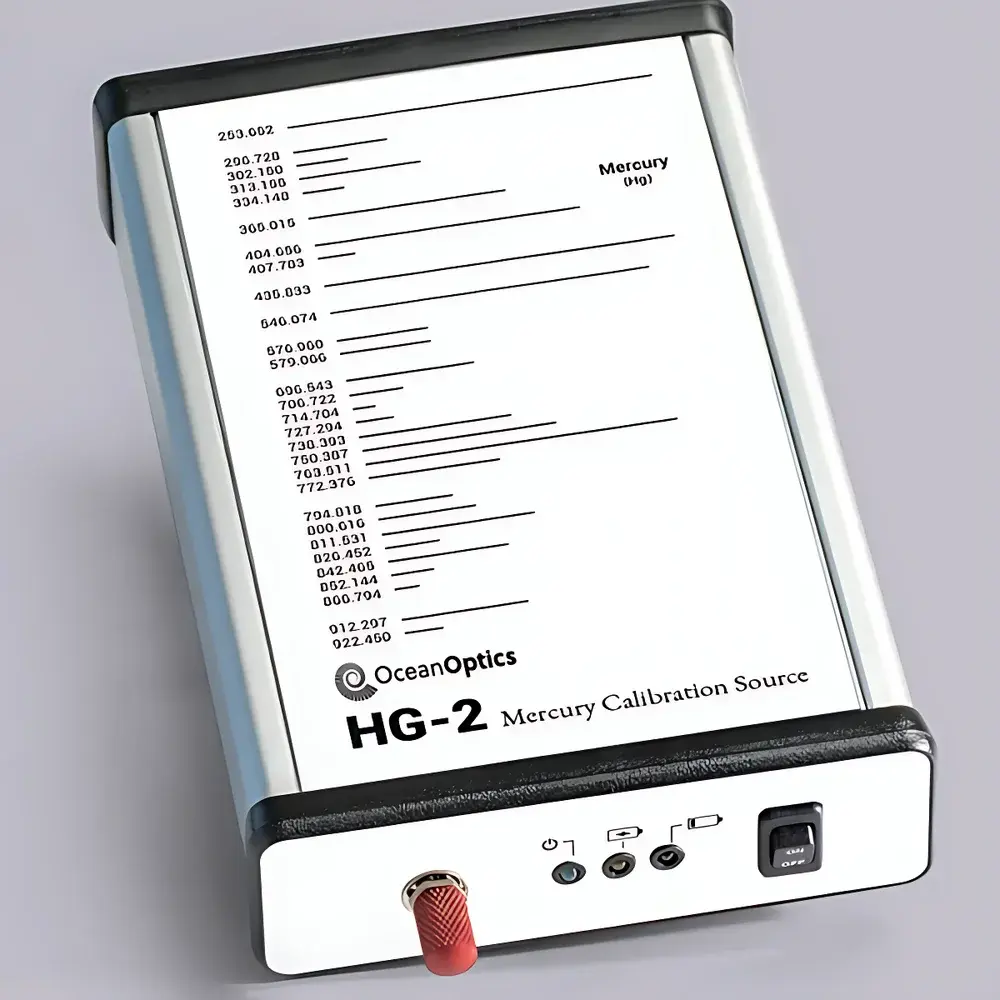
Ocean Optics HG-2 Wavelength Calibration Light Source
| Brand | Ocean Optics |
|---|---|
| Model | HG-2 |
| Origin | USA |
| Light Source Type | Mercury-Argon / Argon / Krypton / Neon / Xenon Hollow Cathode Lamps |
| Spectral Range | 253 nm – 1984 nm (configurable by lamp module) |
| Output Interface | SMA 905 |
| Power Supply | 5 V DC, rechargeable battery integrated |
| Compliance | CE, RoHS |
| Lamp Configuration | Interchangeable single-element hollow cathode modules |
| Operating Temperature | 15–35 °C |
| Warm-up Time | < 5 min to spectral stability |
| Spectral Linewidth | < 0.05 nm (FWHM, typical for hollow cathode lamps) |
| Lifetime | ≥ 5,000 hours (lamp-dependent) |
Overview
The Ocean Optics HG-2 Wavelength Calibration Light Source is a precision-engineered, modular calibration standard designed for traceable wavelength verification and alignment of UV-VIS-NIR spectrometers across laboratory, industrial, and field-deployable optical systems. Based on low-pressure hollow cathode discharge lamp technology, the HG-2 emits narrow, well-characterized atomic emission lines with high spectral purity and long-term repeatability—critical for maintaining instrument compliance with ISO/IEC 17025, ASTM E275, and USP requirements. Unlike broadband or LED-based references, hollow cathode lamps deliver discrete, NIST-traceable emission peaks (e.g., Hg I at 253.65 nm, Ar I at 696.54 nm, Ne I at 540.06 nm), enabling sub-pixel wavelength registration and drift correction in array-based detectors. The HG-2 operates without external gas supply or high-voltage drivers; its integrated 5 V DC rechargeable power system ensures stable current regulation and thermal management for consistent line intensity and centroid position over time.
Key Features
- Modular lamp architecture: Five interchangeable hollow cathode modules—HG-2AR (Hg-Ar), HG-2KR (Kr), HG-2NE (Ne), HG-2XE (Xe), and HG-2AR (Ar)—cover a continuous composite range from 253 nm to 1984 nm
- NIST-traceable emission lines: Each lamp emits certified atomic transitions with documented peak wavelengths, intensities, and relative uncertainties per manufacturer calibration report
- SMA 905 fiber-coupled output: Ensures efficient, reproducible light delivery to spectrometer input slits or integrating spheres without alignment drift
- Integrated 5 V DC rechargeable power system: Eliminates need for AC adapters or external ballasts; supports >4 hours of continuous operation per charge with constant-current regulation
- Thermally stabilized housing: Aluminum chassis with passive heat dissipation maintains lamp temperature within ±1.5 °C during warm-up and steady-state operation, minimizing Doppler broadening and peak shift
- Low temporal drift: <0.002 nm/h wavelength drift after 15-minute stabilization, verified per internal QA protocol against reference interferometer
Sample Compatibility & Compliance
The HG-2 is compatible with all grating-based, CCD/CMOS-array, and photodiode-array spectrometers equipped with SMA 905 input ports—including Ocean Insight’s own QE Pro, Flame, and Maya2000 series, as well as instruments from Avantes, Hamamatsu, and Princeton Instruments. It satisfies wavelength accuracy validation requirements under ISO 17025 Clause 6.4.8 (Equipment Calibration), ASTM E275-22 Annex A1 (Spectrophotometer Wavelength Accuracy Assessment), and FDA 21 CFR Part 11 when used in conjunction with compliant spectroscopic data acquisition software. Each lamp module ships with a certificate of conformance listing measured peak positions (±0.005 nm uncertainty, k=2), spectral purity index (>98% line isolation), and lamp serial number traceable to factory calibration records.
Software & Data Management
While the HG-2 operates as a hardware-only reference source, it integrates seamlessly into validated calibration workflows via Ocean Insight’s OceanView v3.5+ and SpectraSuite platforms. These applications support automated wavelength mapping routines that capture full-spectrum scans, identify user-defined emission lines (e.g., Hg 365.01 nm, Ar 750.387 nm), compute pixel-to-wavelength polynomials (up to 5th order), and generate PDF calibration reports with audit trail metadata (operator ID, timestamp, instrument ID, lamp SN). All calibration sessions are logged with electronic signatures and exportable CSV/JSON datasets compliant with GLP/GMP documentation standards.
Applications
- Pre- and post-maintenance wavelength recalibration of benchtop and portable spectrometers
- Factory acceptance testing (FAT) and site acceptance testing (SAT) of OEM optical modules
- Reference standard in metrology labs performing inter-instrument comparison studies
- Validation of chemometric models requiring stable spectral axis registration (e.g., NIR pharmaceutical blend uniformity)
- Education and training: Demonstrating atomic emission physics, spectral resolution limits, and detector pixel response nonlinearity
- Environmental monitoring networks: Ensuring cross-platform consistency in UV-Vis water quality analyzers deployed across distributed sensor nodes
FAQ
What emission lines are included in the HG-2AR (Mercury-Argon) module?
The HG-2AR lamp emits 12 primary NIST-certified lines between 253.65 nm and 922.45 nm, including Hg I at 253.65, 365.01, 404.66, 435.83, and 546.07 nm; Ar I at 696.54, 706.72, 727.29, 763.51, 811.53, 840.82, and 912.29 nm.
Can multiple HG-2 modules be used simultaneously?
No—the HG-2 is a single-lamp housing; however, users may manually swap modules between calibrations. For multi-line simultaneous excitation, Ocean Insight recommends the PX-2 pulsed xenon source paired with spectral filtering.
Is the HG-2 suitable for radiometric calibration?
No—it is a wavelength reference only. Intensity calibration requires a separate NIST-traceable irradiance standard (e.g., Ocean Insight’s SLS201L or calibrated tungsten halogen source).
How often does the HG-2 require recalibration?
The lamp modules themselves do not require user recalibration; each is factory-calibrated with lifetime validity unless physically damaged. Users should verify performance annually using a reference spectrometer with known linearity.
Does the HG-2 support USB or Bluetooth connectivity?
No—it is a passive optical source with no embedded electronics or communication interface. Power and control are entirely local via the onboard rechargeable circuit.




