
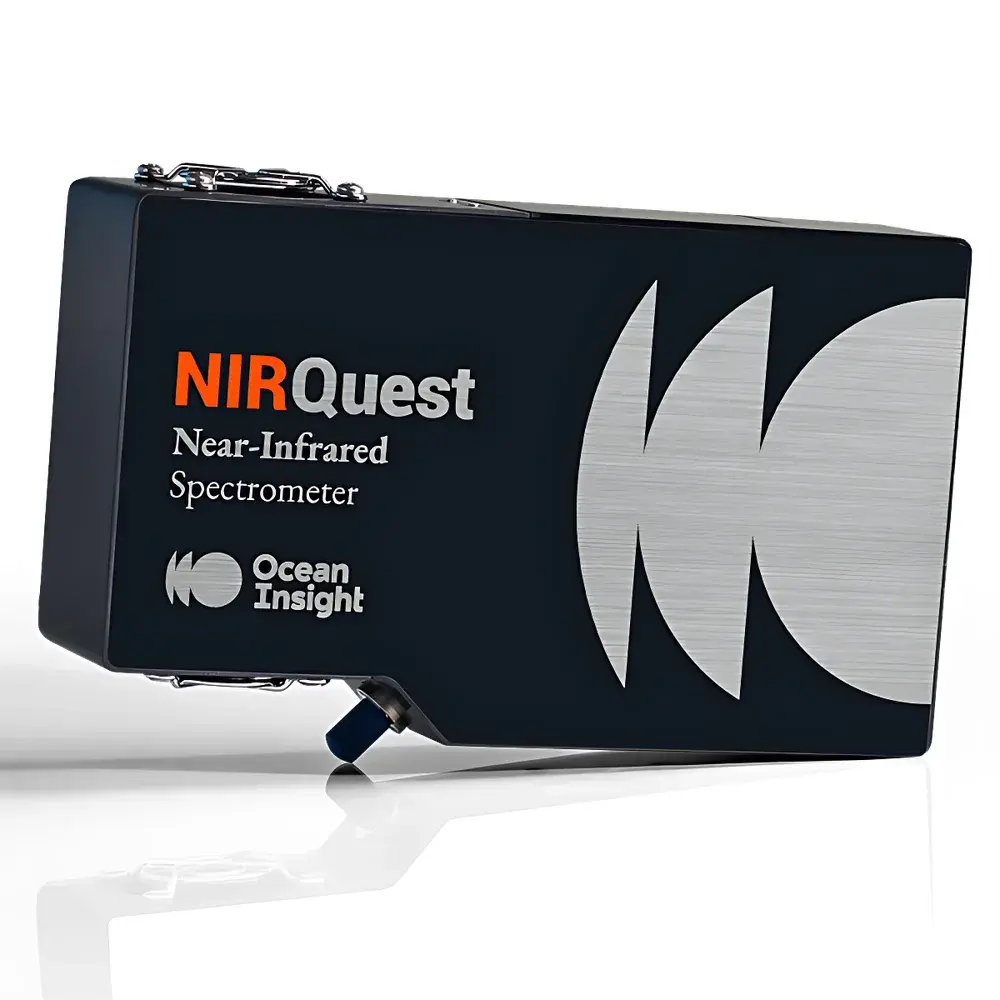
Ocean Optics NIRQuest Near Infrared Spectrometer
| Brand | Ocean Optics |
|---|---|
| Origin | Shanghai, China |
| Manufacturer Type | Manufacturer |
| Regional Origin | Domestic (China) |
| Model | NIRQuest |
| Instrument Type | Laboratory |
| Application Field | Grain Analysis |
| Operating Principle | Portable & Online Deployment |
| Wavelength Range | 900–1700 nm (extendable to 2500 nm) |
| Scan Speed | 1 ms |
| Measurement Mode | Diffuse Reflectance / Transmission |
| Detector | InGaAs Linear Array with Integrated Thermoelectric Cooling |
| Optical Platform | Crossed Czerny-Turner |
| A/D Resolution | 16-bit USB |
| Interface | SMA905 Fiber Optic Connector |
| Compliance | Compatible with ASTM E1655, ISO 12099, USP <856>, and GLP/GMP-aligned data workflows |
Overview
The Ocean Optics NIRQuest Near Infrared Spectrometer is a modular, fiber-coupled benchtop spectrometer engineered for high-fidelity spectral acquisition in the near-infrared region. Based on the principles of dispersive spectroscopy—where incident light is collimated, diffracted by a ruled or holographic grating, and focused onto an InGaAs photodiode array—the NIRQuest delivers real-time, quantitative spectral data with robust signal-to-noise performance. Its core architecture integrates a thermoelectrically cooled InGaAs detector (operating up to 30 °C below ambient), a low-stray-light crossed Czerny-Turner optical bench, and user-selectable gratings to optimize resolution and spectral coverage across three standard configurations: 900–1700 nm, 900–2100 nm, and 900–2500 nm. Designed explicitly for laboratory-based method development and process-adjacent deployment, the NIRQuest supports both offline calibration transfer and inline monitoring via standardized fiber-optic interfacing (SMA905), making it suitable for applications requiring regulatory traceability and repeatable spectral acquisition under variable environmental conditions.
Key Features
- Thermoelectrically cooled InGaAs linear array detectors (Hamamatsu G9204-512, G9206-256, or G9208-256), enabling stable dark current suppression and extended integration times without thermal drift
- Crossed Czerny-Turner optical design with low aberration optics and selectable slit widths (10–200 µm) to balance resolution and throughput per application requirement
- 16-bit USB-based analog-to-digital conversion with 1 ms minimum integration time, supporting high-speed kinetic measurements and trigger-synchronized acquisitions
- Modular grating selection—including options optimized for 900–1700 nm, 1200–2100 nm, and 900–2500 nm ranges—to tailor spectral resolution (typically 1.2–5.0 nm FWHM depending on configuration) and minimize order overlap
- Fiber-optic coupling via industry-standard SMA905 interface, ensuring compatibility with Ocean Insight’s full ecosystem of broadband NIR sources, integrating sphere reflectance accessories, transmission cuvette holders, and immersion probes
- Embedded firmware supporting hardware-level triggering (external TTL, software, or level-triggered modes), essential for synchronization with automated sample handling or industrial PLC systems
Sample Compatibility & Compliance
The NIRQuest accommodates solid, liquid, and semi-solid samples through configurable measurement geometries—primarily diffuse reflectance (e.g., grain kernels, powdered pharmaceuticals, soil) and transmission (e.g., clear liquids, thin films, polymer solutions). Its optical path is compatible with ISO 12099:2017 (animal feeding stuffs), ASTM E1655-22 (standard practices for multivariate calibration), and USP (near-infrared spectroscopy for pharmaceutical analysis). When deployed within validated workflows—including audit-trail-enabled software environments—the system supports GLP and GMP documentation requirements. While the instrument itself does not carry FDA 21 CFR Part 11 certification, its raw spectral output (in .SDA or .CSV format) is fully compatible with compliant third-party chemometric platforms that implement electronic signatures, change control, and secure data archiving.
Software & Data Management
The NIRQuest operates natively with Ocean Insight’s SpectraSuite spectral acquisition software, which provides real-time visualization, baseline correction, smoothing, and peak identification tools. For advanced modeling, exported spectra integrate seamlessly into MATLAB, Python (via seabreeze or oceanoptics-spectra libraries), and commercial chemometrics suites such as Unscrambler X, CAMO Analytics, or Pirouette. All spectral metadata—including integration time, grating ID, slit width, detector temperature, and calibration coefficients—are embedded in vendor-neutral file headers. Raw intensity data is stored without proprietary compression, ensuring long-term readability and reproducibility. Batch acquisition scripts and API-driven control (through USB HID or virtual COM port protocols) enable unattended operation in quality control laboratories and pilot-scale process monitoring environments.
Applications
- Grain and cereal analysis: moisture, protein, starch, and oil content quantification using PLS regression models validated per AOAC 2015.01 and ICC 171
- Pharmaceutical solid dosage form verification: blend uniformity assessment, coating thickness estimation, and polymorph identification in tablets and capsules
- Environmental monitoring: rapid screening of organic contaminants (e.g., hydrocarbons, phenols) and total suspended solids in wastewater effluents
- Food authenticity and adulteration detection: olive oil purity, honey origin verification, and dairy fat substitution analysis
- Chemical process analytics: real-time reaction endpoint determination in esterification, hydrogenation, and polymerization processes
- Material science: crystallinity index evaluation in biopolymers and cellulose derivatives via second-derivative band ratio analysis
FAQ
What wavelength ranges are available for the NIRQuest series?
The NIRQuest is offered in three standard configurations: NIRQuest512 (850–1700 nm), NIRQuest256-2.1 (900–2100 nm), and NIRQuest256-2.5 (900–2500 nm), each with dedicated InGaAs detector variants and grating options.
Is the NIRQuest suitable for regulated pharmaceutical environments?
Yes—when integrated with compliant chemometric software and documented SOPs, the NIRQuest meets foundational requirements for PAT (Process Analytical Technology) implementation under ICH Q8/Q9/Q10 and supports Stage 3 validation per USP .
Can I use my existing Ocean Insight fiber optics and light sources with the NIRQuest?
Absolutely—all NIRQuest units share mechanical, optical, and electrical interoperability with Ocean Insight’s full portfolio of tungsten-halogen, quartz-tungsten-halogen, and pulsed LED NIR sources, as well as reflection probes, transmission cells, and cosine correctors.
Does the NIRQuest support external triggering for synchronized measurements?
Yes—it accepts TTL-level trigger signals (rising/falling edge or level-sensitive) and supports software-initiated, hardware-gated, and self-triggered acquisition modes.
How is detector cooling implemented, and what is its operational impact?
An integrated single-stage thermoelectric cooler maintains the InGaAs array at up to 30 °C below ambient temperature, reducing dark current by >90% and enabling stable 1–60 s integrations without pixel saturation or thermal noise accumulation.
Related Products





