
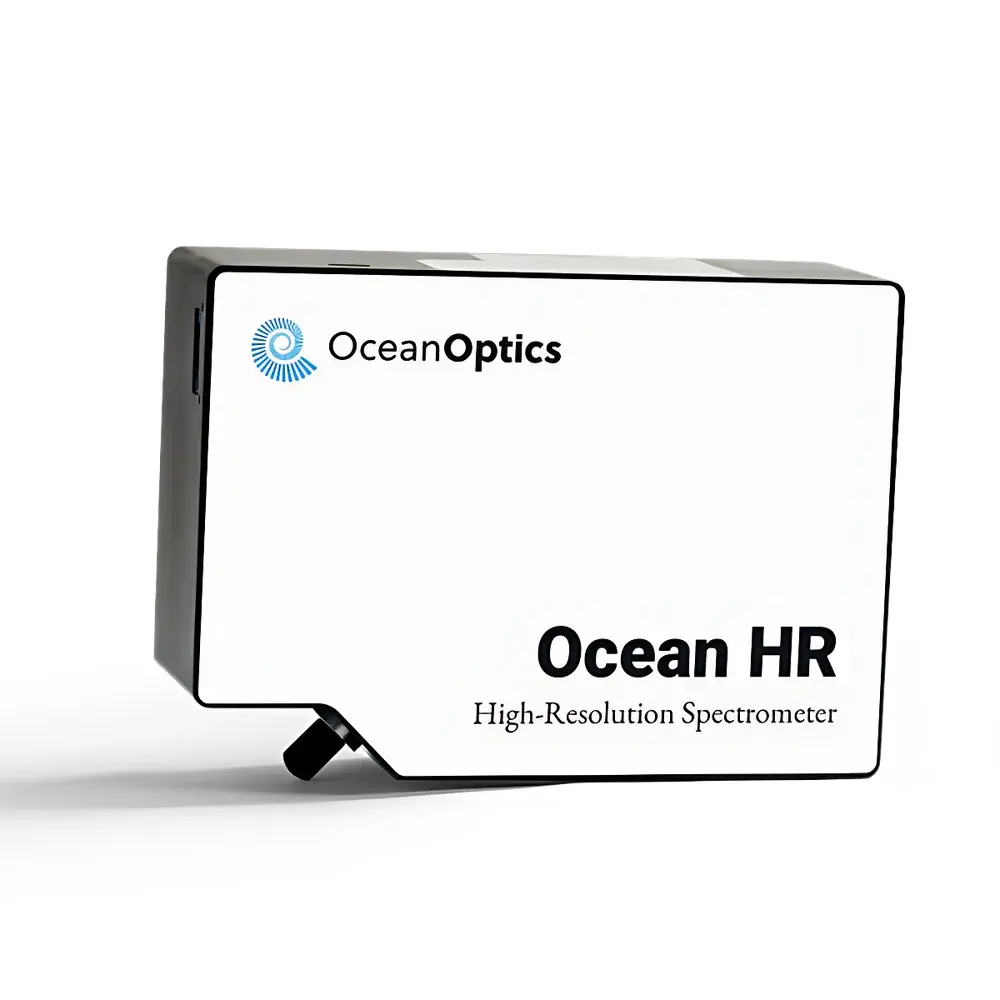
Ocean Optics Ocean HR6 High-Resolution Fiber Optic Spectrometer
| Brand | Ocean Optics |
|---|---|
| Origin | USA |
| Manufacturer Type | Original Equipment Manufacturer (OEM) |
| Import Status | Imported |
| Model | Ocean HR6 |
| Spectral Range | ~185–1100 nm |
| Optical Resolution | <1.0 nm FWHM (configurable, e.g., with 25 µm slit) |
| Signal-to-Noise Ratio | 3500:1 (on-board averaging mode) |
| Dynamic Range | 12,000:1 (single-scan) |
Overview
The Ocean Optics Ocean HR6 is a high-resolution, high-sensitivity fiber optic spectrometer engineered for demanding UV-VIS-NIR spectroscopic applications requiring sub-nanometer spectral fidelity. Based on a Czerny-Turner optical architecture with optimized diffraction grating selection and thermally stabilized detector mounting, the HR6 delivers exceptional wavelength accuracy and long-term measurement repeatability across its full operational range (~185–1100 nm). Its core design emphasizes metrological robustness: thermal drift is limited to 0.02 nm/°C, enabling reliable operation in non-climate-controlled laboratory or field-deployable environments. Unlike lower-resolution spectrometers that sacrifice resolution for throughput, the HR6 achieves <1.0 nm FWHM resolution—without compromising sensitivity—through precision-aligned optics, low-noise CMOS linear array detection (2048 pixels), and advanced on-board signal processing. This makes it particularly suitable for applications where spectral feature discrimination is critical: protein absorbance quantification (e.g., A280/A260 ratio analysis), LED and laser diode emission profiling, Raman excitation line monitoring, and broadband source characterization.
Key Features
- Sub-nanometer optical resolution: <1.0 nm FWHM (achievable with 25 µm input slit; configurable slits from 5 µm to 200 µm enable trade-off optimization between resolution and light throughput)
- Extended spectral coverage: Broadband response from deep UV (~185 nm) through visible to near-infrared (1100 nm), supporting modular grating and detector options for UV-VIS, VIS-NIR, or extended-range (XR) configurations
- High dynamic range & SNR: 12,000:1 single-scan dynamic range; 3500:1 signal-to-noise ratio in on-board averaging mode (with integration times up to 5 s); 400:1 SNR at 10 ms single-scan exposure
- Thermal stability: Precision-machined aluminum housing and thermally anchored optical bench ensure wavelength calibration retention of ±0.02 nm/°C over 0–55 °C operating range
- Flexible connectivity: USB Type-C interface for high-speed data transfer; SMA 905 fiber coupling; 16-pin Samtec TM connector for TTL triggering, analog output, and external synchronization; optional RS-232 serial control
- Compact and rugged form factor: 149 × 106 × 48 mm footprint; 931 g mass; rated for storage between –30 °C and +70 °C
Sample Compatibility & Compliance
The Ocean HR6 interfaces seamlessly with standard spectroscopic sampling accessories—including cuvette holders, integrating spheres, reflection probes, collimating lenses, and pulsed or continuous-wave light sources—via SMA 905 optical fiber. Its wide spectral range supports compliance-critical measurements aligned with ASTM E308 (colorimetry), ISO 13406-2 (display luminance), USP (UV-Vis spectrophotometric system suitability), and ICH Q2(R2) guidelines for analytical instrument qualification. While not inherently GLP/GMP-certified as a standalone unit, the HR6’s deterministic firmware behavior, traceable wavelength calibration (NIST-traceable options available), and reproducible integration timing support audit-ready workflows when deployed within validated systems. Data integrity is reinforced by deterministic timestamping, hardware-level exposure control, and absence of automatic gain adjustment during acquisition—ensuring raw spectra remain unaltered for regulatory review.
Software & Data Management
Every Ocean HR6 ships with OceanDirect—a vendor-supported, cross-platform SDK (Windows, macOS, Linux) providing full programmatic access via C/C++, Python, MATLAB, LabVIEW, and .NET APIs. OceanDirect enables low-level configuration of integration time (7.2 ms to 5 s), pixel binning, dark current subtraction, and real-time on-board averaging—critical for optimizing SNR in low-light applications such as fluorescence or Raman. The SDK supports synchronous multi-device triggering, hardware-based ROI readout, and metadata embedding (e.g., calibration date, slit width, grating ID) directly into spectrum files (CSV, HDF5, or proprietary .OO format). For regulated environments, OceanDirect can be integrated into 21 CFR Part 11-compliant software stacks via third-party LIMS or custom applications that implement electronic signatures, audit trails, and user access controls.
Applications
- Protein and nucleic acid quantification: Linear absorbance response across wide concentration ranges eliminates need for serial dilution—reducing pipetting error and improving assay reproducibility in biopharma QC labs
- LED and laser spectral characterization: Resolving narrow emission peaks (<2 nm FWHM), side-mode suppression ratio (SMSR), and centroid wavelength shift under thermal load
- Environmental monitoring: Detection of trace UV-absorbing compounds (e.g., NO₂, SO₂, benzene derivatives) using differential optical absorption spectroscopy (DOAS) principles
- Material reflectance/transmittance analysis: High-fidelity spectral shape capture for thin-film interference modeling, pigment identification, and photovoltaic cell EQE validation
- Educational and research spectroscopy: Teaching atomic emission line identification, Beer-Lambert law validation, and Fourier-transform-limited pulse diagnostics in ultrafast optics labs
FAQ
What slit width should I select for optimal resolution vs. sensitivity trade-off?
For maximum resolution (<1.0 nm FWHM), use a 25 µm slit. For higher throughput in low-light applications (e.g., fluorescence), 50–100 µm slits are recommended—though resolution degrades proportionally. Slit selection must be specified at time of order, as it is mechanically fixed.
Is NIST-traceable calibration included with the HR6?
Standard units ship with factory calibration (wavelength and intensity). NIST-traceable calibration certificates (including uncertainty budgets per ISO/IEC 17025) are available as an optional add-on at time of purchase.
Can the HR6 operate in triggered or gated acquisition mode?
Yes—the 16-pin Samtec TM interface supports TTL-level external trigger input, hardware gating, and programmable delay, enabling synchronization with pulsed lasers, strobed light sources, or motion stages.
Does OceanDirect support real-time spectrum streaming at maximum acquisition rate?
At full 2048-pixel resolution and minimum 7.2 ms integration, sustained streaming exceeds 100 spectra/s over USB Type-C; performance scales with host CPU and buffer management—full API documentation includes latency benchmarks and memory-mapped I/O examples.
How is thermal wavelength drift corrected during long-duration measurements?
The HR6 does not perform active wavelength recalibration. Instead, its passive thermal design limits drift to ≤0.02 nm/°C. For multi-hour experiments, users may apply periodic reference lamp checks or embed internal wavelength references (e.g., mercury-argon lamp lines) in acquisition protocols.





