
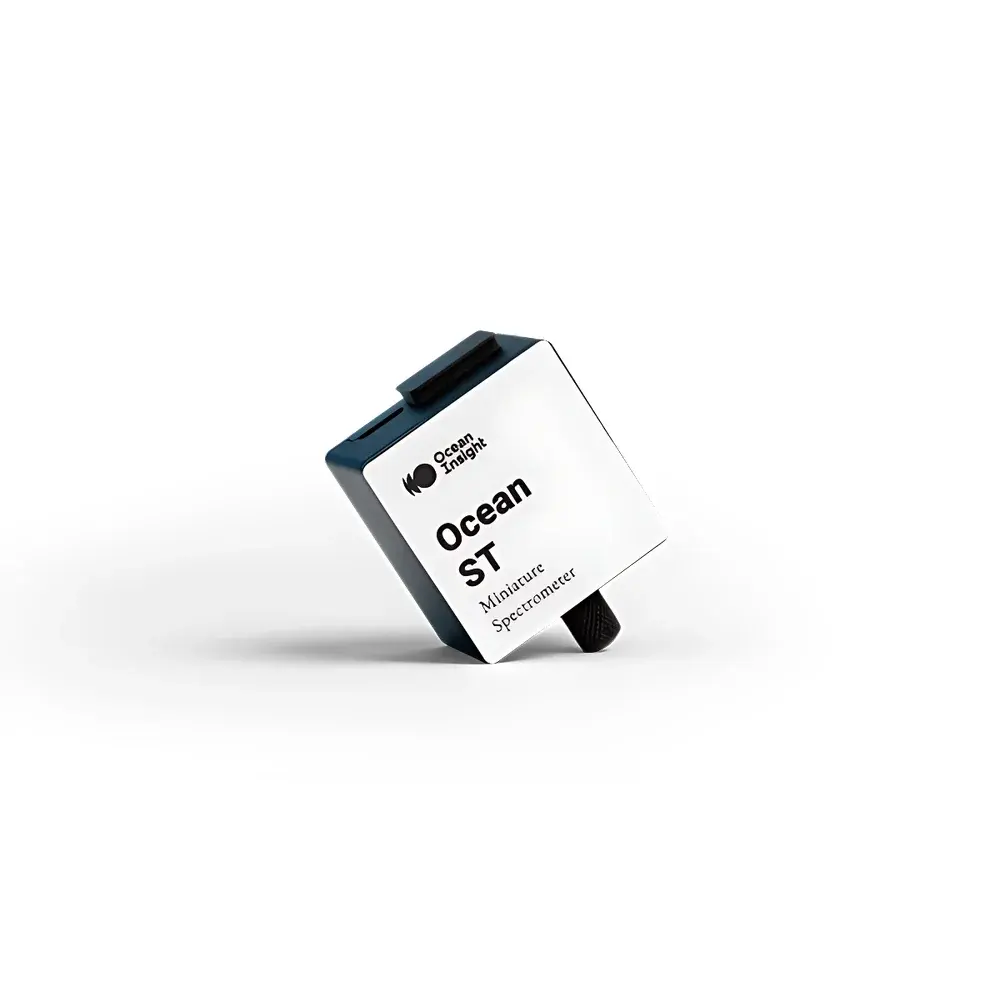
Ocean Optics Ocean ST Fiber Optic Spectrometer
| Brand | Ocean Optics |
|---|---|
| Origin | USA |
| Manufacturer Type | Original Equipment Manufacturer (OEM) |
| Import Category | Imported Instrument |
| Model | Ocean ST |
| Spectral Range | 185–650 nm (UV-VIS), 350–810 nm (VIS-NIR), 645–1085 nm (NIR) |
| Optical Resolution | 2.2 nm FWHM (configuration-dependent) |
| Signal-to-Noise Ratio | >250:1 (full-scale, single-scan, typical) |
| Dynamic Range | 1000:1 (single-scan) |
| Stray Light | <0.2% at 600 nm (typical) |
Overview
The Ocean Optics Ocean ST Fiber Optic Spectrometer is a high-performance, ultra-compact spectrometer engineered for precision spectral measurement across ultraviolet, visible, and near-infrared wavelengths. Based on a fixed-grating Czerny-Turner optical architecture with a back-thinned CMOS linear array detector, the Ocean ST delivers robust photometric stability, low thermal drift, and reproducible spectral response—critical attributes for both laboratory analysis and embedded OEM applications. Its miniature form factor (94 × 63.5 × 34.9 mm) and low mass (<250 g) enable seamless integration into portable analyzers, inline process monitors, handheld devices, and automated test platforms without compromising analytical fidelity. Designed for operation in ambient or thermally uncontrolled environments, the Ocean ST features passive thermal stabilization and minimal inter-unit spectral variation (typical wavelength repeatability ±0.1 nm), supporting multi-instrument deployment in distributed sensing networks or production-line QA/QC stations.
Key Features
- Three interchangeable spectral configurations: UV-VIS (185–650 nm), VIS-NIR (350–810 nm), and NIR (645–1085 nm), each optimized for detector quantum efficiency and grating blaze characteristics
- Optical resolution of 2.2 nm FWHM (typical), adjustable via user-selectable entrance slits (10 µm, 25 µm, 50 µm, or 100 µm) to balance spectral resolution against light throughput
- Back-thinned CMOS detector with >90% peak quantum efficiency in UV and high UV responsivity down to 185 nm—enabling reliable nucleic acid quantification (e.g., A260/A280 assays) and fluorescence excitation profiling
- Single-scan dynamic range of 1000:1 and signal-to-noise ratio exceeding 250:1 (full-scale, 10 s integration), supporting quantitative reflectance, absorbance, and emission measurements
- Rugged aluminum housing with IP52-rated environmental protection, operating temperature range of 5–40 °C, and shock resistance compliant with MIL-STD-810G (vibration: 5–500 Hz, 1.5 g RMS)
- USB 2.0 interface with <10 ms full-spectrum readout latency and hardware-triggered acquisition for synchronization with external light sources or motion stages
Sample Compatibility & Compliance
The Ocean ST is compatible with standard SMA 905 fiber-optic interfaces (core diameters from 50 µm to 600 µm) and supports common sampling geometries including transmission cuvettes, integrating spheres, reflection probes, and collimated free-space coupling. It meets key regulatory and quality system requirements for analytical instrumentation: optical calibration traceable to NIST SRM 2031 (mercury-argon lamp), firmware compliant with FDA 21 CFR Part 11 data integrity principles (audit trail-enabled configuration via OceanDirect SDK), and design aligned with ISO/IEC 17025:2017 clauses for measurement uncertainty estimation. While not certified for Class I medical device use, its performance stability and documentation support GLP/GMP-aligned validation protocols for QC laboratories in pharmaceutical, food, and materials science sectors.
Software & Data Management
Ocean ST systems ship with OceanDirect—a vendor-supported, cross-platform SDK supporting Windows, macOS, and Linux (x64/ARM64). The SDK provides a documented C/C++, Python, MATLAB, and LabVIEW API for low-level control of integration time (1 ms–65 s), scan averaging, dark correction, nonlinearity compensation, and real-time spectral streaming. All firmware updates, calibration files (.cal), and spectral metadata (wavelength array, pixel sensitivity, slit function) are stored internally and accessible programmatically. OceanDirect enables deterministic timestamping (µs resolution), hardware-triggered acquisition sequences, and configurable data export formats (CSV, HDF5, JSON) suitable for LIMS integration or automated report generation. No proprietary runtime licenses or subscription fees apply—users retain full ownership of deployed instrument control logic.
Applications
- DNA/RNA quantification and purity assessment (A260/A230, A260/A280 ratios) using UV-enhanced configurations
- Colorimetric analysis in paint, textile, and display manufacturing per CIE 1931 XYZ and DIN 6174 standards
- In-line monitoring of chemical reaction kinetics via UV-VIS absorbance tracking (e.g., nitrate reduction, dye degradation)
- NIR-based moisture and protein content screening in agricultural feed and pharmaceutical granules
- LED and laser diode spectral characterization (FWHM, centroid wavelength, side-mode suppression ratio)
- Embedded OEM integration in environmental sensors (e.g., dissolved organic carbon detection), point-of-care diagnostics, and educational lab kits
FAQ
Is the Ocean ST spectrometer suitable for GMP-regulated environments?
Yes—when deployed with validated OceanDirect scripts, calibrated reference standards, and documented instrument qualification (IQ/OQ/PQ), it supports routine use in GMP-compliant QC labs. Audit trails, electronic signatures, and calibration history retention are enabled via SDK-level logging.
Can I change the spectral range after purchase?
No—the grating and detector are permanently configured at manufacture. Users must select the appropriate model variant (UV-VIS, VIS-NIR, or NIR) prior to ordering.
What is the minimum integration time, and how does it affect SNR?
The shortest integration time is 1 ms. Reducing integration time lowers total photon collection and thus degrades SNR; optimal SNR is achieved at integration times ≥100 ms for most low-light applications.
Does the Ocean ST support synchronous multi-spectrometer triggering?
Yes—via TTL-compatible hardware trigger input/output ports, enabling precise temporal alignment of up to 8 Ocean ST units in a master-slave configuration for hyperspectral imaging or multi-angle reflectance studies.
Are calibration certificates included with shipment?
Each unit ships with a factory spectral calibration certificate (wavelength and intensity) traceable to NIST standards. Optional ISO/IEC 17025-accredited calibration services are available upon request.
Related Products





