
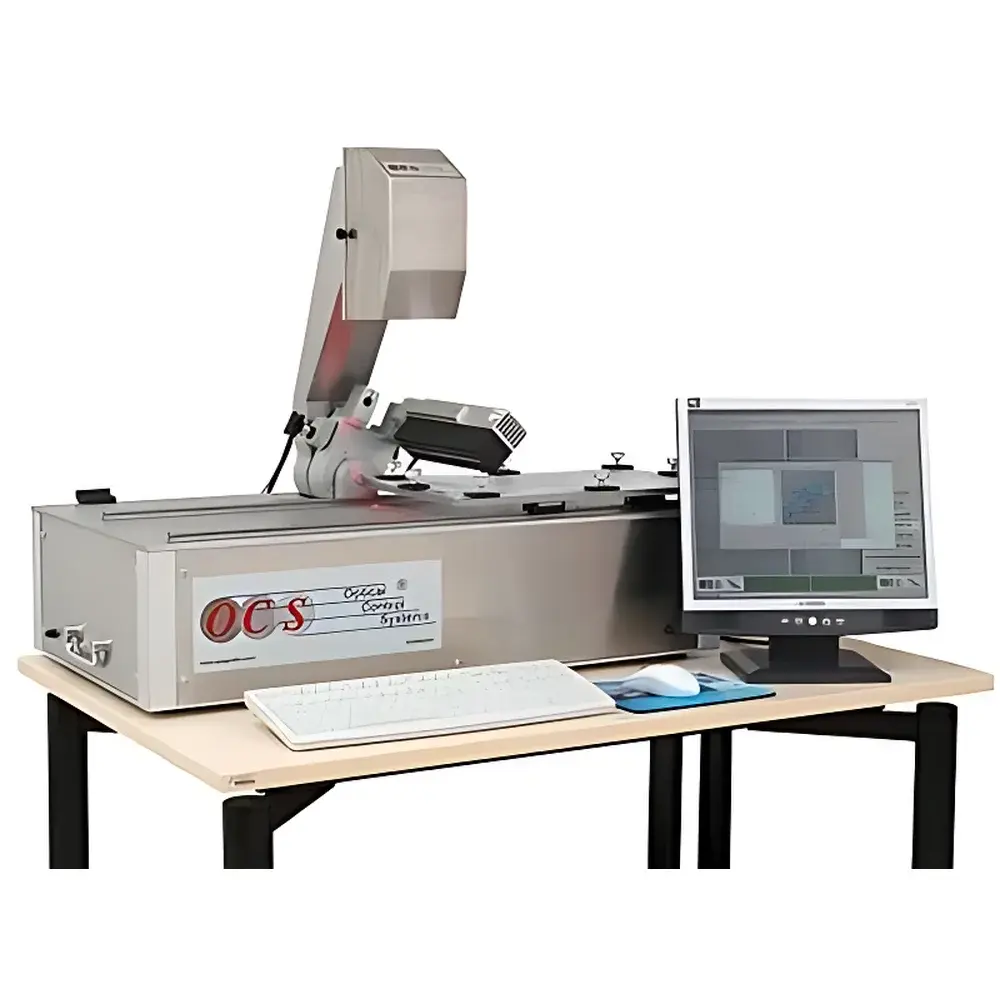
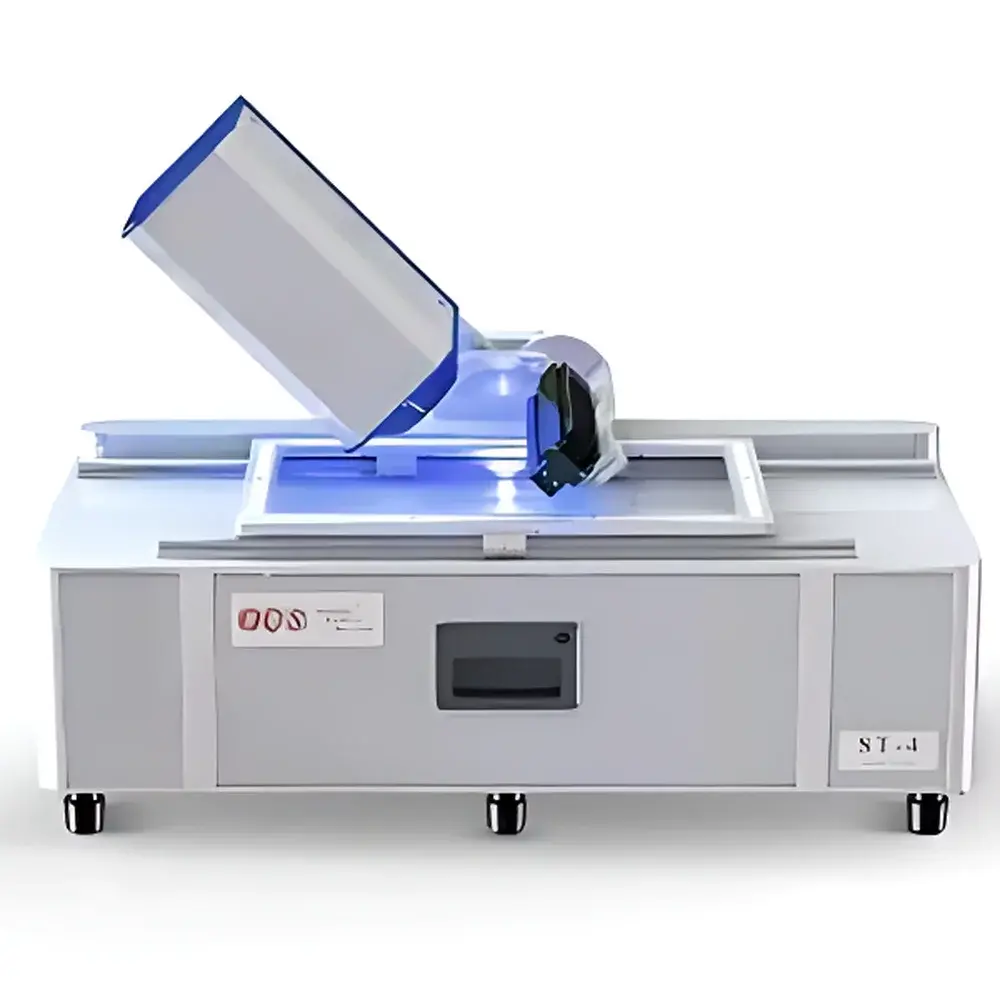
OCS ST-4 Desktop Thin Film Quality Inspection System
| Brand | OCS |
|---|---|
| Origin | Germany |
| Model | ST-4 |
| Configuration | Desktop-integrated line-scan imaging system with dual-mode (transmission/reflection) illumination |
| Detection Principle | High-speed linear CCD-based surface defect metrology |
| Sample Handling | Motorized precision translation stage with programmable scan speed and repeatable positioning |
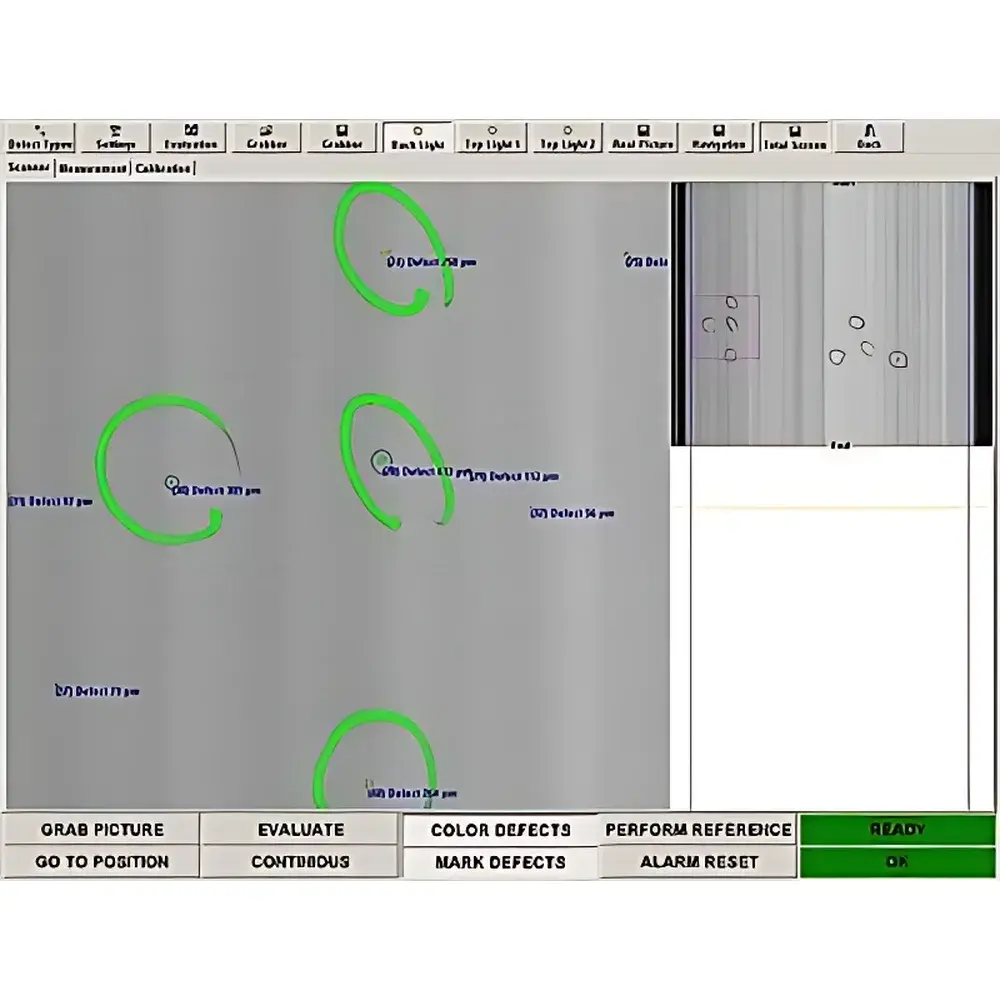
| Software Platform | Windows-based GUI with real-time image acquisition, defect classification, and audit-trail-enabled data logging |
| Compliance Context | Designed for R&D lab environments supporting ISO 9001-aligned quality documentation workflows and GLP-compliant experimental traceability |
Overview
The OCS ST-4 Desktop Thin Film Quality Inspection System is an engineered solution for high-resolution, non-contact surface defect characterization of polymeric and composite sheet materials. Based on linear CCD imaging metrology, the system employs a calibrated line-scan camera operating at up to 12 kHz line rate, synchronized with a closed-loop stepper-driven sample translation stage. This architecture enables pixel-level spatial resolution (≤10 µm) across full-width scans of flexible webs up to 400 mm wide. Unlike fixed-mount industrial vision systems, the ST-4’s compact benchtop footprint (W × D × H: 650 × 420 × 380 mm) allows seamless integration into polymer R&D laboratories—particularly those engaged in polyolefin (PP/PE) formulation development, blown film process optimization, or cast film extrusion troubleshooting. Its core function is quantitative detection and morphological classification of surface anomalies—including gels, fisheyes, particulate contaminants, pinholes, scratches, haze clusters, and localized thickness variation—without physical contact or sample destruction.
Key Features
- Modular dual-illumination design: Independent transmission-mode (for transparent films, e.g., PP/PE, PC, PET, glass) and reflection-mode (for opaque substrates, e.g., paper, metallized foils, textiles) optical paths, each optimized for signal-to-noise ratio and contrast fidelity.
- High-stability mechanical platform: Anodized aluminum enclosure with vibration-damped base; precision-ground linear guide rails and microstepping motor control ensure ≤±2 µm positional repeatability over 300 mm travel range.
- Real-time image processing engine: GPU-accelerated defect segmentation using adaptive thresholding, morphological filtering, and size/shape/contrast-based classification algorithms—configurable via intuitive parameter sliders.
- Calibration traceability: Includes NIST-traceable grayscale reference target and certified step-height standard for periodic verification of intensity linearity and spatial resolution.
- Interfacing flexibility: GigE Vision-compliant camera interface; USB 3.0 host connection; optional RS-232/485 I/O for external process synchronization (e.g., linking to extruder RPM or chill roll temperature signals).
Sample Compatibility & Compliance
The ST-4 accommodates flat, flexible specimens ranging from 20 µm to 2 mm thickness and up to 400 mm width. Compatible substrate classes include thermoplastic films (polyolefins, polyesters, polyamides), thermoset sheets, coated papers, thin metal foils (<0.1 mm), and woven/nonwoven fabrics. All optical components meet IEC 62471 photobiological safety standards for Class 1 LED illumination. While not certified for GMP production-line deployment, the system supports GLP-aligned documentation practices: software enforces user authentication, timestamps all acquisitions, logs operator ID and parameter sets, and generates CSV/Excel-compatible reports with embedded metadata (exposure time, gain, scan velocity, ROI coordinates). Data export formats comply with ASTM E2714-20 guidelines for digital image-based quality records.
Software & Data Management
The ST-4 Control Suite runs natively on Windows 10/11 (64-bit) and features a tabbed, context-sensitive GUI with dedicated modules for acquisition setup, real-time preview, post-scan analysis, and report generation. Users define custom Regions of Interest (ROIs), set minimum detectable defect area (0.01–10 mm²), and configure pass/fail thresholds per defect class. All raw image data (12-bit TIFF), processed binary masks, and summary statistics are stored in a hierarchical folder structure with SHA-256 checksums. Audit trails record every parameter change, manual reclassification event, or report export—meeting foundational requirements for FDA 21 CFR Part 11 compliance when deployed with validated IT infrastructure and electronic signature protocols. Batch processing mode enables unattended overnight scanning of multi-sample trays.
Applications
- Polyolefin R&D labs evaluating resin batch variability, additive dispersion homogeneity, or melt filtration efficiency.
- Blown film pilot lines correlating die lip geometry adjustments with surface defect frequency and distribution.
- Cast film development teams assessing quench roll temperature gradients’ impact on gel formation and haze propagation.
- Quality assurance groups establishing baseline defect profiles for new grades prior to scale-up.
- Academic polymer science programs conducting fundamental studies on crystallization-induced surface topography evolution.
FAQ
What types of defects can the ST-4 reliably detect and classify?
It detects and categorizes gels, fisheyes, foreign particles (>20 µm), pinholes, scratches, coating streaks, and localized haze—provided they generate sufficient contrast under selected illumination mode.
Does the system require external environmental controls (e.g., cleanroom or humidity regulation)?
No. The enclosed optical path isolates the imaging train from ambient dust and airflow; however, stable ambient temperature (20–25°C ±2°C) is recommended for optimal thermal drift compensation.
Can the ST-4 be integrated with existing LIMS or ELN platforms?
Yes—via configurable CSV/XML export templates and optional OPC UA server add-on for bidirectional data exchange with laboratory informatics systems.
Is calibration performed onsite by OCS engineers or user-serviceable?
Initial factory calibration is documented in the Certificate of Conformance; users perform routine verification using supplied standards—full recalibration requires authorized service center support.
What is the typical throughput for a 300 mm wide PE film sample at 10 µm resolution?
Approximately 45 seconds per 1 m length at nominal scan speed (100 mm/s), including stage acceleration/deceleration and image buffering overhead.




